New Deputy Director for Arkansas Heritage announced

DAH Dep DirStacy Hurst, director of the Department of Arkansas Heritage (DAH), announced today that she has named Rebecca Burkes as the new deputy director for DAH. Burkes holds an M.S. in operations management from the University of Arkansas, Fayetteville, and a Juris Doctorate from the Baylor University School of Law.

“I am very happy to bring Rebecca on board to help lead and manage DAH,” said Hurst. “Her skills in managing organizations and people will be a tremendous asset to us. Our seven separate agencies, operating under the larger umbrella of Heritage, will benefit greatly from her skills.”

Burkes most recently was an assistant professor at the University of Wisconsin Law School, Madison. Previous to that, she lived in Northwest Arkansas, where she practiced law in Fayetteville (1993-95), was corporate counsel at Wal-Mart Stores, Inc., in Bentonville (1995-98) and was vice president and chief counsel for the Burkes Company, a diversified real estate development, construction and brokerage company (1998-2011).

The Department of Arkansas Heritage, through its seven agencies, seeks to recognize the state’s heritage and to enhance Arkansas’s quality of life through the discovery, preservation and presentation of the state’s cultural, natural and historic resources. The agencies are Arkansas Arts Council, Arkansas Historic Preservation Program, Arkansas Natural Heritage Commission, Delta Cultural Center, Historic Arkansas Museum, Mosaic Templars Cultural Center and Old State House Museum.

Artist David Bailin at today’s Legacies & Lunch

Legacies & Lunch: David Bailin 
Wednesday, September 2, noon – 1:00 p.m. 
CALS Main Library’s Darragh Center, 100 Rock Street
David Bailin (work pictured above) is an artist who currently works primarily in drawing, but has worked previously in painting, writing, theater, and performance. He has received fellowships from the National Endowment for the Arts and the Arkansas Arts Council.

At Legacies & Lunch, Bailin will discuss the artistic community he has found in Arkansas with artists Warren Criswell and Sammy Peters over the past thirty years. Their work has evolved, changed focus, and acquired new media and techniques, but has remained a central part of their lives, both individually and collectively.

Some results of those years of companionship are featured in the exhibition, Disparate Acts Redux: Bailin, Criswell, Peters, on view through Saturday, October 31 at Butler Center Galleries, 401 President Clinton Ave.

 Legacies & Lunch is free, open to the public, and sponsored in part by the Arkansas Humanities Council.  Bring a sack lunch; drinks and dessert are provided.

Little Rock Look Back: The City welcomes Katrina evacuees

Hurricane KatrinaIn light of the landfall of Hurricane Katrina in August 2005, Little Rock Mayor Jim Dailey and City Manager Bruce Moore sprung into action to marshal resources to welcome visitors who found themselves in Little Rock. From greeting buses and aircraft that arrived with evacuees, to coordinating with churches and non-profits to distribute supplies, to working with area businesses to identify resources, Mayor Dailey, the City Manager and other City leaders worked diligently to offer assistance.

Mayor Dailey noted, “While we welcome these visitors to our City, obviously the timeframe for this stay was not of their own choosing. As they wait out the hurricane and its aftereffects, I wanted to extend this hospitality to them on behalf of all our citizens.”

One of the things the City did was distribute a list of the cultural institutions which had free admission. These museums offered a respite for people who were spending time in hotel rooms or temporary shelters. With economic futures uncertain, spending money on entertainment was not an option for many.  The chance to see exhibits for free was a break from the monotony of television coverage and endless waiting.

In addition to providing information on free and low-cost Little Rock attractions, the Convention & Visitors Bureau worked around the clock to identify available hotel rooms and other places where evacuees could stay.  Little Rock’s Animal Services division worked to find places to keep animals since some could not stay in hotel rooms.

With the breaking of the levee and the subsequent flooding, it became obvious that what many had expected to be a three-day absence from New Orleans and the Gulf Coast, was going to be much longer.  The days turned into weeks; subsequently, the City shifted its focus into helping people find housing and jobs.

“I am proud of how Little Rock has responded,” said Mayor Dailey at the time. “From volunteers to utility workers, a number of our citizens are poised to go down there and help restore those basic necessities to the areas hit by Hurricane Katrina. I am also proud to know that our hospitality and attraction industries in Little Rock are working to offer comfort and relief here. Perhaps most importantly, the compassionate smiles and words of encouragement extended by everyday men and women in Little Rock to our newest visitors are so significant.”

“I think we can never underestimate the value of helping our neighbors. When Little Rock has been beset by disaster, it has been the knowledge that other people cared about us that has helped as we worked to return to daily routines. While I am sorry that this situation has occurred, I am grateful that we can repay in some small way, all that others have done for us,” said the Mayor.

Ten years on, much has changed in Little Rock because of Katrina.  Some people who came here “temporarily” have stayed.  Others who returned have maintained ties with Central Arkansas friends.  Little Rock’s culinary and hospitality industry have benefitted from several of the newcomers who were brought here by Katrina.  There is perhaps a bit more diversity of beliefs, tastes, and accents because of this storm.

As they did with people stranded in Little Rock after September 11, the City’s cultural institutions opened their doors, their arms and their hearts to the Katrina visitors.  It proved again the healing power of not only the arts but also of hospitality.

Creative Corridor Banners Unveiled 

  
The designs for the Main Street Creative Corridor banner competition were officially “unveiled” 10 a.m. Thursday, Aug. 27, at the parking deck at 2nd and Main streets as artists Stephano and Virmarie DePoyster who created the winning works are introduced.
Also speaking were Little Rock Mayor Mark Stodola, Downtown Partnership Executive Director Gabe Holmstrom, and Arkansas Arts Center Executive Director Todd Herman.

Funding for the two outside banners and lighting for all three comes from the private foundation ArtPlace. Funding for the middle banner comes from the Little Rock Visitors and Convention Bureau.

BEND, examining Japanese American experience in World War II, to be presented tonight

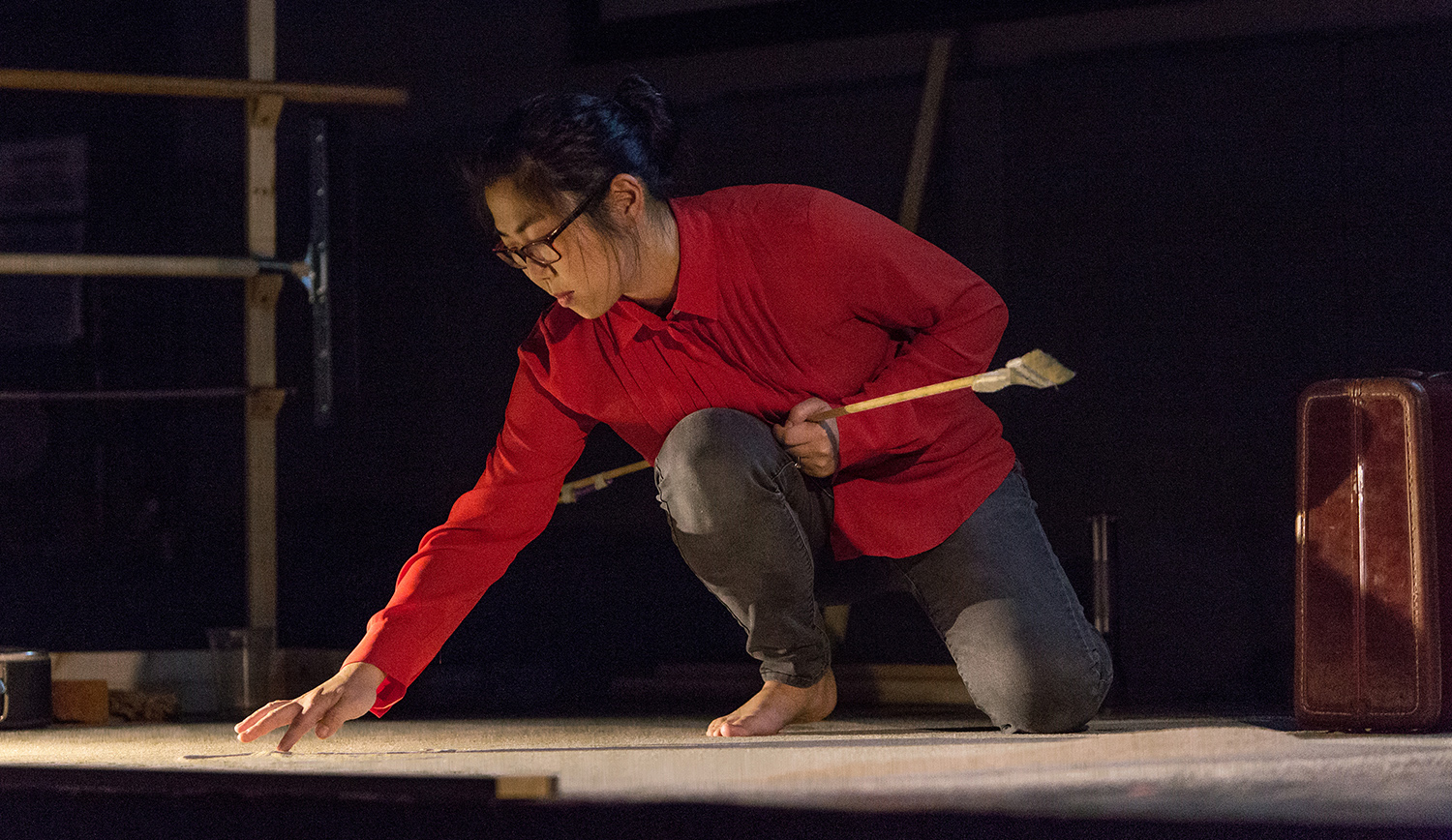
Bend-DrawingCloseUp72-bannerTonight at 7pm at the Ron Robinson Theater, the Arkansas Archeological Survey presents a play about the Japanese American experience during World War II.
Kimi Maeda’s solo performance, Bend, tells the true story of two men interned in a Japanese American internment camp during World War II: Maeda’s father, an Asian Art historian currently suffering from dementia, and the subject of his research, Isamu Noguchi, a half-Japanese-half-American sculptor. Weaving together live feed projections of sand drawings with archival footage from the 1940s, Maeda’s performance poses important questions about how the Japanese American internment camps will be remembered.
The Arkansas Archeological Survey is partnering with the World War II Japanese American Internment Museum, the University of Arkansas at Monticello’s Japanese Club, and the University of Arkansas in Little Rock (UALR) to help teach the public about the state’s rich history. Art, particularly the performance and active creation of art, as Maeda does, is an important way to communicate the emotion of past events. Bend will be performed in Little Rock and McGehee. Dr. Johanna Miller-Lewis, a historian at UALR, and Richard Yada, who was born at Rohwer, will participate in a talk back session following the performance.
Bend in Little Rock – Thursday, August 27, 7 PM
Ron Robinson Theater
100 River Market Avenue
Purchase your tickets now. $10.00

Little Rock Look Back: City Council approves 1935 auditorium plan

An August 25, 1935, rendering in the ARKANSAS GAZETTE of the proposed Little Rock auditorium at Capitol and Scott Streets.

An August 25, 1935, rendering in the ARKANSAS GAZETTE of the proposed Little Rock auditorium at Capitol and Scott Streets.

On August 26, 1935, the City of Little Rock took its first significant step in a decade for the creation of a City auditorium..  Under the leadership of Mayor R. E. Overman, the City Council approved authorization for the City to apply for $1,000,000 from the Federal Emergency Administration of Public Works (PWA) for the construction of an auditorium.  The PWA had issued a September 16, 1935, deadline for applications to be received as it sought to spend $4.8 billion in construction projects.

The auditorium plan was announced on Saturday, August 24, 1935.  Much preparation had already been undertaken before the project was publicly unveiled.  Private presentations hhad taken place, a team of architects had been chosen (Eugene Stern and the firm of Wittenberg & Delony), and a location had been selected.

The auditorium complex was slated for a block bounded by Capitol, Scott, Fourth and Cumberland Streets.  The Women’s City Club building on that block would remain with the new structure being built to wrap around two sides of the existing structure. The site was chosen because it was one block east of the Main Street business corridor and near existing meeting locations such as the Boys Club, Albert Pike Hotel, Albert Pike Masonic Lodge and several churches.

As planned by the architects, this structure’s front façade would have run the length of the Capitol Avenue side of the block.  The building was proposed to be constructed of concrete, stone and steel.  It would have a large hall with a proscenium stage and seating capacity of 4,000 with overflow of an additional 500.  The adjoining exhibition hall could seat 3,500 people.  The plan called for 150 cars to be parked in the building, and an additional 100 cars to be parked on a surface lot on the site.

Following an August 26 closed door meeting to discuss the project from which members of the public and press were excluded, in open session the City Council voted to pursue the funding for the million dollar auditorium.  If approved by the PWA, the funds would be provided in grants and loans, to be paid by over a 35 year period.

The auditorium proposal was filed with the PWA in Washington in September 1935.  Throughout the next several months, Mayor Overman and the city were engaged in a series of conversations and negotiations with the PWA for the expansion of both the water system and the sewer system. This diverted attention from pursuing the auditorium immediately.  This specific auditorium project stalled.  But because the plan had been filed by the September 16 deadline, it allowed the City to make use of PWA funds a few years later which would lead to the construction of Robinson Auditorium.


RSVP today for August 29 Lights! Camera! Arkansas! FREE seminar at Old State House Museum

LCA_topThis Saturday, the Old State House Museum will host a FREE seminar to explore Arkansas’s connection with the film and television industry.  It will take place from 9am to 2:30pm on August 29.

Activities will include a screening of the 2001 Academy-award winning Best Live Action Short Film “The Accountant.” Speakers including Robert Cochran, Suzanne McCray, Ben Fry, Stephen Koch and Philip Martin will discuss topics including women in film, Broncho Billy Anderson, music in Arkansas and Arkansas in the rise of regional Southern cinema.

“It gives a great sense of state pride knowing how incredibly important Arkansas has been to the film industry from a historical, technical and social standpoint,” said Suzanne McCray, one of the seminar’s presenters. “From the very first cowboy in film to the great up-and-coming actors and directors of today, Arkansas has made its case as a relevant and essential part of film and television.”

OSH logoSimilarly, presenter Bob Cochran said that his talk about a common film character-type is a perfect analogy for Arkansas. “There’s a standard trope of Hollywood films, the outsider — the character who the audience doesn’t expect anything from,” Cochran said. “However, by the end of the film this outsider reveals unexpected qualities and potential. That’s a wonderful analogy for the film industry in the state of Arkansas.”

An RSVP to the free event is required, and reservations can be made by emailing georganne@arkansasheritage.org or calling (501) 324-9685 today to reserve a place. The seminar is programming in support of the “Lights! Camera! Arkansas!” exhibit at the Old State House Museum, which will be on display until January 25, 2016.

The Old State House Museum is an agency of the Department of Arkansas Heritage.