1906 verdict halts plans for new LR City Hall, Jail and Auditorium

The 1906 plans for City Hall with the Municipal Auditorium on the left portion.

Little Rock Mayor Warren E. Lenon had been advocating for a new City Hall a municipal auditorium since shortly after taking office in April 1903. After plans were approved in July 1906, a group of citizens, led by Arkansas Gazette publisher J. N. Heiskell, filed suit to stop the City.

The closing arguments in the trial against plans for a new City Hall and auditorium complex had been heard on Monday, July 30.  The case was heard by Chancery Judge J. C. Hart.  Serving as an advisor to Chancellor Hart throughout the trial (though with no official legal standing) was Pulaski County Circuit Court Judge Robert J. Lea.  To accommodate the expected large attendance, the trial had been moved into his courtroom which was larger than Chancellor Hart’s.

On Friday, August 3, Pulaski County Chancery Judge J. C. Hart issued an injunction to keep the City from signing a contract for the construction of a city hall, jail and auditorium.  Chancellor Hart concurred with the plaintiffs that Arkansas’ constitution and laws dictated all taxation must be for public purposes.  He found there was nothing in Arkansas case law which defined an auditorium to be used for conventions as a public purpose.

As had been the case throughout the trial, the tone of the coverage of the decision differed greatly in the city’s two daily papers.  The subheading in the Democrat noted that the plaintiffs would be liable for any losses to the municipal government’s coffers due to a delay in commencing the construction if Little Rock eventually prevailed.  That fact is not mentioned by the Gazette.  Both papers did make note that Judge Lea agreed with the Chancellor’s decision.

For now, it looked as if the City of Little Rock would be stuck in the 1867 City Hall on Markham between Main and Louisiana.  Mr. Heiskell and his compatriots waited to see if the City would appeal the decision.

While August would be a quiet month publicly, work would go on behind the scenes.  More on that, in the future.

Sandwich in History at the Stebbins-Roberts Building today

Image may contain: plant, sky and outdoor

You are invited to join the Arkansas Historic Preservation Program’s next “Sandwiching in History” tour, which will visit the Stebbins-Roberts Building at 1300 East Sixth Street in Little Rock beginning at noon on Friday, August 2, 2019.

The 1947 Stebbins-Roberts Building was designed by noted Arkansas architect H. Ray Burks for the Stebbins & Roberts Paint Company, the former sole provider of Benjamin Moore paint products in Arkansas. The building is a late example of Art Deco and Art Moderne architecture by Burks, who was known for his work in the style.

Sandwiching in History tours are worth one hour of AIA continuing education credit. If you would like to receive email notifications of upcoming tours instead of postcards or need additional information, please contact Callie Williams, Education and Outreach Coordinator for AHPP, at 501-324-9880 or Callie.Williams@arkansas.gov.

MacArthur Museum hosts Arkansas State Archives exhibit on Territorial Arkansas

Image may contain: 2 people, text

“Territorial Arkansas: The Wild Western Frontier” will open at the MacArthur Museum of Arkansas Military History August 1st, 2019.

The exhibit will have a month long run and will end on August 26th.

The traveling exhibit consists of 15 panels that explore the history of Arkansas Territory though the collections of the Arkansas State Archives and their branch archives, the Northeast Arkansas Regional Archives in Powhatan and the Southwest Arkansas Regional Archives in Washington.

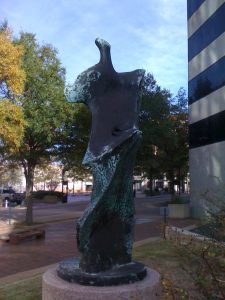
Celebrating Henry Moore’s Birthday with a look at Large Standing Figure, Knife Edge

British sculptor Henry Moore was born on July 30, 1898.  He became connected with Little Rock 80 years after his birth.

It was 1978, Bill Clinton was making his first run for Governor, Dallas and Robin Williams both made their TV debuts, disco was dominating the music scene, and Little Rock received its first major piece of public art.

Arguably Little Rock’s most famous piece of public art is Henry Moore’s 1961 creation Large Standing Figure: Knife Edge, which is known locally as “The Henry Moore Sculpture.”

The original model was created in 1961; this sculpture was cast in 1976 and purchased in June 1978 by the Little Rock Metrocentre Improvement District.

The purchase price was $185,000 — a princely sum at the time but now a bargain for a Henry Moore sculpture. (Adjusted for inflation, that amount would be the equivalent of $727,000 today.)

A committee consisting of Townsend Wolfe (then the director and chief curator of the Arkansas Arts Center), James Dyke and Dr. Virginia Rembert traveled to England to meet with Moore about the sculpture.

It was originally placed on Main Street when the street had been bricked over as part of the Metrocentre Mall pedestrian mall plan. As portions of the street became unbricked and reopened to vehicular traffic, it was moved to the intersection of Capitol and Main. Finally, when the last segment was reopened to vehicular traffic, it was put at its current location of the southeast corner of Capitol and Louisiana.

In March 2018, ownership was transferred to the City of Little Rock.  Plans call for it to be relocated to the Arkansas Arts Center when it reopens in 2022.

A replica of the sculpture is featured in the 1980s classic The Breakfast Club.

HIDDEN FIGURES closes out July’s Space Cinema events on CALS Ron Robinson Theatre screen

Image result for hidden figures movieThe 2016 film Hidden Figures is being shown tonight  (July 30) at the CALS Ron Robinson Theater as it closes out Space Cinema events.

As the United States raced against Russia to put a man in space, NASA found untapped talent in a group of African-American female mathematicians that served as the brains behind one of the greatest operations in U.S. history. Based on the unbelievably true life stories of three of these women, known as “human computers”,  Dorothy Vaughan, Mary Jackson, and Katherine Gobels Johnson crossed all gender, race, and professional lines while their brilliance and desire to dream big, beyond anything ever accomplished before by the human race, firmly cemented them in U.S. history as true American heroes.

The film stars Taraji P. Henson, Octavia Spencer, Janelle Monae, Kevin Costner, Kirsten Dunst, Jim Parsons, Mahershala Ali, and Aldis Hodge.  Directed by Theodore Melfi, it was based on Margot Lee Shetterly’s book.  It was nominated for three Oscars: Best Picture, Supporting Actress (Spencer), and Adapted Screenplay.

The screening starts at 7:00pm.