
Grant in Little Rock, but horseless in Capital Hotel elevator

US_Grant_fOn April 15, 1880, former president Ulysses S. Grant spoke in Little Rock as part of his world tour. While here he made a couple of appearances and participated in a parade. It was General Grant’s first visit to Arkansas either as a soldier or a politician.

(At the time, and through much of the 20th Century, former US presidents were not referred to as President after leaving office. He was referred to as General Grant or Mr. Grant during his time in Little Rock.)

At his outdoor speech, his remarks followed brief comments by Governor William R. Miller and Mayor John Gould Fletcher (erroneously referred to as John C. Fletcher in the Memphis Appeal story the next day). Grant’s comments were brief and flowery. He thanked Arkansans for a warm welcome, praised the future prospects of Arkansas and discussed the demise of what he termed “sectionalism” which was undoubtedly a reference to the division between the Union and and former Confederate states.

Also that day, Grant addressed a banquet in Concordia Hall (now part of the Arkansas Studies Institute complex on the Central Arkansas Library downtown campus). His was one of fifteen toasts that evening. It was simply “The United States of America, forever United.” He expounded briefly on the theme of unity of citizens from all states. He also discussed immigration noting, “All foreigners find a welcome here. We make them American citizens. After we receive them, it is but one generation until they are Americans.” He noted that he could speak much more on the topic, but that since he was but one of fifteen toasts and that there was to be music after each toast, “It will be to-morrow (sic) morning when we get through if we all take as much time as the subjects admit of.”

Not everyone was thrilled to have the former commander of the Union Army in Little Rock. The story goes that when he was parading down the street, some Little Rock women (in a display of Souther un-hospitality) sat in chairs with their backs to the parade route. But all in all, it appears to have been a successful visit for the man who was the only Republican in the 19th Century to win Arkansas’ Electoral votes.

Grant arrived in Little Rock on the night of April 14 and lodged at the Capital Hotel. He undoubtedly enjoyed some whiskey and cigars while at the Capital. Grant had originally planned on departing in the afternoon of April 15, but Little Rock leaders pled with him to stay so that he could be honored at the banquet. He assented.

Incidentally, there is an urban myth that, while in Little Rock, General Grant rode his horse in the oversized elevator of the Capital Hotel.  This is a relatively recent story. The oversized elevator was not installed until the 1980s, over 100 years after Gen. Grant was a guest of the facility.

Little Rock City Hall at 110

LR City Hall circa 1908

City Hall circa 1908

110 years ago today, Little Rock City Hall officially opened at the corner of Markham and Broadway.

On April 15, 1908, the Italian Renaissance Revival style building, which had been designed by local architect Charles Thompson, played host to an open house. Staff had started moving into the building in March of that year.   This was, as often is the case, behind schedule.  The date in the cornice toward the top of the building is 1907, but the building was not completed until 1908.

An open house took place on April 15, 1908, presided over by Mayor John Herndon Hollis and his wife as well as former Mayor W. E. Lenon and his wife.  (Mayor Hollis’ wife is a distant cousin of the Culture Vulture.)

In 1903, W. E. Lenon became Mayor of Little Rock. Back then, the terms were two-year terms.  Before the start of his second term in 1905, he realized that the City was outgrowing City Hall, which was, at the time, on the northeast corner of Markham and Louisiana – where part of the Statehouse Convention Center sits today.

In February 1906, Mayor Lenon appointed a committee of five aldermen to over see the planning for the building of a new City Hall. In July 1906, the City Council approved plans, which called for a City Hall with an municipal auditorium wing. There was some hue and cry about the cost spending and a resulting lawsuit, so, in September 1906, those plans were scrapped and a simpler City Hall was approved for the cost of $175,000.

The last resolution in the old City Hall called for the banning of smoking in the new Council Chambers – while the Council was in session. This may well have been the first smoking ban in a public government building in the history of Arkansas.

When the building opened, the third floor was not finished out. The space was not needed. When the Museum of Natural History and Antiquities (now the Museum of Discovery) moved into City Hall in 1929, they had to finish out their space.

In 1913, the new Central Fire Station, designed in the Beaux Arts style, was constructed adjacent to City Hall. During the 1930s, as the City grew, more space was needed. A garage, designed in the “austere, utilitarian” style was built in 1936 and a City Jail Annex, built by the WPA in the modified Art Deco style was built in 1938.


By 1984, the decision was made to stay at Markham and Broadway. An extensive renovation and restoration effort was undertaken. In 1988, the building reopened, and the interior had been restored to its 1908 appearance.

Pulitzers Play Little Rock: A CHORUS LINE on the UALR stage

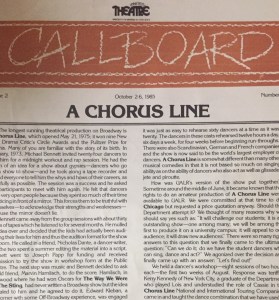
IMG_0274In April 1975 A Chorus Line premiered Off Broadway before transferring to Broadway in July 1975. In 1976, it became only the fifth musical to win the Pulitzer Prize for Drama.

Whereas the composer of the first musical to win the Pulitzer was not honored (apparently because he only wrote music, not actual words), with A Chorus Line’s citation, the Pulitzers recognized not only librettists James Kirkwood and Nicholas Dante, lyricist Edward Kleban, and composer Marvin Hamlisch, but also Michael Bennett who conceived the project and steered its development.

In October 1985, the University of Arkansas at Little Rock became one of the first non-professional organizations to ever perform  A Chorus Line.  The theatre department was planning on producing Chicago, but dropped that show when rights for A Chorus Line became available.  (Chicago was on Broadway at the same time as A Chorus Line and was often overshadowed by it.)

In preparation for the show, UALR (as it was then known) conducted a dance workshop in August 1985 conducted by alum Kerry Kennedy, who had appeared in the national and international tours of the show.  After the workshop, auditions were held and the rehearsal process started.

Many familiar names in the Little Rock theatre scene from the 1970s to the present were involved in A Chorus Line.  The production was directed by Carolyn Curry, choreographed by Dot Callanen, and music directed by Lori Loree.  Jay Jagim provided the scenic and lighting design, while Joy Breckenridge was costume designer.

The cast was led by Tom Crone as Zach, the director of the show within the show, and Janet Ford as Cassie.  Other performers included Lee Borchert, Sara Cole, Missy Cook, Greg Donaldson, Jo Bocage Few, Dennis Glasscock, Leslie Hall (who joined the cast two weeks before opening), John Hartman, William R Holloway, Shawn Lynnette Jackson, Traci Presley, Joey Stocks, Allison Streepey, Joe Terry, Kevin Trippe, and Scarlet White.

Rounding out the company were Paula A. Barr, Kelly Bascue, Melanie Cameron, Caran Curry, Leigh Anne Embrey, James Finch, Tijuana McKnight, Leah McSpadden, Rick Riley, Karissa Rushing, and Curtis B. Tate.

2018 marks the 100th anniversary of the first Pulitzer Prize for Drama being given. To pay tribute to 100 years of the Pulitzer for Drama, each day this month a different Little Rock production of a Pulitzer Prize winning play will be highlighted.  Many of these titles have been produced numerous times.  This look will veer from high school to national tours in an attempt to give a glimpse into Little Rock’s breadth and depth of theatrical history.

Little Rock Look Back: Brooks-Baxter War Starts

Brooks BaxterOn April 15, 1874, Joseph Brooks, accompanied by armed men, including the Pulaski County Sheriff, went into the office of Governor Elisha Baxter demanding he vacate the office.  Alone, save a young son, Governor Baxter departed the Arkansas State Capitol (now the Old State House), and met up with a group of supporters to plan their response.
Thus, the Brooks-Baxter War in Arkansas had begun.

Brooks had faced off against Baxter in the 1872 gubernatorial election.  Both were Republicans, but represented different factions of the party.  Brooks led the Brindletails, which were more aligned with efforts to gradually re-enfranchise former Confederates as well as have a smaller government with limited gubernatorial powers.  Baxter led the Minstrels.  This group was focused on retaining power and control of state government by limiting re-enfranchisement of former Confederates.

Many historians believe that Brooks may have actually won the election, but Baxter’s faction’s control of the state machinery resulted in him being declared the winner.  Brooks’ appeal to the Arkansas General Assembly was unsuccessful.  He took it to the state courts, which was likewise going nowhere.  EXCEPT….

Baxter had changed course on his views toward Democrats and members of his own party. This resulted in him losing support of many Republicans.  He also fought with fellow Republicans regarding a railroad issue.  This led to a meeting of many leading Republicans including Arkansas’ two US Senators.  Not long after that, Pulaski County Circuit Judge John Whytock heard Brooks’ case.  On April 15, 1874, Judge Whytock ruled in favor of Brooks.

Following his ouster from the governor’s office, Baxter telegraphed President Grant, asking for assistance.  In the meantime, both sides recruited supporters.  Baxter and 200 men set up headquarters in the Anthony House, which was near the State Capitol.  Brooks and his supporters used furniture to barricade the capitol building.  Robert Catterson, a former Little Rock mayor, set up artillery pieces on the capitol lawn to defend Brooks.

For the next month, there would be many rumors and skirmishes.  Little Rock, like the rest of the state, was divided. And the conflict was just beginning.

Sculpture Vulture: Kathleen Caricof’s INFINITY dedicated in 2011

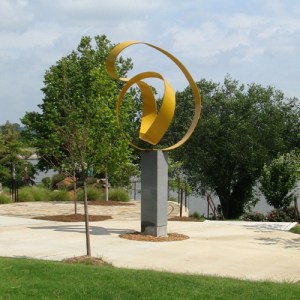
CARICOF05bOn April 14, 2011, Kathleen Caricof’s Infinity sculpture was dedicated in Riverfront Park. It became the signature sculpture for the Vogel Schwartz Sculpture Garden.
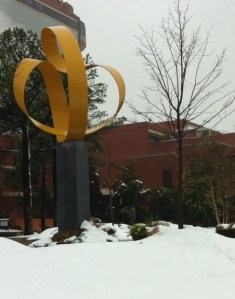
Standing over 10 feet tall, it consists of one inch thick steel which loops around to form a continuous abstract shape. It sits atop a column of grey granite.

Caricof suggested the warm golden yellow hue represented “the warmth of the people of Little Rock.”

Funding for the project came, in part, from the Vogel Schwartz Foundation.

IMG_3980

INFINITY amidst snow in 2012

Caricof is a member of the National Sculptors Guild.  Her interest in sculpture developed from a background in designing for space. Much of her past work incorporates the theme of community through abstract form. She places a great deal of importance in ‘the gathering’ for mutual support and as a collective celebration of life. Caricof focuses her creative energies on public art because of its shared impact on a wide range of diverse viewers, fueling community involvement and enriching the surrounding environment.

Pulitzers Play Little Rock: RABBIT HOLE at Weekend Theater

RabbitHoleTWTThe announcement that the 2007 Pulitzer Prize for Drama went to David Lindsay-Abaire for Rabbit Hole was a bit of surprise.  The play had actually opened on Broadway the prior season.  (While now the Pulitzer year equals the calendar year, at that time, the Pulitzer calendar went from Autumn to Autumn.)
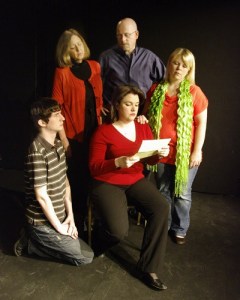
Lindsay-Abaire’s play tells the tale of a family coming to grips with the accidental death of a four year old son.  The Weekend Theatre brought the play to life on a Little Rock stage in 2009.  Andy Hall directed the production (duties he has performed for the current Weekend Theatre production of Assassins).

Patti Airoldi took on the central role of the aggrieved mother.  Duane Jackson played her husband, Patti German played her mother, and Regi Ott was her somewhat unconventional sister.  William Moon rounded out the cast.

Though the play veers to the edge of maudlin, it never gets there.  The script presents how different people cope with grief and guilt without becoming a “Very Special Episode” of After School Special.

2018 marks the 100th anniversary of the first Pulitzer Prize for Drama being given. To pay tribute to 100 years of the Pulitzer for Drama, each day this month a different Little Rock production of a Pulitzer Prize winning play will be highlighted.  Many of these titles have been produced numerous times.  This look will veer from high school to national tours in an attempt to give a glimpse into Little Rock’s breadth and depth of theatrical history.

Pulitzers Play Little Rock: Talley’s Folly

TalleyLanford Wilson’s two person play Talley’s Folly has one of the smallest casts of a Pulitzer Prize winning play.  It is a prequel to Wilson’s Fifth of July giving a backstory that is only touched upon the earlier play.

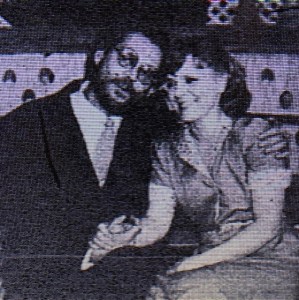
In January 1985, the Arkansas Rep staged this seemingly simple play in Little Rock.  A quiet, romantic story, it reveals much in the layered story and nuanced characters.  Directed by Rep favorite Terry Sneed, the two-hander starred Ronald J. Aulgur and Cathey Crowell Sawyer.  The former was a frequent actor in Rep productions.  The latter was making her Rep acting debut, though she was on the Rep staff as Associate Director.

In his Arkansas Gazette review, Bill Lewis singled out Mike Nichols for his set (Nichols is still designing and building sets for the Rep in 2018) and James Hunter for his lighting.

2018 marks the 100th anniversary of the first Pulitzer Prize for Drama being given. To pay tribute to 100 years of the Pulitzer for Drama, each day this month a different Little Rock production of a Pulitzer Prize winning play will be highlighted.  Many of these titles have been produced numerous times.  This look will veer from high school to national tours in an attempt to give a glimpse into Little Rock’s breadth and depth of theatrical history.