
Little Rock Look Back: Little Rock Public Library opens in 1910

On February 2, 1910, the Little Rock Public Library officially opened its doors.  There had been an open house the night before, but this was the first day of acquiring a library card and checking out books.

Various private libraries had existed sporadically in Little Rock throughout the 19th Century.  In November 1900, a Little Rock School District committee made the first inquiry into the the creation of a Carnegie Library in Little Rock.  Over the next several years, numerous entreaties were made, but funding for the City’s portion was an obstacle.  On December 17, 1906, the Little Rock City Council passed an ordinance to move forward with building, furnishing and equipping a library.  Finally, in February 1908, the City approved acceptance of $88,100 from Andrew Carnegie.  The building would be designed by Edward Tilton, who designed Carnegie libraries, working with local architect Charles Thompson.

Mary Maud Pugsley was hired as the first librarian for Little Rock in May 1909. She began her duties on September 15, 1909, in order to get ready for the opening of the library at the southwest corner of 7th and Louisiana Streets.

On February 2, 1910, formal circulation of books began.  J. N. Heiskell was issued library card number 1.  He was secretary of the Library’s Board of Trustees and had long been an advocate for a public library in Little Rock.  He had often used his bully pulpit as editor of the Arkansas Gazette to advocate for a public library since arriving in Little Rock in 1902.  (Years later — he lived until 1972 — he received a replica of the library card made out of gold.)

That first day of operation, 500 people had applied for library cards. The application process required one to be a Little Rock property owner or to have a property owner sign the application.

Within the first year of operation, 2.5% of Little Rock’s population of 45,951 had applied for a library card.

For more on the history of the transformation of the Little Rock Public Library into the Central Arkansas Library System, read Shirley Schuette and Nathania Sawyer’s From Carnegie to Cyberspace — 100 Years at the Central Arkansas Library System, published by Butler Center Books.
130 years of Cromwell Firm focus of Old State House Museum Brown Bag lecture today

OSH Brown BagJoin the Old State House Museum at noon on Thursday, December 3, for a Brown Bag Lunch Lecture led by Dan Fowler, Chief Operating Officer at Cromwell Architects Engineers, as he speaks about the influence and history of 130 years of Cromwell.
The talk is in support of the current temporary exhibit at the Old State House Museum, “Lost + Found.”
“Lost + Found” highlights eight different projects completed or renovated by Cromwell during its 130 year history. These include projects in Little Rock (Little Rock City Hall, the Federal Reserve Bank Building and 615 Main Street), North Little Rock (St Joseph’s Home for Children), Pine Bluff (the Temple Building and the Pines Hotel) and Hot Springs (the de Soto and Majestic Hotels). Many of these structures were designed by Charles L. Thompson, one of the founders of Cromwell and one of the most-known and prolific architects in Arkansas in the 20th century. “Lost + Found” ends December 11.
The talk is free and participants are encouraged to bring a lunch. Soft drinks and water are provided.


“Lost + Found: Saving Downtowns in Arkansas” exhibit by Old State House Museum and Cromwell firm runs through December 11

The Old State House Museum and Cromwell Architects Engineers present a new exhibit: “Lost + Found: Saving Downtowns in Arkansas.” The exhibit will highlight eight different structures in Arkansas and raise awareness of the need for the preservation of Arkansas’s architectural heritage, and will be on exhibit for four weeks from November 13, 2015, until December 11, 2015.

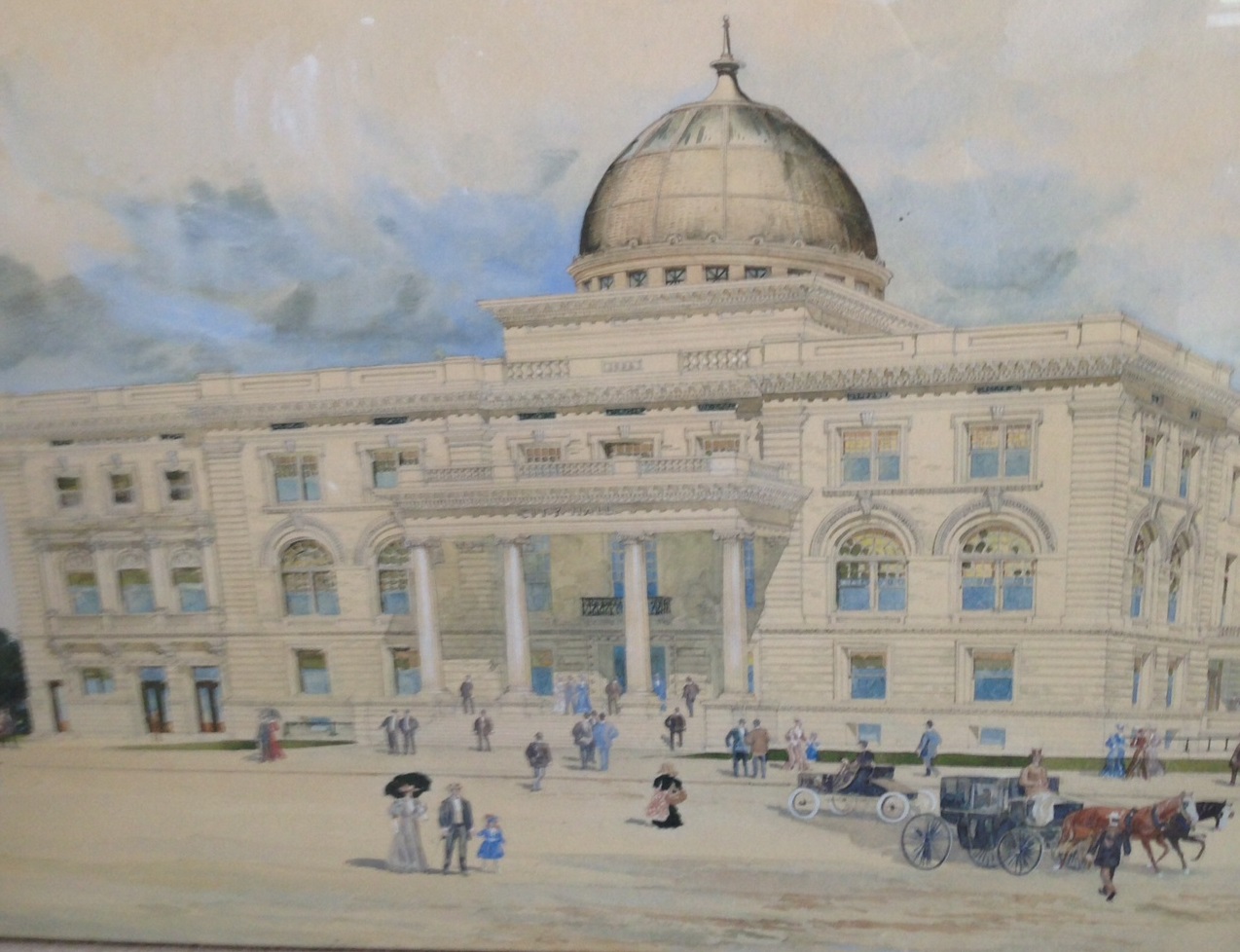
“This exhibit takes a close look at eight pieces of Arkansas’s architectural heritage; some of those are in dire need of preservation, and others are outstanding examples of restoration and creative reuse,” said Bill Gatewood, Old State House Museum director. “The Old State House Museum is a natural venue for this exhibit, as the repository of the drawings of Charles L. Thompson and as one of the state’s earliest historic preservation success stories.”

“Lost + Found” highlights eight different projects completed or renovated by Cromwell during its 130 year history. These include projects in Little Rock (Little Rock City Hall, the Federal Reserve Bank Building and 615 Main Street), North Little Rock, (St Joseph’s Home for Children) Pine Bluff (the Temple Building and the Pines Hotel) and Hot Springs (the de Soto and Majestic Hotels). Many of these structures were designed by Charles L. Thompson, one of the founders of Cromwell and one of the most-known and prolific architects in Arkansas in the 20th century.

The Old State House Museum will also host several programs to showcase the exhibit. “Lost + Found” will take center stage on Second Friday Art Night at the Museum on Friday, November 13. The Museum will be open until 8 p.m. for the opening of the exhibit. On Thursday, December 3, at noon, Dan Fowler of Cromwell will present a Brown Bag Lunch Lecture chronicling his firm’s 130 year history. The Museum will also release articles weekly on its blog which will enhance the information provided in the exhibit. Admission is free to the Museum and all events.

About the Old State House Museum The Old State House Museum is a museum of the Department of Arkansas Heritage and shares the goal of all seven Department of Arkansas Heritage agencies, that of preserving and enhancing the heritage of the state of Arkansas. The agencies are Arkansas Arts Council, Arkansas Historic Preservation Program, Arkansas Natural Heritage Commission, Delta Cultural Center in Helena, Historic Arkansas Museum, Mosaic Templars Cultural Center, and the Old State House Museum.

About Cromwell Architects Engineers

Cromwell Architects Engineers is an international client-focused, integrated building services firm based in Little Rock, Arkansas. Celebrating its 130th anniversary in 2015, Cromwell is committed to the state of Arkansas and its people, who have been the foundation for its success. For more information, visit online at cromwell.com.

About Abandoned Arkansas

Abandoned Arkansas is dedicated to preserving Arkansas’ most precious history that may be on the verge of being lost forever. Through photography, video, articles and an active social media presence, Abandoned Arkansas documents the stories that go along with each structure. Online at abandonedar.com.

Little Rock Look Back: Plans for a new City Hall finally move forward

City Hall circa 1908

City Hall circa 1908

After a judge ruled in August 1906 that the City of Little Rock could not build a new City Hall and Auditorium complex, it looked like Little Rock would be stuck with its existing inadequate building.

However on September 10 it became obvious that much work had been taking place behind the scenes after that ruling.  On that day, the Board of Public Affairs (a City body charged with overseeing municipal government construction projects and comprised of the mayor and two citizens approved by the City Council) voted to ask the aldermen to cancel plans and rescind legislation for the city hall, jail and auditorium complex.  The Board of Public Affairs then offered up a new plan for a city hall and jail building.  Because no auditorium was involved, these plans would not be in violation of the Chancery Court.

That same evening the City Council followed suit and revoked the plans for the original project.  The aldermen then voted to proceed with building a new city hall and jail without the auditorium.  There was only one dissenting vote; Alderman Jonathan Tuohey voted no.  He explained his negative vote was not a lack of support for the project, but he was not comfortable with the way it was rushed through.

Mayor Warren E. Lenon told the Gazette, “The Chancery Court has enjoined us from erecting an auditorium and the Board of Public Affairs has consequently rescinded all resolutions and orders pertaining to that structure.” He noted that there would “be no appeal from the injunction granted by Chancellor Hart, because there is nothing to appeal.”

The coverage of the actions of the City Council that night was in keeping with the manner in which the two daily newspapers had covered the lawsuit and the trial.  The Gazette headline cried “City Hall Ordinance Railroaded Through” while the staid Democrat merely stated “New $175,000 City Hall Provided by City Council.”  The tone of theGazette’s article matched the headline while the Democrat’s story was more straightforward.

Architect Charles Thompson adjusted his plan for the new City Hall by removing the auditorium wing.  With the revised Th0mpson plan and the approval of the City Council, Little Rock was at last on its way to a new City Hall.  This was over two years after Mayor Lenon had first broached the subject.

Originally slated to open in 1907, the building officially opened in April 1908.

Learn about Little Rock’s earliest auditorium (which also was a roller rink AND rifle range) today at noon at Old State House Museum Brown Bag Lecture

11805726_10154024863604908_1192217255_nToday at noon, the Old State House Museum will have another Brown Bag Lecture.  This one focuses on three decades of unsuccessful efforts to build a municipal auditorium in Little Rock.  That time period was filled with big dreams, lawsuits, personality clashes, disappointments, and a Roller Rink that was also a Rifle Range.

In April 1904, Little Rock Mayor W. E. Lenon spoke of the need for a municipal auditorium in Little Rock. It would take thirty-six years for that dream to be realized. Along the way there were numerous twists, turns, detours and disappointments as the saga was played out in the newspapers, courtrooms, and offices of every major Little Rock architect at the time.

Until a permanent auditorium could be found, the City made do with vaudeville houses, high schools, and even a roller skating rink which doubled as a rifle range. Over the three decades of planning for an auditorium, some names came and went, others such as Mayor Lenon, architect Charles L. Thompson and Arkansas Gazette publisher J. N. Heiskell appeared time and time again. This Brown Bag Lunch Lecture explores the time period from 1904 to 1934 as it looks at the numerous unsuccessful attempts to construct a municipal auditorium in Little Rock.

In 2016, there will be a Brown Bag Lecture to look at construction and opening of Robinson Center Music Hall.

Scott Whiteley Carter is Special Projects Administrator for the City of Little Rock. As the unofficial historian of Little Rock City Hall, he can often be found leafing through sheaves of papers in the City Clerk’s vault or furiously scribbling notes in Little Rock research libraries. He is also the author of the LRCultureVulture.comblog. A native of Little Rock, he is a graduate of Missouri State University.

Little Rock Look Back: New City Hall approved in 1906

The 1906 plans for City Hall with the Municipal Auditorium on the left portion.

The 1906 plans for City Hall with the Municipal Auditorium on the left portion.

On July 9, 1906, the Little Rock City Council approved Resolution 281 and Ordinance 1,295. These actions approved the plans for a new City Hall complex to be constructed on land at the northwest corner of Markham and Broadway Streets.  A few days later, the contract was awarded for the construction of the new building.

Mayor Warren E. Lenon had first called for a new city hall complex in his annual address in April 1904. He repeated his request in April 1905.   The City Council took up Mayor Lenon’s quest for a new city hall in December of 1905.  The Council appropriated money for the purchase of land for a city hall, jail and auditorium.

In response to this, the Arkansas Gazette daily newspaper ran a story featuring the viewpoints of a few civic leaders weighing in on the need for a new city hall complex which would also include a new jail and a city auditorium.  Two of the respondents, L. B. Leigh and P. Raleigh, stressed the need for paved streets and better sewers instead of a new city hall and auditorium.

The other three businessmen interviewed were more favorable to Mayor Lenon’s proposal.  Morris M. Cohn, a former Little Rock City Attorney, stated “I do not think we can make a better investment than in a fine city hall and auditorium.”  (Mr. Cohn, though an M. M. Cohn, was not related the M. M. Cohn who was the namesake for the longtime Little Rock department store.) County Judge William Marmaduke Kavanaugh offered his satisfaction with the action of the City Council on that matter.  R. E. Walt, a banker, opined that he thought $150,000 was not enough; he suggested $200,000 should be spent.

Later that month the Gazette reported that a site had been selected for the city hall and auditorium complex.  The proposed location was most of a city block located at the corner of Markham and Broadway Streets.  Mayor Lenon was vague as to the details of the deal because negotiations were still underway with the property owners

As 1906 dawned, Mayor Lenon and other city leaders continued to take steps to build the new city hall and auditorium.  They invited three local architects to make presentations for the chance to design the new complex.  The three were Charles L. Thompson, Frank W. Gibb and George R. Mann.  Mr. Thompson was chosen to receive the assignment.

On February 5, 1906, Mayor Lenon announced the creation of a special committee to work on the planning for a future city hall complex.  This committee consisted of Aldermen Louis Walther, A. B. Poe, L. N. Whitcomb, Christopher Ledwidge, and John A. Adams.

Mayor Lenon further stated that the new city hall complex and several private developments would “put us in that march of progress with which nothing can prevent us from having a 100,000 population in a few years.”

The saga to get the building built was just starting.

Sandwich in History today at St. Edward’s Catholic Church

St. Edward Catholic Church_tour_tnThe monthly architectural history program “Sandwiching in History” visits St. Edward Catholic Church, lodated at 801 Sherman Street.

In 1883 Bishop Edward Fitzgerald sanctioned the creation of St. Edward parish to accommodate the growing number of German Catholics in Little Rock. The current church, dedicated in 1905, was designed by Charles L. Thompson in the Gothic Revival style.

Sandwiching in History is a program of the Arkansas Historic Preservation Program, an agency of the Department of Arkansas Heritage.