Little Rock Look Back: John Herndon Hollis

John Herndon HollisOn February 5, 1870, future Little Rock alderman and acting mayor John Herndon Hollis was born shortly before his family moved to what is now Cleveland County. His parents were originally from Georgia and came from prosperous and longtime families there.

The Hollis family came to Arkansas after the Civil War and settled in Union County. A portion of that county was carved off and became Dorsey County (named after a Republican US Senator from Arkansas) but was renamed Cleveland County after Grover Cleveland was elected President. Cleveland was the first Democrat to be elected President in over 20 years. This name change also reflected the political shift in Arkansas from the Reconstruction-led Republican politics to the Democratic Party politics which would dominate for the next century.

John Herndon Hollis was one of six children, and the only one with a middle name. Herndon had been his mother’s maiden name. As one of his brothers described their childhood in Cleveland County, “they all went to country schools in their home neighborhood, worked hard on the farm in the summertime, and were inside their little Methodist Church every time the doors were open.”

Around 1900, Hollis and his new wife Malinda M. “Linda” Taliaferro Hollis (formerly of Rison) moved to Little Rock.  Together the couple had six children. In Little Rock, Hollis worked in the banking industry. For years he worked for People’s Building and Loan Association.

Hollis was first elected to the Little Rock City Council in April 1904. He would serve as one of the Aldermen from the city’s Fourth Ward until April 1918.  This was on the western border of Little Rock at the time. The family lived at 1510 S. Schiller, which is one block east of Central High, though at the time neither the school nor its predecessor (West End Park) existed.  From 1907 until 1913 he also served on the Little Rock School Board.

In April 1908, at the first City Council meeting in the new City Hall, Mayor W. E. Lenon announced his resignation. Because the resignation was effective immediately, there was a vacancy in the office of mayor.  Hollis was selected by his colleagues to serve as acting mayor until a successor could be elected. So from April 1908 through June 1908, Hollis was the City’s chief political and executive leader.

Though he was never formally mayor (and did not resign his position as alderman), since 1908, Hollis’ name has appeared on the list of mayors of Little Rock. The reason seems to be as a sign of respect since there was a vacancy.

There previously had been acting mayors when the mayor would be absent on business or due to illness. But in those instances, the mayor had not resigned. This is the only instance in Little Rock history when a mayor resigned immediately with no successor in place. So John Herndon Hollis holds a unique role in Little Rock history.

Hollis’ wife died in 1920.  He later married Ann Jewell of Little Rock (who was a distant cousin of his first wife). They were married until his death on October 23, 1941.  Ann Hollis lived in Little Rock until her death in 1980.  The Hollis family is entombed in the mausoleum at Mount Holly Cemetery.

Both of John Herndon Hollis’ wives are distant cousins of the Culture Vulture, so he is particularly fond of John Herndon Hollis.

Little Rock Look Back: The Public Library Opens

carnegieOn February 2, 1910, the Little Rock Public Library officially opened its doors.  There had been an open house the night before, but this was the first day of acquiring a library card and checking out books.

Various private libraries had existed sporadically in Little Rock throughout the 19th Century.  In November 1900, a Little Rock School District committee made the first inquiry into the the creation of a Carnegie Library in Little Rock.  Over the next several years, numerous entreaties were made, but funding for the City’s portion was an obstacle.  On December 17, 1906, the Little Rock City Council passed an ordinance to move forward with building, furnishing and equipping a library.  Finally, in February 1908, the City approved acceptance of $88,100 from Andrew Carnegie.  The building would be designed by Edward Tilton, who designed Carnegie libraries, working with local architect Charles Thompson.

Mary Maud Pugsley was hired as the first librarian for Little Rock in May 1909. She began her duties on September 15, 1909, in order to get ready for the opening of the library at the southwest corner of 7th and Louisiana Streets.

On February 2, 1910, formal circulation of books began.  J. N. Heiskell was issued library card number 1.  He was secretary of the Library’s Board of Trustees and had long been an advocate for a public library in Little Rock.  He had often used his bully pulpit as editor of the Arkansas Gazette to advocate for a public library since arriving in Little Rock in 1902.  (Years later — he lived until 1972 — he received a replica of the library card made out of gold.)

That first day of operation, 500 people had applied for library cards. The application process required one to be a Little Rock property owner or to have a property owner sign the application.

Within the first year of operation, 2.5% of Little Rock’s population of 45,951 had applied for a library card.

For more on the history of the transformation of the Little Rock Public Library into the Central Arkansas Library System, read Shirley Schuette and Nathania Sawyer’s From Carnegie to Cyberspace — 100 Years at the Central Arkansas Library System, published by Butler Center Books.

Little Rock Look Back: Frederick G. Kramer

Mayor KramerOn December 29, 1829, future Little Rock Mayor Frederick G. Kramer was born in Halle, Prussia.  In 1848, he immigrated to the United States.  Kramer enlisted in the United States Army and served in the Seventh Infantry until his discharge at Fort Gibson, Indian Territory, in July 1857. After his discharge, Kramer settled in Little Rock, and became a citizen in 1859. He married Adaline Margaret Reichardt, an emigrant from Germany, in 1857. They had six children Louisa, Mattie, Emma, Charles, Fred, and Henry.

From 1869 to 1894, Kramer served on the Little Rock School Board.  He was the first School Board president.  Among his other civic activities were serving as president of the Masonic Mutual Relief Association, a founder of the Mount Holly Cemetery Commission, and a founder of Temple B’nai Israel.  In 1875 he and F. A. Sarasin opened a mercantile business. Kramer later became the president of the Bank of Commerce.

Frederick Kramer was elected Mayor of Little Rock in November 1873.  He served until April 1875, when a new Arkansas Constitution took effect.

From November 1869 through March 1875, the City Council President presided over City Council meetings and signed ordinances, performing many of the duties formerly ascribed to the Mayor.  As such, during his Mayoral tenure from 1873 to 1875, Kramer was the Chief Executive of the City but did not preside over Council Meeting.  When he had served on the City Council, however, Kramer had been elected President of the Council and had presided over Council meetings from October 1871 to May 1872

Kramer was returned to the Mayoralty in April 1881 and served three more terms leaving office in April 1887.  His tenure as an Alderman and as Mayor overlapped with his service on the school board.

A new Little Rock elementary school which opened in 1895 on Sherman Street was named the Fred Kramer Elementary School in his honor.  Though the building’s bell tower was removed in the 1950s, the structure still stands today.  It now houses loft apartments.

Frederick G. Kramer died on September 8, 1896, in Colorado Springs, Colorado.  A few months earlier, he had traveled there with his wife and daughter Emma to recuperate from an illness. He is buried in Oakland Cemetery.

Turkey Day Football in LR – An Overview

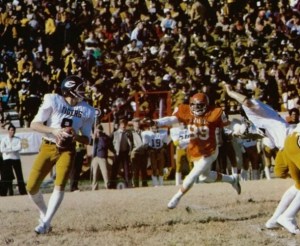
thanks-grid-lrc-lrh102 years ago, Little Rock High School (then located on Scott Street) kicked off a 69-year tradition of playing football on Thanksgiving Day.  (Though the date of Thanksgiving floats anywhere from the 22nd to the 28th, Thanksgiving Day 1914 was on November 26.)

From 1914 until 1933, the Little Rock High School Tigers played a variety of different schools.  Then from 1934 until 1957, they played North Little Rock. From 1958 until 1982, the Little Rock Central Tigers took on the Warriors of Little Rock Hall.

Thanksgiving Day football was a tradition not just for high schools in Little Rock but also all levels throughout the state and country.  The Friday after Thanksgiving, newspapers carried stories and scores for professional, college and high school football.  It was probably the only day of the year to see all three levels of football covered in the paper, and often high school games received the most ink.  This mix of football continued for decades.  In 1969, there were four football games played in Pulaski County on Thanksgiving Day: Little Rock Hall vs. Little Rock Central, Little Rock Catholic vs. North Little Rock, Horace Mann vs. Scipio Jones, and the Arkansas Razorbacks vs. Texas Tech.

By the 1970s, both high school and college football games on Thanksgiving were on the wane.  While college games on Turkey Day have regained some popularity, they are nowhere near approaching the level they once had.  High school football on Thanksgiving disappeared in Arkansas following the 1982 game between Hall and Central.  That rivalry had been the final series on Turkey Day to still be played.

While they lasted, Thanksgiving Day high school football games were civic focal points. They were about bragging rights.  For students who had grown up attending the games, the chance to play or cheer in a Turkey Day classic was a rite of passage.  Alumni home from college or visiting the family for Thanksgiving would descend on the stadium ensuring the largest attendance of the season.

High school football on Thanksgiving Day in Little Rock tells the tale of not just football; it reflects changes in the city and society.  What started out as two small high schools from neighboring cities changed as both schools grew. The addition of a second Little Rock high school reflected the city’s growth.  (Indeed the 1954 Little Rock High School yearbook, in discussing the school’s new designation as Central High, mentions vaguely that the second high school would be built at some yet to be determined location in “west” Little Rock.)

The presence of segregated high schools in separate but unequal football rivalries (lasting nearly two decades after the Supreme Court’s Brown v. Board decision) is an indictment of an unjust parallel education system.  As Little Rock continued to grow and diversify, the two high schools playing on Thanksgiving were no longer always the predominant schools in football – or other activities.  With state championships once again on the line, the last few years of the Hall and Central Thanksgiving rivalry were, in a way, a return to the halcyon days of the early faceoffs (though this time, thankfully, with fully integrated teams). In addition to trading the top spots in football, the two schools were piling accolades. In fact, all three Little Rock public high schools had achieved a stasis that inadvertently rotated areas of excellence academically, athletically and artistically fairly equally among the three.

There were undercurrents at work that hinted at future instabilities to come.  Indeed by 1982, the same year of the final game, Little Rock had filed suit against the North Little Rock and the Pulaski County Special School Districts claiming the schools in those neighboring districts were siphoning off white students from the Little Rock schools. The ensuing realignment of schools and districts would probably have brought an end to Central vs. Hall games even if athletic reclassification had not.

Central is now much larger than Hall, Parkview is a magnet school, two formerly county high schools (and several elementary schools and junior highs) were brought into the LR school district in the late 1980s.  Where once the Little Rock high schools were roughly equal in enrollment, they now are so varied they play in three different classifications.

It is up to the alternative historians to envision what continued Turkey Day classics would have looked like after 1982. Little Rock has grown and diversified. There are six public high schools and five private high schools playing football within the Little Rock city limits each season. With all these competing interests it is unlikely to envision the same citywide level of interest in one football game.

But back in the day…

RobinsoNovember: E. E. “Ned” Beaumont

e-e-beaumontOnce Mayor J. V. Satterfield was ready to appoint a new Auditorium Commission, he chose longtime banker E. E. “Ned” Beaumont to lead it.

After graduating from Little Rock High School in 1910, Beaumont entered the banking world. His first stop was with State National Bank. In 1914, he moved to Exchange National Bank.  Four years later, he was hired by Bankers Trust Company. After sixteen years there, he joined Commercial National Bank.  He would be with them from 1934 until his death in 1968.

In January 1940, Mayor Satterfield appointed him to be chairman of the reconstituted Auditorium Commission.  As such, he took a leadership role as a spokesman for the facility during its opening in February 1940.  Beaumont served as chairman of the Commission from January 1940 until his death in July 1968.  During his tenure the building saw the touring industry change.  With the rise of Las Vegas and Miami and longterm performance destinations, fewer top name singers were touring by the mid-1950s.  The music scene also changed in content as it went from Big Band to rock and roll.  (No word on his thoughts of Elvis Presley.)

On August 19, 1968, the City Board of Directors adopted a resolution memorializing Beaumont’s contributions to Little Rock civic life.  In addition to his long service on the Auditorium Commission, he had also served as treasurer of the Little Rock School District and of the Pulaski County School District.

Creative Class 2016: Spencer Sutterfield

cc16-sutterfieldSpencer Sutterfield is an arts educator and leadership trainer.  He appears on the Arkansas Arts Council Arts in Education roster as well as being a 2016 Regional Arkansas Teacher of the Year as well as the Little Rock School District Teacher of the Year.

He specializes in theatre and speech education, team building, dramatic play, and directing actors of all ages. Diagnosed with dyslexia at age 8, Spencer has an inspiring story of perseverance and achievement that underscores much of his teaching artist work. He has a bachelor’s degree in Theatre Arts/ Speech Communication Education and an M.F.A. in Drama and Theatre for Youth and Communities.

Spencer has dedicated more than a decade to using theatre as a tool to inspire and educate. Spencer has directed plays for young audiences at the university and high school levels including The Arkansaw Bear, Mother Hicks, Holes, and The Imaginary Invalid. As a graduate student, Spencer wrote, directed, and performed in a documentary theatre piece about the experiences of students with dyslexia. This piece was accepted for entry into the University of Texas at Austin’s highly competitive Cohen New Works Festival. He later incorporated a shortened version of the piece into a professional development workshop he facilitated across Texas and Arkansas.

Spencer currently holds the position of Drama Specialist at Parkview where he serves as the Drama Department Chair. In this position, he directs main stage productions and a yearly student-devised performance about Arkansas history that tours to elementary and middle schools. In addition to directing, he teaches year long, in-depth courses in Theatre History, Children’s Theatre, and Ensemble Theatre for 10th through 12th grade theatre students. Spencer has also taught Introduction to Improvisation and Introduction to Theatre on the college level.  He also has taught for several years at Arkansas Governor’s School.

Creative Class 2016: Danny Fletcher

cc16-fletcherBy day, Dr. Danny Fletcher is the Director of Fine Arts for the Little Rock School District.  By night, he is an in-demand musician.  In his surprisingly existent spare time, he mentors youth as the director of the Art Porter Music Education’s Minors in Music Program.

A student of Art Porter, Fletcher has made his career as an arts educator and musician.  After years of being a band director, he made the transition to being an administrator about a decade ago when the district restored the Director of Fine Arts position.  In this capacity, he works with students at every school, instead of just one.  Through his leadership, the Little Rock School District sponsors a multi-day Artistry in the Rock arts festival each spring.

Danny is also involved in the THEA Foundation (where he serves as President of the Board).  Last year, he retired after 42 years with the Army National Guard.  In 2015, in conjunction with his retirement from the Guard, Brian Rhodes composed a new jazz composition in honor of Danny which is called “Back This Thang Up.”