
Monday Musings: Janell Mason

Janell MasonThis Thursday, Janell Mason will be recognized as the Outstanding Volunteer Fundraiser by the Association of Arkansas Chapter of the Association of Fundraising Professionals.  While she will be recognized primarily for her work with the Ronald McDonald House, she devotes her time to many worthy causes.  One of her focuses each spring is the Sculpture at the River Market show and sale.

Here, in her own words, are some thoughts about her volunteering and her responses to the Nine Monday Musings questions.

I serve on the board of Ronald McDonald House Charities of Arkansas. The Ronald McDonald House, located directly across the street from Arkansas Children’s Hospital, is a 28-bedroom home away from home for families whose child is receiving treatment in area hospitals. Families staying there need to be close to the hospital, and are provided with comfortable beds, a hot shower, play space, nightly dinners prepared by community volunteers, and the support of other families in similar situations.  Every day families staying at the House say, “We don’t know what we would do without the Ronald McDonald House.”  Families  stay in the House for an average of 21 days, but some stay overnight while other stay for months while their child receives cancer treatment or a transplant.

I also serve as chair of the Where Hope Has a Home  capital campaign, which is raising funds for  construction of a new House at the corner of MLK and 10th. Of the $8.6 million required to build this 5-story, 35,000 sq. foot home, we need just $600,000 to complete the campaign!  While construction of a new, larger Ronald McDonald House is our ultimate goal, our House and programs are more than just a building. We pride ourselves on providing a home away from home that allows families to be at their child’s side through every step of their healing while allowing them to have a safe, private and, at times, fun place to rest, reflect and comfort one another. The success for us is being able to provide families with what matters most—time with their child.


-My earliest memory was (age and incident)

Very vivid – Go Texan Day. We went downtown to watch the Salt Grass Trail riders parade through town. I was wearing my black cowgirl outfit with white fringe and red cowboy boots. I loved those boots!  Age 3, Houston, TX

-When I was in high school and imagined my adulthood, I thought I would be…

a commercial photographer or journalist. My, how life has different plans for us.

-Star Wars, Star Trek, Battle of the Network Stars, or Dancing with the Stars?  

Star Trek (Live Long and Prosper). Watched it every day after school. I always wanted a tribble.

 -I most identify with the Winnie the Pooh character of…

Christopher Robin

 -The performer I’d drop everything to see is…

Two – Andrea Bocelli and Steve Perry

 -My first paying job was…

University of Houston Bookstore when I was home summer after my freshman year. I stocked shelves and organized. I especially enjoyed the smell of the books in the stock basement; the scent of knowledge.

-A book I think everyone should read is….

The Four Agreements by Don Miguel Ruiz

-My favorite season is…

Fall; it is so colorful in Arkansas!

-We are all geeks (or experts) about something.

My field is Volunteerism.


“Lost + Found: Saving Downtowns in Arkansas” exhibit by Old State House Museum and Cromwell firm runs through December 11

The Old State House Museum and Cromwell Architects Engineers present a new exhibit: “Lost + Found: Saving Downtowns in Arkansas.” The exhibit will highlight eight different structures in Arkansas and raise awareness of the need for the preservation of Arkansas’s architectural heritage, and will be on exhibit for four weeks from November 13, 2015, until December 11, 2015.

“This exhibit takes a close look at eight pieces of Arkansas’s architectural heritage; some of those are in dire need of preservation, and others are outstanding examples of restoration and creative reuse,” said Bill Gatewood, Old State House Museum director. “The Old State House Museum is a natural venue for this exhibit, as the repository of the drawings of Charles L. Thompson and as one of the state’s earliest historic preservation success stories.”

“Lost + Found” highlights eight different projects completed or renovated by Cromwell during its 130 year history. These include projects in Little Rock (Little Rock City Hall, the Federal Reserve Bank Building and 615 Main Street), North Little Rock, (St Joseph’s Home for Children) Pine Bluff (the Temple Building and the Pines Hotel) and Hot Springs (the de Soto and Majestic Hotels). Many of these structures were designed by Charles L. Thompson, one of the founders of Cromwell and one of the most-known and prolific architects in Arkansas in the 20th century.

The Old State House Museum will also host several programs to showcase the exhibit. “Lost + Found” will take center stage on Second Friday Art Night at the Museum on Friday, November 13. The Museum will be open until 8 p.m. for the opening of the exhibit. On Thursday, December 3, at noon, Dan Fowler of Cromwell will present a Brown Bag Lunch Lecture chronicling his firm’s 130 year history. The Museum will also release articles weekly on its blog which will enhance the information provided in the exhibit. Admission is free to the Museum and all events.

About the Old State House Museum The Old State House Museum is a museum of the Department of Arkansas Heritage and shares the goal of all seven Department of Arkansas Heritage agencies, that of preserving and enhancing the heritage of the state of Arkansas. The agencies are Arkansas Arts Council, Arkansas Historic Preservation Program, Arkansas Natural Heritage Commission, Delta Cultural Center in Helena, Historic Arkansas Museum, Mosaic Templars Cultural Center, and the Old State House Museum.

About Cromwell Architects Engineers

Cromwell Architects Engineers is an international client-focused, integrated building services firm based in Little Rock, Arkansas. Celebrating its 130th anniversary in 2015, Cromwell is committed to the state of Arkansas and its people, who have been the foundation for its success. For more information, visit online at cromwell.com.

About Abandoned Arkansas

Abandoned Arkansas is dedicated to preserving Arkansas’ most precious history that may be on the verge of being lost forever. Through photography, video, articles and an active social media presence, Abandoned Arkansas documents the stories that go along with each structure. Online at abandonedar.com.

HAM kicks off 75th Anniversary Celebration with Candlelight Gala

HAM CandleThe biennial Candlelight Gala will usher Historic Arkansas Museum into its 75th Diamond Anniversary tonight.

The 20th Candlelight Gala will be a special night for friends, families and colleagues who value Arkansas heritage, history and the arts. Proceeds from the 20th Candlelight Gala will empower Historic Arkansas Museum to continue protecting and preserving our Arkansas heritage.

Historic Arkansas Museum is both a history and historic site museum. The museum’s mission is to communicate the early history of Arkansas and its creative legacy through preserving, interpreting, and presenting stories and collections for the education and enjoyment of the people who visit.

Founded in 1941 as the Arkansas Territorial Restoration, it was one of Arkansas’ first historic preservation efforts.  The museum of today has far exceeded what the founders could have envisioned.  It not only contains Little Rock’s oldest buildings but also some of its newest art.

Historic Arkansas Museum is led by longtime director Bill Worthen. It is an agency of the Department of Arkansas Heritage.

Sandwich in History at the Thomas M. Clifton house today

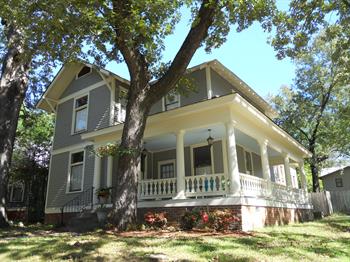
sandwich Thomas M Clifton HouseThe monthly architectural history program “Sandwiching in History” visits the Thomas M. Clifton House, located at 1423 South Summit Street. The program begins at noon today.  A historian with the Arkansas Historic Preservation Program delivers a brief lecture about the church before leading guests on a tour.

Located in the Central High School Neighborhood Historic District, this house was built about 1900 and features elements of the Craftsman and Colonial Revival styles. The first long-term occupant was Thomas M. Clifton, who worked in the Choctaw, Oklahoma & Gulf Railroad shops.

Sandwiching in History is a program of the Arkansas Historic Preservation Program, an agency of the Department of Arkansas Heritage.  The AHPP is responsible for identifying, evaluating, registering and preserving the state’s cultural resources. Other DAH agencies are the Arkansas Arts Council, the Delta Cultural Center in Helena, the Old State House Museum, the Mosaic Templars Cultural Center, the Arkansas Natural Heritage Commission and the Historic Arkansas Museum.

SOCIALIGHT, a lecture by Mark Manack, AIA and Frank Jacobus AIA tonight at 6pm.

Marc Manack (L)  and  Frank Jacobus (R)

ARCHITECTURE AND DESIGN NETWORK presents

 
SOCIALIGHT
a lecture by
 
Marc Manack, AIA, NCARB, Assistant Professor, Fay Jones School of Architecture & Design 
Frank Jacobus, AIA, Associate Professor, Fay Jones School of Architecture & Design
          Principals, SILO AR+D, Fayetteville, AR and Cleveland, OH 
 
Date: Tuesday, November 3, 2015
Place: Arkansas Arts Center lecture hall
Time: 6:00 p.m. preceded by a reception at 5:30 p.m.  
 
Marc Manack and Frank Jacobus, the former a founding principal and the latter a principal of  SILO AR+D, an award winning architectural, research and design collaborative, will share their insights into the evolving role of the architect in relation to contemporary design, technology and changing perceptions of the built environment. 
 
While they, like other architects, still deal with bricks and  mortar, glass, steel and other traditional building elements, the two men have sought out and  experimented in unexpected ways with new, non-traditional  materials and techniques, employing them in the design and making of  temporary as well as permanent  structures, installations and objects. 
 
The work of the two architects has been published widely and has been  featured in ARCHITECTURE, Dwell, Slate, Fast Company and the Wall Street Journal.   
 
Architecture and Design Network (ADN) lectures are free and open to the public. For additional information about this and other ADN programs contact ardenetwork@icloud.com. Supporters of ADN include the Central Section of the Arkansas Chapter of the American Institute of Architects, the UA Fay Jones School of Architecture and Design, the Arkansas Arts Center and friends in the community.

Little Rock Look Back: Site selected for Robinson Auditorium

Potential rendering of new auditorium which appeared in October 30, 1937 ARKANSAS GAZETTE

Potential rendering of new auditorium which appeared in October 30, 1937 ARKANSAS GAZETTE

On October 29, 1937, the Little Rock City Council finally selected the site for the Municipal Auditorium.  It had been approved by voters in January of that year, but no site had been identified during the campaign.

During the early autumn, the City had engaged a consultant to evaluate several downtown locations as potential sites for the municipal auditorium.  One stipulation was that it had to be an entire city block.

The six sites were:

Broadway, Markham, Spring and Garland Streets; Center, Markham, Spring and Second Streets; Center, Eighth, Louisiana and Ninth Streets; Scott, Fourth, Cumberland and Capitol Streets; Scott, Tenth, Cumberland and Ninth Streets; and Third, State, Second and Gaines Streets


The top choice was the site bounded by Center, Markham, Spring and Second Streets.  It was felt that location’s proximity to public buildings made it ideal for a civic auditorium.  It was across the street from the former state capitol (then known as the Arkansas War Memorial) which was, at the time, housing state and federal offices.  The site was also adjacent to the county courthouse structures.

Half of the desired property was owned by the federal government.  Because it was being used for federal offices, it was uncertain as to the site’s availability.  Therefore a city committee recommended the site bounded by Center, Eighth, Louisiana and Ninth Streets be utilized as the auditorium location.

The City Council met on October 20 to make a decision. But were at a stalemate. They met again a few days later with still no resolution.

At an October 25 City Council meeting, Arkansas Gazette publisher (and chairman of the Planning Commission) J. N. Heiskell, advocated the site on Markham and Broadway Streets. The Council convened on October 29 to meet again.  The clock was ticking, a site had to be selected because ground had to be broken prior to January 1, 1938.


At the October 29th meeting, the discussion from previous meetings among the aldermen picked up where it had left off.  Again J. N. Heiskell spoke about the importance of employing city planning concepts in selecting the site.

“In the past, selection of a site for a public building has been merely a matter of who could sell the city some property.  I had hoped we were starting a new effort in starting selection of an auditorium site with the advice of Mr. Bartholomew.  Starting with the auditorium, we should be guided by competent advice and locate future buildings following a city plan.  Your vote today will determine the future of Little Rock so far as city building goes.”

After having engaged in discussions with various federal government agencies, Mayor Overman reported that the city could not obtain the recommended site.  It would not be possible for the federal government to relocate those agencies currently occupying half of that block within the time allowed.  The mayor also stated that he had been warned that if construction did not start by January 1, 1938, (which was just a few weeks away) then the money could be taken back and allocated to other projects.

Ultimately the City Council voted 16 to 1 with 1 absent to locate it at the corner of Markham and Broadway.  At last, Little Rock had a location for the new municipal auditorium!

Though it had not been anyone’s first choice (except Mr. Heiskell, who did not have a vote), in retrospect, the auditorium site finally chosen offered many advantages which were not identified during the marathon selection discussions.  The grade of the land sloped toward the Arkansas River from Markham Street down to Garland Street which allowed for a street level entrance to both the planned exhibition hall on a lower level and the music hall on an upper level.  Given the topography of the other sites under consideration, this was only possible at the chosen location.  By stacking the two major components the project did not take up an entire block, which had been the forecasted footprint.  Not using the entire block allowed for subsequent expansion of the complex’s footprint in the coming decades.  This would not have been possible at any of the other sites under consideration if the original structure had taken up the entire block.  In addition, both Markham and Broadway Streets are wider than normal city streets which allowed for better traffic flow and for easier access to a loading dock.

Interestingly, the Convention & Visitors Bureau, which oversees Robinson Center Music Hall, now has offices in the Cromwell Building. This building is located on the site which had been the first choice for the auditorium in 1937.


QQA celebrates Annual Meeting & Greater LR Preservation Awards tonight!

QQAThe Quapaw Quarter Association will present the Greater Little Rock Preservation Awards at its 2015 Annual Membership Meeting on Tuesday, October 27 at the Ron Robinson Theater.

This year’s Award of Merit recipients include

  • Matt Foster for the rehabilitation of the Leo Treadway House
  • CJRW, Jameson Architects, Kinco Constructors, and Terraforma LLC for the rehabilitation of the Fulk Building
  • Darrell Brown and the Sherwood History and Heritage Committee for the rehabilitation of the Roundtop Filling Station
  • Tom and Ellen Fennell for their Forgotten Little Rock Facebook page

Laura Sergeant will receive the Peg Smith Award to recognize her exemplary volunteer work.  The Group will be presented with the Jimmy Strawn Award, the QQA’s most prestigious award, for their long time efforts to revitalize South Gaines Street and stabilize the Governor’s Mansion Historic District, as well as their contributions to downtown Little Rock.

The meeting will begin at 5:00 p.m. with a 30 minute reception, followed by the annual meeting and award presentation at the Ron Robinson Theater at 100 River Market Avenue in Little Rock.  The QQA’s annual membership meeting is free and open to the public.  Nonmembers are encouraged to support Little Rock preservation efforts at the door.

The QQA is pleased to welcome Donovan Rypkema as this year’s guest speaker.  Mr. Rypkema is principal of Place Economics, a Washington, DC-based real estate and economic development consulting firm.  The firm is currently working on a ReLocal study for the City of Little Rock.  This project has surveyed 8,000 parcels in the study area, and will look at over seventy five metrics to make specific recommendations to the City of Little Rock for how to stabilize and revitalize its historic neighborhoods.

The QQA’s mission is to promote the preservation of Little Rock’s architectural heritage through advocacy, marketing and education.  Visit Quapaw.com for more information and to become a member.