KOYAANISQATSI tonight at 7 at the CALS Ron Robinson Theater

Koyaanisqatsi

As part of the “Movies Meant for the Big Screen” series, the CALS Ron Robinson Theater tonight is showing KOYAANISQATSI. The screening starts at 7pm.  Admission is $5.

Drawing its title from the Hopi word meaning “life out of balance,” this renowned 1982 documentary reveals how humanity has grown apart from nature. Featuring extensive footage of natural landscapes and elemental forces, the film gives way to many scenes of modern civilization and technology. Given its lack of narration and dialogue, the production makes its points solely through imagery and music, with many scenes either slowed down or sped up for dramatic effect.


70 Years of SOUTH PACIFIC

Original Broadway production marquee of the Majestic Theatre – photo from the Shubert Organization

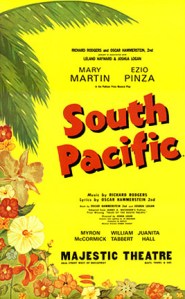
Seventy years ago today, a fictional Little Rock heroine took the stage of a Broadway megahit when South Pacific opened at the Majestic Theatre on April 7, 1949. It settled in for a run of 1925 performances.

Based on the James Michener Pulitzer Prize winning novel Tales of the South Pacific, it featured a book by Oscar Hammerstein II and Joshua Logan, songs by Richard Rodgers and Hammerstein and direction by Logan. It was produced by Rodgers, Hammerstein, Logan and Leland Hayward. Set in the titular islands, it concerned the relationships of sailors, nurses, island natives and other island inhabitants.

The musical starred recent Tony winner Mary Martin as Little Rock native Nellie Forbush, opera star Ezio Pinza, stage veterans Myron McCormick and Juanita Hall, and stage newcomers William Tabbert and Betta St. John. Cloris Leachman was Martin’s understudy and would later succeed her in the part of Little Rock native Nellie Forbush.
Like other Rodgers and Hammerstein musicals, this show tackled tough themes – this one being prejudice. That did not set well with some theatergoers. Indeed, some potential investors did not put money into the show because of its stance. But Rodgers, Hammerstein, Logan and Hayward persisted. Their diligence paid off when the musical received the 1950 Pulitzer Prize in Drama, only the second musical to receive this designation.

This was the first Rodgers & Hammerstein musical to not feature big dance numbers. In fact, there was no choreographer. The dance steps which existed were created by Martin, who had taught dance in her native Texas as a young mother.

Opening late in the season, South Pacific was named the 1949 New York Drama Critics Circle Best Musical, but was not part of the Tony Awards until 1950. (Though Jo Mielziner, who designed the set for South Pacific received a Tony for his set designs of shows during the 1948-49 season and South Pacific was one of the titles listed.)

At the 1950 Tonys, it received six Tony Awards (sometimes listed as eight because Book and Score were not broken separate from Best Musical that year—but some sources incorrectly separate them.) It was named Best Musical, Actor in a Musical (Pinza), Actress in a Musical (Martin), Featured Actor in a Musical (McCormick), Featured Actress in a Musical (Hall), and Director (Logan). This is the only time that all four acting awards in the musical category went to performers in the same production. In fact, the other two acting trophies that year were incorrectly engraved as being from South Pacific out of habit.

Logan’s win was also the first time that the Director Tony went for a musical, since at the time that award was not separated out among plays and musicals. Hall was the first African American to win a Tony Award for Acting. Martin would reunite with Hayward, Rodgers & Hammerstein ten years later for The Sound of Music. Pinza and Tabbert reunited in 1954 for Fanny which would be the final Broadway credit for each gentleman. McCormick stayed with the show the entire run, except for vacations.

In 1999 for the 50th anniversary and in 2008 for the opening of the first Broadway revival remaining cast members from the original production had reunions in New York City. At the 50th anniversary ceremony, a proclamation from Little Rock Mayor Jim Dailey was read declaring it South Pacific day in Little Rock and honoring the show. It is interesting to note that in 1949, there were two heroines on the Broadway stage from Little Rock: Nellie Forbush from South Pacific and Lorelei Lee from Gentlemen Prefer Blondes.

Tartan Day – BRIGADOON appears in Little Rock for the first time in 1951

April 6 is Tartan Day – a chance to pay tribute to the achievements of Scots in the U.S.  It is also a good chance to wear plaid.

On January 17 and 18, 1951, the Broadway musical Brigadoon materialized at Robinson Memorial Auditorium for its first visit to Little Rock.  This musical by Alan Jay Lerner and Frederick Loewe is a Scottish fantasy about a town that materializes for one day every 100 years.

First performed on Broadway in 1947, it was revived at New York City Center in 1950. It was that production that toured in 1951 to Little Rock.  The production was produced by John Yorke (who had worked on the original Broadway production) and brought to Little Rock by Metropolitan Attractions.

The cast was led by future Tony nominee Susan Johnson.  Others in the cast were Elizabeth Early, Robert Busch, Betty Logue and Thaddeus Clancy. All had appeared at City Center, though some in different roles than on the tour.  This touring production featured the original Broadway creative team from 1947 with direction by Robert Lewis, choreography by Agnes de Mille (who won a Tony for it, at the first ceremony), scenery by future Tony winner Oliver Smith, costumes by Tony winner David Ffolkes, lighting by Peggy Clark, and orchestrations by Ted Royal.

Over the years, Brigadoon has resurfaced in Little Rock in community theatre and school productions.  But this was the first time that tartans of the MacLaren, Dalrymple, Brockie and Anderson clans first appeared in Little Rock.

Little Rock Look Back: First City Council meeting in current LR City Hall

City Hall circa 1908

On April 6, 1908, the first City Council meeting took place in the new Little Rock City Hall.  Located at the corner of Markham and Broadway Streets, this three story structure was designed by Charles L. Thompson.

The idea of a new City Hall had first been raised by Mayor W. E. Lenon in 1904.  After a couple of false starts and delays, the project finally got underway in the autumn of 1906.  (The date on the front of the building is the optimistic and ultimately wrong 1907.  But it is etched in stone and set into the exterior.)

City offices started moving in during January and February 1908 while construction continued.  By the end of March, the building was complete and all offices moved in.  The final City Council meeting in the 1868 City Hall took place on March 30.  One week later, the body reassembled in their new space.

All sixteen of the aldermen were present for this meeting, which was a rare occurrence.  The regular order of business was dispensed with except for approval of payments for the bills and payroll for March.  That totaled $25,719.56. (This is the equivalent of $664,729.65 in 2018).

The floor was then turned over to Mayor Lenon to make an announcement.  In his remarks, the Mayor praised the new building, and then stated he was resigning immediately.  His business interests were such that he did not have time to be mayor.

The Council reluctantly accepted the resignation.  Because there was over a year remaining in the term, a special election would need to be called to select a successor.  If Mayor Lenon had waited two more weeks to resign, the Council would have appointed a new mayor for the duration of the term.

Alderman John Herndon Hollis was chosen to serve as mayor until the special election could be held.  First elected in 1904, he was about to start his third term as an alderman.  Though he did not have to give up his seat (and in fact served as an alderman until 1918), he was referred to as Mayor Hollis during his brief tenure.  He is counted as one of Little Rock’s mayors.  Unlike other times where there was an acting mayor while a mayor was out of town, in 1908, there was no other mayor for whom Mayor Hollis was acting in absentia.

After the selection of the new mayor, a committee was appointed to draft a resolution praising retiring Mayor Lenon.  The final business at the meeting was the reading of a resolution memorializing longtime City Clerk H. Clay Jones.  The former city official had died in March.

Tartan Day, celebrate all things Scottish, visit the Brownlee House at HAM

Photo by Larry Pennington

Today is Tartan Day, designated to celebrate the contributions of Scots everywhere.

One of Little Rock’s oldest structures, the Brownlee House was built by a Scotsman.  The Brownlee House is one of the restored structures at Historic Arkansas Museum.

Robert Brownlee built this Federal style brick house in the late 1840s for his brother and sister-in-law. A Scottish stonemason, Brownlee came to Little Rock in 1837 to help build the State House (now the Old State House Museum). He pursued a number of careers before leaving for California in the 1849 Gold Rush. From the late 1840s through 1852, the home’s residents were James and Isabelle Brownlee and Tabby, a woman enslaved by James Brownlee.

Brownlee had the wooden mantels in the parlor and bedroom marbleized, a popular decorative art of the time. The home’s furnishings reflect the mid-19th century.

This house is a project of The National Society of the Colonial Dames of America in the State of Arkansas.

Historic Arkansas Museum is open seven days a week.  The galleries are free, but the tours of the historic structures have a nominal fee.  It is an agency of the Department of Arkansas Heritage.

Little Rock Look Back: “Nine from Little Rock” wins an Oscar

On April 5, 1965, the Academy Award for Best Documentary, Short Subject went to the film “Nine from Little Rock.”

Narrated by Jefferson Thomas, Charles Guggenheim’s documentary looks at the nine African-American students who enrolled in Little Rock Central High School in 1957. Thomas, one of the students reflects on the state of race relations in the seven years that had elapsed (up to 1964).  The film also focuses on Ernest Green, Elizabeth Eckford and Thelma Mothershed.

Guggenheim both directed and co-wrote the film. The latter credit was shared with Shelby Storck, who also produced the film.   The film had been commissioned by George Stevens, Jr., for the United State Information Agency.

The Oscar that night was Guggenheim’s first of four.  His others would be for: 1968’s “Robert Kennedy Remembered” (Live Action Short), 1989’s “The Johnstown Flood” (Documentary Short) and 1994’s “A Time for Justice” (Documentary Short).  His son Davis Guggenheim won the Oscar for Documentary, Feature for An Inconvenient Truth.

The film was digitally restored by the Motion Picture Preservation Lab for the 50th anniversary of its win for Best Short Documentary at the 1965 Academy Awards.  It is available for purchase on DVD and can also be viewed in its entirety on YouTube

Little Rock Look Back: How LR reacted to Assassination of Dr. King

On April 4, 1968,  when Dr. King was assassinated, Little Rock did not see the unrest that many cities did.  Part of that was probably due to quick action by Governor Winthrop Rockefeller.

The Governor released a statement fairly quickly expressing his sorrow at the tragedy and calling for a day of mourning. He also made the State Capitol available for the NAACP to have a public memorial, as well as worked with a group of ministers to host an interdenominational service.

Little Rock Mayor Martin Borchert issued a statement as well:

We in Little Rock are disturbed about the incident in Memphis. We are disturbed regardless of where it had happened.  Killing is not the Christian solution to any of our problems today.

In Little Rock, we feel we have come a long way in 10 years toward solving some of our problems of living and working together regardless of race, creed or color.

The city Board of Directors in Little Rock has pledged itself toward continuing efforts to make Little Rock a better place in which to live and work for all our citizens.

We feel the efforts of all thus far have proved we can live in harmony in Little Rock and are confident such an incident as has happened will not occur in Little Rock.  We will continue our most earnest efforts toward the full needs of our citizens.

The day after Dr. King was assassinated, a group of Philander Smith College students undertook a spontaneous walk to the nearby State Capitol, sang “We Shall Overcome” and then walked back to the campus.  President Ernest T. Dixon, Jr., of the college then hosted a 90 minute prayer service in the Wesley Chapel on the campus.

On the Sunday following Dr. King’s assassination, some churches featured messages about Dr. King.  As it was part of Holy Week, the Catholic Bishop for the Diocese of Little Rock had instructed all priests to include messages about Dr. King in their homilies. Some protestant ministers did as well. The Arkansas Gazette noted that Dr. Dale Cowling of Second Baptist Church downtown (who had received many threats because of his pro-integration stance in 1957) had preached about Dr. King and his legacy that morning.

Later that day, Governor Rockefeller participated in a public memorial service on the front steps of the State Capitol. The crowd, which started at 1,000 and grew to 3,000 before it was over, was racially mixed. At the conclusion of the ceremony, Governor and Mrs. Rockefeller joined hands with African American ministers and sang “We Shall Overcome.”

That evening, Trinity Episcopal Cathedral was the site of an interdenominational service which featured Methodist Bishop Rev. Paul V. Galloway, Catholic Bishop Most Rev. Albert L. Fletcher, Episcopal Bishop Rt. Rev. Robert R. Brown, Rabbi E. E. Palnick of Temple B’Nai Israel, Gov. Rockefeller, Philander Smith President Dixon, and Rufus King Young of Bethel AME Church.

Earlier in the day, Mayor Borchert stated:

We are gathered this afternoon to memorialize and pay tribute to a great American….To achieve equality of opportunity for all will require men of compassion and understanding on the one hand and men of reason and desire on the other.