Sandwich in History at the Arsenal Tower Building in MacArthur Park today

Image may contain: sky, cloud, house and outdoorYou are invited to join the Arkansas Historic Preservation Program’s next “Sandwiching in History” tour, which will visit one of Little Rock’s oldest standing structures, the Arsenal Tower Building, now home to the MacArthur Museum of Arkansas Military History on 9th Street in MacArthur Park in Little Rock beginning at noon on Friday, December 6, 2019.

This structure was built as part of a federal military installation. The U.S. Arsenal is the only building that remains of the more than 30 that made up the original installation. After 1892, the arsenal grounds became City Park and later MacArthur Park in 1942.

The two-story brick building displays a slight Gothic influence in a centered octagonal entry tower. Symmetrical east and west wings display two-story full porches. For several decades, the building was endangered, but the City of Little Rock undertook a renovation project in the 1930s. The U.S. Arsenal currently houses the MacArthur Museum of Arkansas Military History.

Sandwiching in History tours are worth one hour of AIA continuing education credit. If you would like to receive email notifications of upcoming tours instead of postcards or need additional information, please contact Callie Williams, Education and Outreach Coordinator for AHPP, at 501-324-9880 or Callie.Williams@arkansas.gov.
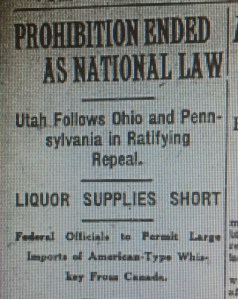
Prohibition Repealed on December 5, 1933

On December 5, 1933, Ohio, Pennsylvania and Utah provided the necessary support to officially repeal “the great experiment.”

Because this was such a foregone conclusion, the Arkansas Gazette and Arkansas Democrat carried only small, single column stories on their front pages.  Perhaps because this was Arkansas, it did not appear that any Little Rock businesses immediately set about to capitalize on this.  At least there were not any large scale advertisements in the days following that would indicate any specials or activities planned for the December 15 official end.

In fact, the only mention in the newspapers on December 15 was that President Roosevelt was trying to decide what the alcohol taxing structure should be.

One amusing story that ran in the Arkansas Democrat on December 6 was that Mrs. Roosevelt was keeping the wine glasses in storage at the White House for the time being.  She was awaiting action by Congress once it convened in January 1934 as to how it would deal with properly ending Prohibition in the District of Columbia.  Over 3,000 wine glasses had been in storage since Prohibition had been enacted.

LR Winds Holiday Concert tonight

LR Winds at UA-PTC CHARTSThe Little Rock Winds annual holiday concert takes place tonight (December 5). It features yuletide favorites performed with a cheerful chorus, delightful dancers, stunning soloists, and a right jolly old elf, all at UA-Pulaski Tech CHARTS Theater!

Under the direction of conductor Israel Getzov, guest artists include Michael Oriatti, tenor; Pat Walker, narrator; Arkansas Festival Ballet Performing Company with artistic director Rebecca Miller Stalcup; Sylvan Hills Choirs with director Elaine Bohannon Harris; Baton auction winner Michele King Hellstern, guest conductor.

There will be a silent auction before the concert, offering lots of items to fill those Christmas stockings. The auction opens at 6:30 p.m. and bidding will conclude at the end of the concert intermission.

AND there will be a photo booth for Selfies with Santa!

Arrest of 12 Little Rock Aldermen on December 4, 1939

The Pulaski County Courthouse where the 12 Little Rock aldermen were arraigned.

On Monday, December 4, 1939, a dozen of Little Rock’s aldermen reported to the county jail to serve sentences for contempt of court.

The previous Monday, the twelve council members had voted against an ordinance which had been ordered by the judge in an improvement district matter.  The other aldermen had either voted in the affirmative or had been absent.  Because the twelve had refused to change their votes since that meeting, the judge ordered them jailed.

At the hearing, the judge brought each alderman up one by one. This seemed to be in order to further embarrass the aldermen.  The judge also interviewed Mayor J. V. Satterfield and City Clerk H. C. “Sport” Graham to put on the record that they had counseled the aldermen to obey the judge’s order.

Mrs. C. C. Conner, the only female alderman, was not jailed but was fined $50. The eleven men were held at the jail, though not in cells.  Newspaper photos showed the men playing cards in a conference room.  In order to get out of jail, the judge gave the aldermen the chance to change their votes.

Mayor J. V. Satterfield plead with the judge to let the aldermen leave the jail to attend the meeting at City Hall, which was nearby.  He requested that the city be allowed to maintain “what little dignity remained” by not having the meeting at the jail.  The judge relented, and the aldermen were escorted by deputies to the council chambers.

After the aldermen changed their votes, the judge suspended the remainder of their sentences.  The sentences were not vacated, they were only suspended.  The judge admonished them that should they attempt to reverse their reversal, he would throw them back in jail.

Learn about Arkansas in Modern America at the December CALS Butler Center Legacies & Lunch program today at noon

Dr.-Ben-Johnson-Ark-Studies-Endowed-Professor-300x196Today (December 4) at noon, the Central Arkansas Library System’s Butler Center’s monthly Legacies & Lunch program will feature Dr. Ben Johnson discussing Arkansas in Modern America.

Ben Johnson will discuss the topics and themes in his book Arkansas in Modern America Since 1930, published in August by the University of Arkansas Press. This second edition is a comprehensive revision of and elaboration on the first edition, which was published in 2000. Johnson incorporates recent scholarship to extend the analysis of economic, social, and cultural developments in Arkansas into the present day.

Ben Johnson is the John G. Ragsdale, Jr. and Dora J. Ragsdale Professor of Arkansas Studies at Southern Arkansas University in Magnolia. In addition to Arkansas in Modern America, he has published Fierce Solitude: A Life of John Gould Fletcher and John Barleycorn Must Die: The War Against Drink in Arkansas, each published by the University of Arkansas Press.

Legacies & Lunch is a free monthly program of CALS Butler Center for Arkansas Studies about Arkansas related topics.  Program are generally held from noon to 1 pm on the first Wednesday of the month in the Main Library’s Darragh Center.  Attendees are invited to bring a sack lunch; drinks and dessert are provided.  A library parking discount is available upon request.  For more information, or to share ideas for future programs, please contact Heather Zbinden, 320-5744, hzbinden@cals.org.

Nov 30, 1936 – City of Little Rock sets election for what is now Robinson Center Performance Hall

On November 30, 1936, Little Rock Mayor R. E. Overman asked the City Council to call a special election for January 1937 for approval of the issuance of bonds for a municipal auditorium.  Prior to asking the aldermen to call the election, the mayor had been in Washington DC to visit with Public Works Administration (PWA) officials. The mayor was assured that the auditorium project would be approved for federal funds.

While the mayor was meeting with federal officials, architects Eugene Stern, George Wittenberg and Lawson Delony were meeting with local PWA officials in Little Rock.  They were reviewing the plans for the funding request.  Though there were still a few refinements to be completed in the documents, the local officials seemed satisfied.  With these assurances in hand, Mayor Overman moved forward with putting the request before the City Council.

Though there were many things discussed at length during the November 30 City Council meeting, there was virtually no conversation regarding the structure before the 15-0 vote by the City Council to refer the auditorium bonds to the voters.  There were three different bond programs to be put before the voters in January 1937: a municipal auditorium, expansion of the public library and creation of a park for African Americans.

The bonds for the auditorium would be $468,000 in general obligation bonds which would be paid off between 1940 and 1971.  This was toward a total cost of $760,000 for the entire project.  At the time of the initial auditorium application in 1935, the mayor had noted that if the PWA failed to approve funding for the entire project, it could be submitted to the voters for the issuance of municipal bonds.  This was ultimately the course of action that would come to pass.  The PWA grant would only cover a portion of the project.  The government did agree it would purchase the financing bonds if no other entity did.

The election would be held on January 26, 1937.