
Little Rock Look Back: Brooks-Baxter War erupts 145 years ago today

On April 15, 1874, Joseph Brooks, accompanied by armed men, including the Pulaski County Sheriff, went into the office of Governor Elisha Baxter demanding he vacate the office.  Alone, save a young son, Governor Baxter departed the Arkansas State Capitol (now the Old State House), and met up with a group of supporters to plan their response.

Thus, the Brooks-Baxter War in Arkansas had begun.

Brooks had faced off against Baxter in the 1872 gubernatorial election.  Both were Republicans, but represented different factions of the party.  Brooks led the Brindletails, which were more aligned with efforts to gradually re-enfranchise former Confederates as well as have a smaller government with limited gubernatorial powers.  Baxter led the Minstrels.  This group was focused on retaining power and control of state government by limiting re-enfranchisement of former Confederates.

Many historians believe that Brooks may have actually won the election, but Baxter’s faction’s control of the state machinery resulted in him being declared the winner.  Brooks’ appeal to the Arkansas General Assembly was unsuccessful.  He took it to the state courts, which was likewise going nowhere.  EXCEPT….

Baxter had changed course on his views toward Democrats and members of his own party. This resulted in him losing support of many Republicans.  He also fought with fellow Republicans regarding a railroad issue.  This led to a meeting of many leading Republicans including Arkansas’ two US Senators.  Not long after that, Pulaski County Circuit Judge John Whytock heard Brooks’ case.  On April 15, 1874, Judge Whytock ruled in favor of Brooks.

Following his ouster from the governor’s office, Baxter telegraphed President Grant, asking for assistance.  In the meantime, both sides recruited supporters.  Baxter and 200 men set up headquarters in the Anthony House, which was near the State Capitol.  Brooks and his supporters used furniture to barricade the capitol building.  Robert Catterson, a former Little Rock mayor, set up artillery pieces on the capitol lawn to defend Brooks.

For the next month, there would be many rumors and skirmishes.  Little Rock, like the rest of the state, was divided. And the conflict was just beginning.

Little Rock City Hall turns 111 today

City Hall circa 1908

111 years ago today, Little Rock City Hall officially opened at the corner of Markham and Broadway.

On April 15, 1908, the Italian Renaissance Revival style building, which had been designed by local architect Charles Thompson, played host to an open house. Staff had started moving into the building in March of that year.   This was, as often is the case, behind schedule.  The date in the cornice toward the top of the building is 1907, but the building was not completed until 1908.

An open house took place on April 15, 1908, presided over by Mayor John Herndon Hollis and his wife as well as former Mayor W. E. Lenon and his wife.  (Mayor Hollis’ wife is a distant cousin of the Culture Vulture.)

In 1903, W. E. Lenon became Mayor of Little Rock. Back then, the terms were two-year terms.  Before the start of his second term in 1905, he realized that the City was outgrowing City Hall, which was, at the time, on the northeast corner of Markham and Louisiana – where part of the Statehouse Convention Center sits today.

In February 1906, Mayor Lenon appointed a committee of five aldermen to over see the planning for the building of a new City Hall. In July 1906, the City Council approved plans, which called for a City Hall with an municipal auditorium wing. There was some hue and cry about the cost spending and a resulting lawsuit, so, in September 1906, those plans were scrapped and a simpler City Hall was approved for the cost of $175,000.

The last resolution in the old City Hall called for the banning of smoking in the new Council Chambers – while the Council was in session. This may well have been the first smoking ban in a public government building in the history of Arkansas.

When the building opened, the third floor was not finished out. The space was not needed. When the Museum of Natural History and Antiquities (now the Museum of Discovery) moved into City Hall in 1929, they had to finish out their space.

In 1913, the new Central Fire Station, designed in the Beaux Arts style, was constructed adjacent to City Hall. During the 1930s, as the City grew, more space was needed. A garage, designed in the “austere, utilitarian” style was built in 1936 and a City Jail Annex, built by the WPA in the modified Art Deco style was built in 1938.

By 1984, the decision was made to stay at Markham and Broadway. An extensive renovation and restoration effort was undertaken. In 1988, the building reopened, and the interior had been restored to its 1908 appearance.

Little Rock Look Back: General Grant in Little Rock

On April 15, 1880, former president Ulysses S. Grant spoke in Little Rock as part of his world tour. While here he made a couple of appearances and participated in a parade. It was General Grant’s first visit to Arkansas either as a soldier or a politician.

(At the time, and through much of the 20th Century, former US presidents were not referred to as President after leaving office. He was referred to as General Grant or Mr. Grant during his time in Little Rock.)

At his outdoor speech, his remarks followed brief comments by Governor William R. Miller and Mayor John Gould Fletcher (erroneously referred to as John C. Fletcher in the Memphis Appeal story the next day). Grant’s comments were brief and flowery. He thanked Arkansans for a warm welcome, praised the future prospects of Arkansas and discussed the demise of what he termed “sectionalism” which was undoubtedly a reference to the division between the Union and and former Confederate states.

Also that day, Grant addressed a banquet in Concordia Hall (now part of the Arkansas Studies Institute complex on the Central Arkansas Library downtown campus). His was one of fifteen toasts that evening. It was simply “The United States of America, forever United.” He expounded briefly on the theme of unity of citizens from all states. He also discussed immigration noting, “All foreigners find a welcome here. We make them American citizens. After we receive them, it is but one generation until they are Americans.” He noted that he could speak much more on the topic, but that since he was but one of fifteen toasts and that there was to be music after each toast, “It will be to-morrow (sic) morning when we get through if we all take as much time as the subjects admit of.”

Not everyone was thrilled to have the former commander of the Union Army in Little Rock. The story goes that when he was parading down the street, some Little Rock women (in a display of Souther un-hospitality) sat in chairs with their backs to the parade route. But all in all, it appears to have been a successful visit for the man who was the only Republican in the 19th Century to win Arkansas’ Electoral votes.

Grant arrived in Little Rock on the night of April 14 and lodged at the Capital Hotel. He undoubtedly enjoyed some whiskey and cigars while at the Capital. Grant had originally planned on departing in the afternoon of April 15, but Little Rock leaders pled with him to stay so that he could be honored at the banquet. He assented.

Incidentally, there is an urban myth that, while in Little Rock, General Grant rode his horse in the oversized elevator of the Capital Hotel.  This is a relatively recent story. The oversized elevator was not installed until the 1980s, over 100 years after Gen. Grant was a guest of the facility.

You cannot spell Pulitzer without LIT

The 2019 Pulitzer Prizes are announced later today.  Over the years, there have been several Pulitzer winners with connections to Little Rock.
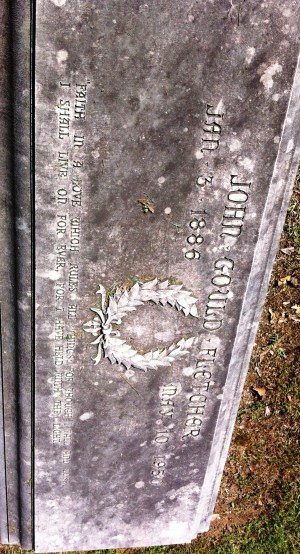
In 1939,  Little Rock native John Gould Fletcher, a scion of a politically prominent family, won the Pulitzer Prize in Poetry for his work Selected Poems.  He appears to be the first Pulitzer Prize winner with Little Rock connections.

The 1950 Pulitzer Prize for Drama went to South Pacific. With a leading lady who is from Little Rock, this Richard Rodgers, Oscar Hammerstein II, and Joshua Logan musical explores race against the backdrop of World War II.  It is based on James Michener’s Tales of the South Pacific, which won the 1948 Pulitzer for Fiction. (Because it was a collection of interrelated short stories, the category was changed from Novel to Fiction from that year onward.)  But in the Michener book, Forbush is not from Little Rock.

The Arkansas Gazette made Pulitzer history in 1958 by winning both the Public Service and Editorial prizes in the same year. This was the first time that one organization had received both awards in the same year.  These were for the coverage of and response to the 1957 integration of Central High School by the Little Rock Nine.  J. N. Heiskell was the paper’s owner and editor, while Harry Ashmore led the editorial page.  Relman Morin of the Associated Press received the Pulitzer for National Reporting for his coverage of the events at Central.  Apparently Will Counts of the Arkansas Democrat was the jurors’ choice to receive the Pulitzer for Photography. But the Board opted to give the prize to another photographer.  Some speculate that the Pulitzer Board did not want to give four prizes in the same year for the same story.

Current Little Rock resident Paul Greenberg won the 1969 Pulitzer for Editorial Writing.  at the time, he worked for the Pine Bluff Commercial.   In 1986, he was a finalist in the same category.  Greenberg moved to Little Rock to join the staff of the Arkansas Democrat-Gazette in 1992.  While no longer the Editorial Page Editor, Greenberg continues to write columns for the newspaper.

Former Little Rock resident Richard Ford received the 1996 Pulitzer for Fiction for his novel Independence Day.  As a young boy of eight, and for several years after, Ford spent much time at Little Rock’s Marion Hotel with his grandparents.  In making the presentation, the Pulitzer Board noted it was, “A visionary account of American life, Independence Day reveals a man and country with unflinching comedy and the specter of hope and even permanence…”

The Pulitzer Prize for Drama in 2001 went to David Auburn.  A 1987 graduate of Hall High School, Auburn was recognized for his play Proof.  The Pulitzer Board described Proof thus: “This poignant drama about love and reconciliation unfolds on the back porch of a house settled in a suburban university town, that is, like David Auburn’s writing, both simple and elegant.”  Auburn also served as a 2014 juror for the Pulitzer Prize for Drama.  While a student in Little Rock, Auburn participated in theatre at the Arkansas Arts Center.

A Pulitzer Preview – Prizing Mount Holly Cemetery

The Pulitzer Prizes are to be announced tomorrow (Monday, April 15).  This year marks the 102nd anniversary of the prizes, though not all of the current categories have been around since 1917.

Mount Holly Cemetery not only touts that it is the site of a whole host of elected officials, it is also the only place in Arkansas where two Pulitzer Prize recipients are buried.

The cemetery is open every day, but a special visit to these two prize winner gravesites can be made on Sunday, April 28, during the Mount Holly Cemetery Association’s annual “Restore in Perpetuity” fundraiser picnic.

In 1939, John Gould Fletcher became the first Southern poet to win the Pulitzer Prize for Poetry.  He was born into a prominent Little Rock family in 1886.  Fletcher was awarded the prize for his collection Selected Poems which was published by Farrar in 1938.  Two years earlier, he had been commissioned by the Arkansas Gazette to compose an epic poem about the history of Arkansas in conjunction with the state’s centennial.

Fletcher is buried next to his wife, author Charlie May Simon and his parents (his father was former Little Rock Mayor John Gould Fletcher).  Other relatives are buried nearby in the cemetery.

The other Pulitzer Prize winner buried in Mount Holly is J. N. Heiskell, the longtime editor of the Arkansas Gazette.  It was Heiskell, in fact, who asked Fletcher to compose the poem about Arkansas.  Heiskell served as editor of the Gazette from 1902 through 1972.  He died at the age of 100 in 1972.

Under his leadership, the Gazette earned two Pulitzer Prizes for its coverage of the 1957 desegregation of Little Rock Central High.  One was for Harry Ashmore’s editorial writing and the other was for Public Service.

Heiskell remained in charge of the Gazette until his death in 1972.  He is buried alongside his wife with other relatives nearby.  Also not too far from Mr. Heiskell are two of his nemeses, proving that death and cemeteries can be the great equalizer. In the early days of his Gazette stewardship, he often locked horns with Senator (and former Governor) Jeff Davis. Later in Mr. Heiskell’s career, he vehemently disagreed with Dr. Dale Alford, who had been elected to Congress on a segregationist platform.

2nd Friday Art Night – Old State House Museum offers a Cheese Dip Social, craft beer, and The Salty Dogs

Join the Old State House Museum on Friday, April 12, from 5 – 8 pm​, and enjoy a true taste of Arkansas at their Cheese Dip Social, featuring dips from local Central Arkansas restaurants, along with local craft beer from Core Brewing!

While you’re sampling the cheese dip and local brew, enjoy the honky-tonk country sounds of The Salty Dogs, another Arkansas favorite.

GTMO, Original Sin, and Policy Failure is focus of Clinton School program this evening

Tonight (April 11) at the Clinton School, a program entitled “GTMO, Original Sin, and Policy Failure” will be offered.

Benjamin R. Farley is a trial attorney and law-of-war counsel at the U.S. Department of Defense, Military Commissions Defense Organization. He is assigned to the team representing Ammar al-Baluchi, one of the five codefendants in the 9/11 conspiracy case who face capital charges before the military commission at Guantanamo Bay, Cuba.

From 2013 until 2017, he served as a Senior Adviser to the Special Envoy for Guantanamo Closure at the U.S. Department of State. A 2012 Presidential Management Fellow, Mr. Farley received a J.D. with honors from Emory University School of Law, where he served as the editor-in-chief of the Emory International Law Review.

He also holds an M.A. in international affairs from the Elliott School of International Affairs at The George Washington University. Farley has published on topics including sovereignty, statehood, and international humanitarian law in various law and policy journals such as the Michigan Journal of International Law, the Fordham International Law Journal, and World Politics Review.

All Clinton School Speaker Series events are free and open to the public. Reserve your seats by emailing publicprograms@clintonschool.uasys.edu or by calling (501) 683-5239.