
 On April 15, 1874, Joseph Brooks, accompanied by armed men, including the Pulaski County Sheriff, went into the office of Governor Elisha Baxter demanding he vacate the office. Alone, save a young son, Governor Baxter departed the Arkansas State Capitol (now the Old State House), and met up with a group of supporters to plan their response.
Thus, the Brooks-Baxter War in Arkansas had begun.
Brooks had faced off against Baxter in the 1872 gubernatorial election. Both were Republicans, but represented different factions of the party. Brooks led the Brindletails, which were more aligned with efforts to gradually re-enfranchise former Confederates as well as have a smaller government with limited gubernatorial powers. Baxter led the Minstrels. This group was focused on retaining power and control of state government by limiting re-enfranchisement of former Confederates.
Many historians believe that Brooks may have actually won the election, but Baxter’s faction’s control of the state machinery resulted in him being declared the winner. Brooks’ appeal to the Arkansas General Assembly was unsuccessful. He took it to the state courts, which was likewise going nowhere. EXCEPT….
Baxter had changed course on his views toward Democrats and members of his own party. This resulted in him losing support of many Republicans. He also fought with fellow Republicans regarding a railroad issue. This led to a meeting of many leading Republicans including Arkansas’ two US Senators. Not long after that, Pulaski County Circuit Judge John Whytock heard Brooks’ case. On April 15, 1874, Judge Whytock ruled in favor of Brooks.
Following his ouster from the governor’s office, Baxter telegraphed President Grant, asking for assistance. In the meantime, both sides recruited supporters. Baxter and 200 men set up headquarters in the Anthony House, which was near the State Capitol. Brooks and his supporters used furniture to barricade the capitol building. Robert Catterson, a former Little Rock mayor, set up artillery pieces on the capitol lawn to defend Brooks.
For the next month, there would be many rumors and skirmishes. Little Rock, like the rest of the state, was divided. And the conflict was just beginning.

 On April 15, 1880, former president Ulysses S. Grant spoke in Little Rock as part of his world tour. While here he made a couple of appearances and participated in a parade. It was General Grant’s first visit to Arkansas either as a soldier or a politician.
 The 2019 Pulitzer Prizes are announced later today. Over the years, there have been several Pulitzer winners with connections to Little Rock.
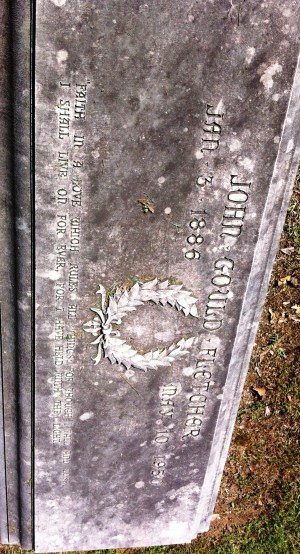 The Pulitzer Prizes are to be announced tomorrow (Monday, April 15). This year marks the 102nd anniversary of the prizes, though not all of the current categories have been around since 1917.
 The other Pulitzer Prize winner buried in Mount Holly is J. N. Heiskell, the longtime editor of the Arkansas Gazette. It was Heiskell, in fact, who asked Fletcher to compose the poem about Arkansas. Heiskell served as editor of the Gazette from 1902 through 1972. He died at the age of 100 in 1972.
 Little Rock Culture Vulture