Arkansas Heritage Month – LR Mayor Moyer and a Municipal Auditorium

Moyer AuditIn anticipation of the November 2016 reopening of Robinson Center Music Hall, this week’s Arkansas Heritage Month entries look at seven Little Rock Mayors who worked on proposals for a municipal auditorium between 1904 and 1940.

After having served as Pulaski County Judge, Charles Moyer was elected Little Rock Mayor in April 1925.  He concluded his inaugural address later that month with a request that all Little Rock voters should support the auditorium district proposal in the May 1925 special election.  Voters approved the auditorium, but the concept of an auditorium district was thrown out by the Arkansas Supreme Court after a legal challenge.

Mayor Moyer then led a statewide effort to get a Constitutional amendment approved to allow for public bonds to be used on auditoriums and a host of other structures, as long as voters approved the issuance of bonds.  This was approved by voters in October 1926.  Though Mayor Moyer publicly advocated for an auditorium after that election, he did not lead a subsequent effort to create one.  During his tenure, conventions were largely centered around the Hotel Marion.  A new Little Rock High School was built (now Little Rock Central High) with that auditorium supplanting its predecessor as the location of choice for large-scale performances.

He left office in April 1929.  In the final weeks of Mayor Moyer’s second term, Planning Commission Chair J. N. Heiskell (editor of the Arkansas Gazette) started discussing the need for a civic center for Little Rock which would include space for a municipal auditorium.

Charles Moyer returned to the office of mayor for an additional two terms in the 1940s. By that time Robinson Auditorium had been opened.

Arkansas Heritage Month – LR Mayor Brickhouse and a Municipal Auditorium

Brickhouse AuditIn anticipation of the November 2016 reopening of Robinson Center Music Hall, this week’s Arkansas Heritage Month entries look at seven Little Rock Mayors who worked on proposals for a municipal auditorium between 1904 and 1940.

Former Alderman Ben D. Brickhouse took office as mayor in April 1919.  As an alderman, he had been party to the discussions and hand-wringing over the existing “temporary” auditorium, which was twelve years old at the time.  In June 1920, he and the City Council authorized City Engineer James Rice to have the building demolished.  (Rice’s grandson Jim Rice is an integral member of the team overseeing the restoration of Robinson Center Music Hall.)

On what seemed to be an annual basis, Brickhouse entertained options for a new municipal auditorium.  Sometimes it would be private groups, on at least one occasion, Mayor Brickhouse himself led the effort.  Funding and location always seemed to be stumbling blocks.  Arkansas law forbade the use of public dollars on an auditorium, so the money would have to be raised privately. Few private entities had the money for this type of project.  Another temporary auditorium had been proposed for City Park (now MacArthur Park), but aldermen balked at the expense for a temporary building.

During the Brickhouse administration, the Hotel Marion was the main site for conventions. The auditorium at the Little Rock High School (later East Side Junior High) was used frequently for performances.

Mayor Brickhouse worked behind the scenes to have the Arkansas General Assembly pass legislation to allow for the creation of an auditorium taxing district, much like a street improvement district. In May 1925 Little Rock voters would be given the chance to approve this.  But Brickhouse would not be mayor by the time that election came around.  He was defeated in his bid for a fourth term and left office in April 1925.

Ben D. Brickhouse did return to public service in 1938, when he was elected to the Arkansas General Assembly.  He was reelected in 1940 and died in June 1941.

Arkansas Heritage Month – LR Mayor Taylor and a Municipal Auditorium

Taylor AuditIn anticipation of the November 2016 reopening of Robinson Center Music Hall, this week’s Arkansas Heritage Month entries look at seven Little Rock Mayors who worked on proposals for a municipal auditorium between 1904 and 1940.

Charles Taylor became Little Rock’s mayor in April 1911.  He inherited the temporary auditorium that was already showing signs of wear and tear after four years.  Throughout the eight years he was in office, he and the City Council wrestled with the question of what to do about the auditorium.

Time and time again, there would be calls to tear the building down. Its proximity to the 1913 fire station was causing the insurance rates on that building to be increased. It was viewed as structurally unsound and had outlived its useful life.  However, without that building, there would be no public space for conventions and community meetings.  While the Hotel Marion offered convention facilities in its ballroom, it did not necessarily lend itself to trade shows. In addition, as a private entity, it was able to set its own rules without necessary regard to the general public.

A 1913 proposal by planner John Nolen had called for an auditorium to be built on a new plaza area near City Hall.  Due to funding issues, that plan never gained traction, despite repeated attempts by its backers to push for it.

At the time he left office in April 1919, Mayor Taylor had still not been able to solve the problem of a municipal auditorium.

Arkansas Heritage Month – LR Mayor Lenon and a Municipal Auditorium

Mayor Lenon with the plans for the original City Hall/Auditorium and the temporary auditorium.

Mayor Lenon with the plans for the original City Hall/Auditorium and the temporary auditorium.

In anticipation of the November 2016 reopening of Robinson Center Music Hall, this week’s Arkansas Heritage Month entries look at seven Little Rock Mayors who worked on proposals for a municipal auditorium between 1904 and 1940.

In 1904, Little Rock Mayor W. E. Lenon first proposed that Little Rock construct at municipal auditorium.  After considering some options, he decided it would be easiest to build it in conjunction with a new City Hall and Jail.  In 1906 plans proceeded in that direction until a lawsuit by J.N. Heiskell to stop it. Following a judge’s ruling that a municipal auditorium was not deemed a proper use for public monies, the City changed course and constructed only a City Hall and Jail (sans auditorium) at the corner of Markham and Broadway. This building opened in 1908.

In 1906, the City gave permission to a private developer to build a temporary auditorium (which also served as a roller skating rink when the chairs were removed) adjacent to the City Hall site.  This opened in 1907.

Mayor Lenon left office in 1908.  He would later chair a committee involved in an auditorium proposal in 1925, but that one would come to naught, as well.  However, he planted the seed and started the public discourse which lasted for 36 years.

Arkansas Heritage Month – On Armed Forces Day visit the City of Little Rock’s MacArthur Museum of Arkansas Military History

MacPark ArsenalToday is Armed Forces Day.  It is a good day to visit Little Rock’s museum devoted to Arkansas’ military heritage.  Located in the historic Arsenal Tower in MacArthur Park, the MacArthur Museum of Arkansas Military History honors the Arkansans who have served in the armed forces.  Exhibits feature artifacts, photographs, weapons, documents, uniforms and other military items that vividly portray Arkansas’s military history at home and abroad.

The exhibits include:

  • From Turbulence to Tranquility: The Little Rock Arsenal
  • Capital In Crisis and Celebration: Little Rock and the Civil War
  • Alger Cadet Gun
  • Camden Expedition
  • David Owen Dodd
  • Through the Camera’s Eye: The Allison Collection of World War II Photographs
  • By the President in the Name of Congress: Arkansas’ Medal of Honor Recipients
  • Conflict and Crisis: The MacArthur- Truman Controversy
  • Duty, Honor and Country: General Douglas MacArthur
  • The Sun Never Sets on the Mighty Jeep: The Jeep During World War II
  • War and Remembrance: The 1911 United Confederate Veterans Reunion
  • First Call – American Posters of World War I
  • Undaunted Courage, Proven Loyalty: Japanese American Soldiers in World War II
  • Vietnam, America’s Conflict

The MacArthur Museum of Arkansas Military History is a museum of the City of Little Rock.  It is led by executive director Stephan McAteer who works with the MacArthur Military History Museum Commission.  The museum is open Tuesday through Friday from 9am to 4pm, Saturday from 10am to 4pm and Sunday from 1pm to 4pm.

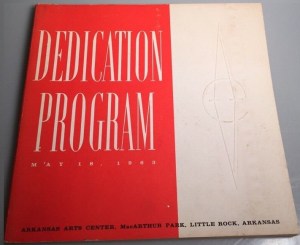
Arkansas Heritage Month – Celebrities and Celebrations open Arkansas Arts Center on May 18, 1963

AAC opening programOn Saturday, May 18, 1963, amidst fanfare and fans of the arts, the Arkansas Arts Center officially opened its doors.  (This was thirty-five years and three days after the Fine Arts Club had opened the first permanent art gallery in Arkansas in the Pulaski County Courthouse).

The dedication ceremonies on May 18 featured U.S. Senator J. William Fulbright (who was in the midst of championing what would soon be known as the John F. Kennedy Center for the Performing Arts), Congressman Wilbur Mills, Governor Orval Faubus, Little Rock Mayor Byron Morse, Winthrop Rockefeller and Jeanette Rockefeller.

On Friday, May 17, 1963, film star Gordon MacRae performed two separate concerts in the theatre space.  There were other assorted small events and tours on May 16 and 17.

The culmination of the weekend was the Beaux Arts Bal.  This black tie event, featured Oscar winner Joan Fontaine, cartoonist Charles Addams (creator of The Addams Family), James Rorimer of the Metropolitan Museum, and Dave Brubeck.  Chaired by Jeane Hamilton, the event set a new standard for events in Little Rock.

Among the exhibits at the Arkansas Arts Center for the grand opening was a special exhibit from the Metropolitan Museum of Art in New York entitled Five Centuries of European Painting.  In Little Rock for six months, this exhibit featured works by El Greco, Titian, Claude Monet, Odilon Redon, Pierre Renoir, Paul Signac, Edgar Degas, and Paul Gauguin among many others and spanned from the fifteenth century Early Renaissance era to the nineteenth century.

Prior to the opening, a profile on the Arts Center in The Christian Science Monitor touted the building as one of the first regional arts centers in the country to be completed. Benefiting from national ties of the Rockefeller family, the events in May 1963, set a high standard for the institution, and for other regional art museums.

Arkansas Heritage Month – Cannes Critics Loving Jeff Nichols’ LOVING Film

NicholsThe early reviews are starting to come in from the Cannes screening of Little Rock native (and Central High grad) Jeff Nichols’ latest opus LOVING.

The film screened on Monday in Cannes.  Oscar buzz has already started for the film, Nichols and his performers.

Here is what some of the critics had to say:

Vox says that the film’s: “subdued tone delivers a wealth of emotions in the film’s final minutes.”  It also declares “Loving is a period piece that feels eerily relevant today.”

IndieWire notes:

“In an impressive body of work accumulated over the past 10 years, Jeff Nichols has emerged as a skilled filmmaker who relishes in the poetry of Southern life. It was only a matter of time of time before he explored its history. With “Loving,” the director moves from the combination of otherworldly lyricism and genre storytelling in “Take Shelter,” “Mud” and “Midnight Special” toward more conventional drama — namely, the backstory of Loving v. Virginia, the 1967 Civil Rights case that overturned laws against interracial marriage. — by exploring the intimate details behind its legacy.”

And also credits “Nichols’ elegant screenplay, which pares down the events so that the emphasis is taken off the legal proceedings and avoids any overdone speechifying.”

loving-teaser-posterVariety calls the movie “a film of utmost sensitivity” and declares, “Though it will inevitably factor heavily in year-end Oscar conversations, Nichols’ film is seemingly less interested in its own glory than in representing what’s right.”

The Hollywood Reporter opines: “writer-director Jeff Nichols takes an appealingly low-key approach to an important American civil rights story in Loving.”  It also praises his “way of underplaying racism, even as he firmly notes its constant presence in daily life and makes it the overriding subject of his film, is refreshing as well as rare in the realm of socially conscious cinema,indicating a respect for his audience’s intelligence and a desire not to hit viewers over the head.”

THR concludes its review by stating “Nichols has delivered a timely drama that, unlike most films of its type, doesn’t want to clobber you with its importance. It just tells its story in a modest, even discreet way that well suits the nature of its principal characters.”

The Daily Beast notes “An anguished, but low-key, meditation on race—American’s ongoing obsession—Loving is the most high-minded sort of Oscar bait.”

In The Telegraph, Robbie Collins declares that Nichols “calmly dodges every expectation you have for the genre. Loving is short on grandstanding and hindsight, long on tenderness and honour, and sticks carefully to the historical record.”  He also says that, “The film’s determination not to overcook any single scene means the tears it eventually draws feel honestly come by.”

While Cannes tries to focus on art and not awards or commercialism, the positive early reviews for Loving, coupled with Focus Features’ November release date, should poise the film for awards season in late 2016 and early 2017. More importantly, this will continue to raise the profile of Jeff Nichols, who continues to make Little Rock proud.