

2nd Friday (the 13th) Art Night

For those who do not have paraskevidekatriaphobia, tonight is a good night to stop by several downtown museums and galleries for 2nd Friday Art Night.

It runs from 5pm to 8pm (though times at some individual locations may vary slightly).

Among the locations and their offerings are:

CALS Butler Center for Arkansas Studies (401 President Clinton Avenue) –

A Matter of Mind and Heart: Portraits of Japanese American Identity holds up a mirror to Arkansas and U.S. culture and asks what it means to be an American today. Displaying portraits created by Japanese Americans unjustly incarcerated in Arkansas during World War II, this exhibition invites visitors to reflect on American identity and challenge widely held assumptions about living in a diverse society.

A Legacy of Brewers  – Incorporating paintings from both private and public collections, this exhibition of paintings by Nicholas, Adrian, and Edwin Brewer includes portraits and landscapes featuring people and places in Arkansas, Arizona, Minnesota, New Mexico, and Texas going back to the early 1900s.

Historic Arkansas Museum (200 E Third Street) – Justin Bryant: That Survival Apparatus.  The exhibit will contain pieces from Justin Bryant’s most recent body of work, which was made in response to Maya Angelou’s poem “Mask.” His drawings and paintings show the bottom half of black faces, images pulled from documentary and commercial photographs of famous individuals and civil rights leaders. Each mouth and chin is carefully rendered, while the eyes and other features are left blank.

Old State House Museum (300 W Markham Street) – Erin Enderlin in Concert.  Beginning at 5:30 p.m., Enderlin will perform on the second floor of the museum. Recently named to the CMT Next Women of Country Class of 2018, Enderlin is an Arkansas native and award-winning singer/songwriter currently based in Nashville, Tenn.

Christ Episcopal Church (500 Scott Street) – a selection of small works including paintings and mixed media by a variety of artists from the Little Rock area.

Matt McLeod Fine Art (108 E Sixth Street) – Arkansas League of Artists 2018 Members Show and Sale.

Other participating sites include Nexus Coffee and Creative (301 President Clinton Avenue); The Art Group Gallery in the Marriott Little Rock (3 Statehouse Plaza), Bella Vita (523 S Louisiana), and Gallery 221 (221 W Second Street).


The late Bob Dorough, Arkansan and musical genius, named a 2019 NEA Jazz Master

Earlier this week, the National Endowment for the Arts announced the 2019 Jazz Masters.  Among them was the late Bob Dorough, who died on April 23 of this year.  The other three recipients are big band leader Maria Schneider, pianist Abdullah Ibrahim, and writer Stanley Crouch.
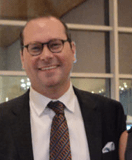
Dorough’s career spanned more than 70 years in jazz as a singer, pianist, composer, and arranger. His distinctive vocals, clever lyrics, and strong melodies were well-known in the jazz world even before his compositions and vocals for the animation series “Schoolhouse Rock!.”

Born in Arkansas and raised in Texas, hepivoted toward jazz after hearing Benny Goodman and Harry James recordings. During a three-year-stint in the U.S. Army from 1943-45, he worked as an arranger and musician in a Special Services band, then earned a bachelor’s degree in composition at North Texas State Teachers College (now known as the University of North Texas) in 1949.

Dorough relocated to New York City to continue his studies at Columbia University and immersed himself in the vibrant local jazz scene.  After spending six months working at the famed Mars Club in Paris, France, he returned to the U.S. and settled in Los Angeles, performing as pianist-vocalist in clubs and as supporting act between sets for comedian Lenny Bruce. Dorough’s first album, Devil May Care, was released in 1956.

In 1962, Dorough was working on the East Coast when he received a call from Miles Davis who he had met several years before in Los Angeles, asking him to write a Christmas song for him to record. Dorough composed “Blue Xmas (To Whom It May Concern)” and sang it with Davis as well as another track, “Nothing Like You,” used as the closing track of Davis’ album Sorcerer in 1967.

In 1972, Dorough was hired by a New York advertising firm to set the multiplication tables to music to make them easier to learn. It was decided that the songs would make good animation, and Tom Yohe put artwork with the music to create Schoolhouse Rock! Dorough became the musical director of the television series, enlisting other well-known jazz musicians to help write and perform the songs. The animated educational series became a staple of the ABC network’s children’s programming for more than two decades.

In 1998, he was inducted into the Arkansas Jazz Hall of Fame.  The Arkansas Arts Center Children’s Theatre has performed the stage adaptation of “School House Rock Live!” (which was created by Arkansan and AAC alum Scott Ferguson and performed all over the country).

On April 15, 2019, the NEA will host a free concert celebrating the Jazz Masters at the John F. Kennedy Center for the Performing Arts in Washington, D.C.

Beginning in 1982, NEA has bestowed the Jazz Master honor on more than 150 people connected to the jazz genre, including Ella Fitzgerald, Miles Davis, Dianne Reeves and George Wein. Individuals first are nominated by the public, with an NEA-convened panel assessing the nominations before the National Council on the Arts reviews the recommendations and forwards them along to the NEA chairman, who makes the final decision.

Todd Herman departs Arkansas Arts Center

On Wednesday, July 11, 2018, Dr. Todd Herman, announced to Arkansas Arts Center staff that he will be leaving to take a position in North Carolina.  His last day at Little Rock’s art museum will be August 10.

Formal announcement of the new position is expected to be made on Thursday, but local media broke the story on Wednesday evening.

Herman, who joined the AAC in 2011, succeeded Nan Plummer as director, who served from 2002 to 2010. She was preceded by longtime director Townsend Wolfe, who led the AAC from 1968 to 2002. Between 1961 and 1968, the Arts Center had a revolving door of directors and acting directors including Muriel Christison (1961), Alan Symonds (1962-1964), William H. Turner (1964-1965), and Louis Ismay (1966-1968).  William Steadman (1958) and George Ware (1959-1960) lead the museum as it transitioned from the Museum of Fine Arts to the Arkansas Arts Center.  Nettie L. Robinson was the director of the original Museum of Fine Arts from its opening in 1937 until her retirement in 1957.

T. Laine Harber, the Arts Center’s Chief Operations Officer/Chief Financial Officer will be Interim Director while a search is conducted for Herman’s replacement.

Work continues on the planning for the expansion and enhancement of the Arts Center which is currently slated to be completed in 2022.

Arkansas Rep reports much progress as they continues steps to their Next Stage

Two months since the Arkansas Repertory Theatre announced it would suspend productions due to significant cash flow issues, fiscal year end reports show significant progress being made in efforts to save the state’s largest nonprofit, professional theatre.

“As of June 30, The Rep is now current with all of its trade vendors and has secured operations and current staff through August 14,” said Ruth Shepherd, Rep board chair and interim leadership team member.

Reporting an emergency deficit of $750,000, The Rep Board of Directors decided earlier this year to suspend productions, resulting in the layoff of two-thirds of its administrative and artistic staff, as well as the cancellation of the final show of the theatre’s 2017-2018 season.

Now concentrating on rebounding from the current financial crisis, Rep leadership has pledged to reassess, refocus and revision a theatre which is professional, affordable and sustainable. The board of directors has appointed an interim leadership team consisting of Shepherd, fellow board member Bill Rector and Rep founding artistic director Cliff Baker.

Since “going dark” on April 24, The Rep has received almost 900 gifts totaling more than $422,000 and has secured two challenge grants – one from the John and Robyn Horn Foundation and another from the Windgate Charitable Foundation – valued collectively at $1,025,000.

The theatre has also finalized the sale of Peachtree Apartments, a 16-unit complex used for actor housing that has been among The Rep’s real estate holdings for more than 30 years. Proceeds from the sale will effectively cut The Rep’s property debt “almost in half,” according to Rep interim leadership team member Bill Rector, who negotiated the sale for The Rep with Rick Freeling of RPM Group representing buyers Mark Brown and Jill Judy. The sale closed on June 20.

Shepherd said a steering committee comprised of more than 60 community and business leaders are working with the Rep Board of Directors to develop a plan targeted for presentation in mid-August for the future of the 42-year-old beloved Arkansas cultural institution.

“Continuing campaign goals include creating board-directed funds such as operating and facilities reserve funds and a subscription escrow,” said Shepherd. “Such funds will enable The Rep to operate with a more fiscally sound business model moving forward. At this point, every gift to The Rep is about our future.”

“So, while the news is good, it is not yet great,” said Shepherd. “There is still a lot of hard work to be done, but we are certainly feeling more confident that with the continued support of our audiences and community, we will ultimately come out of this unfortunate situation with a stronger and more resilient theatre.”

Arkansas Repertory Theatre was founded in 1976 with a mission to produce a diverse body of work intended to illuminate the human condition through great storytelling and is the largest non-profit professional theatre company in the state. Having produced more than 350 shows (including 40 world premieres), the 377-seat theatre is located in downtown Little Rock where it serves as the anchor of the city’s Creative Corridor.

Another Judge Kavanaugh: William Marmaduke Kavanaugh

On March 3, 1866, William Marmaduke Kavanaugh was born in Alabama. He later moved with his family to Kentucky before coming to Little Rock as a newspaper reporter.

Kavanaugh served as editor and manager of the Arkansas Gazette before entering politics.  From 1896 until 1900, he served as Pulaski County Sheriff, which at the time also included the duties of tax collector.  From 1900 until 1904, he was County Judge of Pulaski County.  In that capacity he helped wrangle several cities, railroads and trolley lines to create a compromise which lead to the completion of the Third Street Viaduct which connected Little Rock with Pulaski Heights. It is still in use today.

After leaving his post as County Judge, he had a varied career in banking and business interests.

When Senator Jeff Davis died in early January 1913, he left the last few weeks of his term incomplete as well as the new term he was set to start in March 1913.  There was much interest in who would fill the remainder of Davis’ current term, because that person might be the frontrunner to also fill out the new term.  (This was at the time that the U.S. Senators were still selected by state legislatures.) Defeated Governor George Donaghey appointed J. N. Heiskell to fill out the term. But once the Arkansas General Assembly convened in mid-January, they overrode Donaghey’s appointment and replaced Heiskell with Kavanaugh.

Kavanaugh served in the Senate from January 29, 1913 until March 3, 1913.  He was succeeded by Joseph T. Robinson who had only recently taken office as Governor.  Speculation was that Kavanaugh would not want the full six year term, so that he was acceptable choice to all of the politicians jockeying for the full appointment.  From 1912 until 1915, he was an Arkansas member of the Democratic National Committee.

Another interest of Kavanaugh’s was baseball.  He served as president of the Southern Association minor league starting in 1903.  The baseball field in Little Rock situated at West End Park was named Kavanaugh Field in his honor.  It stood until the 1930s when it was replaced by what is now known as Quigley Stadium.  (In 1927, Little Rock High School had opened on the land which had been West End Park.)

Kavanaugh died on February 2, 1915 at the age of 48.  He is buried in Oakland Cemetery.

Prospect Road was renamed Kavanaugh Boulevard in his memory.

Little Rock Look Back: Plans Approved for new City Hall in 1906. But will it be built?

The 1906 plans for City Hall with the Municipal Auditorium on the left portion.

On July 9, 1906, the Little Rock City Council approved Resolution 281 and Ordinance 1,295. These actions approved the plans for a new City Hall complex to be constructed on land at the northwest corner of Markham and Broadway Streets.  A few days later, the contract was awarded for the construction of the new building.

Mayor Warren E. Lenon had first called for a new city hall complex in his annual address in April 1904. He repeated his request in April 1905.   The City Council took up Mayor Lenon’s quest for a new city hall in December of 1905.  The Council appropriated money for the purchase of land for a city hall, jail and auditorium.

In response to this, the Arkansas Gazette daily newspaper ran a story featuring the viewpoints of a few civic leaders weighing in on the need for a new city hall complex which would also include a new jail and a city auditorium.  Two of the respondents, L. B. Leigh and P. Raleigh, stressed the need for paved streets and better sewers instead of a new city hall and auditorium.

The other three businessmen interviewed were more favorable to Mayor Lenon’s proposal.  Morris M. Cohn, a former Little Rock City Attorney, stated “I do not think we can make a better investment than in a fine city hall and auditorium.”  (Mr. Cohn, though an M. M. Cohn, was not related the M. M. Cohn who was the namesake for the longtime Little Rock department store.) County Judge William Marmaduke Kavanaugh offered his satisfaction with the action of the City Council on that matter.  R. E. Walt, a banker, opined that he thought $150,000 was not enough; he suggested $200,000 should be spent.

Later that month the Gazette reported that a site had been selected for the city hall and auditorium complex.  The proposed location was most of a city block located at the corner of Markham and Broadway Streets.  Mayor Lenon was vague as to the details of the deal because negotiations were still underway with the property owners

As 1906 dawned, Mayor Lenon and other city leaders continued to take steps to build the new city hall and auditorium.  They invited three local architects to make presentations for the chance to design the new complex.  The three were Charles L. Thompson, Frank W. Gibb and George R. Mann.  Mr. Thompson was chosen to receive the assignment.

On February 5, 1906, Mayor Lenon announced the creation of a special committee to work on the planning for a future city hall complex.  This committee consisted of Aldermen Louis Walther, A. B. Poe, L. N. Whitcomb, Christopher Ledwidge, and John A. Adams.

Mayor Lenon further stated that the new city hall complex and several private developments would “put us in that march of progress with which nothing can prevent us from having a 100,000 population in a few years.”

The saga to get the building built was just starting.

Little Rock Look Back: LR City Council authorizes expansion of Museum of Fine Arts

Twenty-two years after authorizing the creation of the Museum of Fine Arts in City Park, the Little Rock City Council was asked to consider expanding the facility.
By 1957, the existing structure was felt to be inadequate.   There was a desire for more gallery space as well as for more space for educational programming.

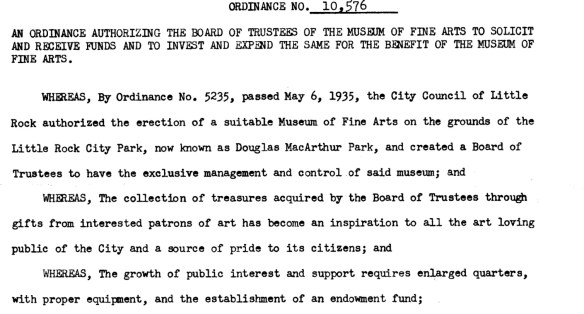
On July 8, 1957, the Little Rock City Council passed an ordinance authorizing the Board of the Museum of Fine Arts to be able to raise the funds for an expansion.  This was merely the start of the process which would eventually lead to the creation of the Arkansas Arts Center.

The ordinance allowed for the expansion or extension of the building. It also authorized the museum’s board to accept gifts for the project and to invest those gifts for the purpose of the museum.  Since the museum only received City funds for maintenance and salary, the ability to raise funds for the expansion was key to the future of the institution.

Lastly, the ordinance gave the museum’s board the ability to increase its membership by up to six positions without having to get additional approval by the City Council.  With a fundraising drive underway and a larger facility planned, these additional board members could certainly prove to be key.

The ordinance passed with nine Ayes, zero Noes, and one absent.