
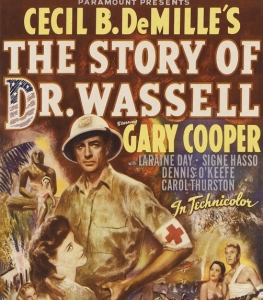
World Premiere of THE STORY OF DR. WASSELL movie in Little Rock

All right Mr. DeMille, Little Rock was ready for its close up.

From April 24 to 26, 1944, Cecil B. DeMille was in Little Rock for the world premiere screening of The Story of Dr. Wassell.  This 1944 Paramount Pictures Technicolor release told the story of wartime hero Dr. Corydon Wassell.

Why was Little Rock chosen?  It was the hometown of Dr. Wassell.  His paternal grandfather, John Wassell, was Little Rock’s 27th mayor.  His first cousin, Sam Wassell, was serving on the City Council at the time of the film’s release and would become Little Rock’s 51st mayor.

Based on a book by James Hilton, it was inspired by the heroic efforts of Dr. Wassell, a naval officer, as he led the evacuation of several sailors (and treated their wounds) in Java in February 1942.  President Roosevelt highlighted Dr. Wassell in his May 26, 1942, fireside chat.

Little Rock rolled out the red carpet (literally and figuratively) for DeMille and a contingency from Hollywood.  Dr. and Mrs. Wassell also returned to Little Rock for the festivities.  Unfortunately, Gary Cooper (who played Wassell in the film) was unable to attend due to illness.  His costar, Laraine Day, was making another film and could not attend either.    Those in attendance with DeMille (and Mrs. DeMille) included actresses Signe Hasso and Carol Thurston, and actor Melvin Francis.  The latter played himself; he had actually been one of the sailors saved by Dr. Wassell.

On April 24, 1944, DeMille and Dr. Wassell appeared on a radio program broadcast live from the music hall of Robinson Auditorium.  The next day, the troupe toured Camp Robinson and spoke to the soldiers there.  Later that day, Miss Hasso and Miss Thurston sold war bonds at Pfeiffers and M.M. Cohn’s.

April 26, 1944, was a full day for the DeMilles, the Wassells, and the others.  It started with a luncheon at the Hotel Marion, hosted by the Lions Club and Little Rock Chamber of Commerce.  Governor Homer Adkins presented DeMille with an Arkansas Traveler certificate.  DeMille, in return, presented Governor Adkins with a copy of the script.

When it was Dr. Wassell’s time to speak, he praised Little Rock’s efforts on the home front.  He also asked for a standing tribute to longtime Little Rock school superintendent R.C. Hall, who had died the day before.  Dr. Wassell had taught with Mr. Hall decades earlier.

Following the lunch, there was a parade on Main Street.  It started at 10th and Main and proceeded to Markham before ending at the War Memorial Building (now the Old State House Museum).  Newspaper accounts said that it was four miles long and featured many military units and marching bands.

Dinner that evening was at the Lafayette Hotel before screenings of the movie at the Capitol and Arkansas Theatres. Both screenings were sold out.  On April 27, 1944, a regular run of the movie started at the Capitol Theatre.  It would be released nationally on July 4, 1944, which also happened to be Dr. Wassell’s birthday.

A GAME OF THRONES themed Science After Dark tonight at the Museum of Discovery

Science After Dark is Coming…on Thursday, April 25.
When you play this game of thrones, you win (you won’t die…you’re welcome.) Brace yourself for an evening of adventure in fantasy as we explore some of the science behind your favorite show. Admission is $5 or free for members. You must be at least 21 to enter.

-Fighting Arena Demos with Society for Creative Anachronism (SCA) local branch The Barony of Small Gray Bear at 6:30 p.m., 7:30 p.m. & 8:30 p.m.
-Dragon-like animals
-“Did your Family Battle for the Throne?” (or maybe just over cattle) Genealogy with Central Arkansas Library System (CALS) – Butler Center
-Archery with Arkansas Game and Fish Commission
-Thrones with Baron & Barroness
-“Winter is Coming” (Destroying things with Liquid Nitrogen)
-Pelts and Furs with Old State House Museum
-Sinking ships with fire Crossbows (Whoa.)
-Weapon Throwing
– Arkansas Poison and Drug Information Center
– MacArthur Museum of Arkansas Military History
And much, much more!!

Tickets are $5 or free for members and may be purchased at the door or online at https://museumofdiscovery.org/event/april2019/. Each Science After Dark, we will support a local charity and this month we are accepting donations for Arkansas Foodbank. You can also sign up to volunteer with us at the Foodbank on Tuesday, June 11 from 6-8 p.m. at http://cerv.is/m?0334gpyrxNj!

Presenting sponsors are Fassler Hall Little Rock and Dust Bowl Lanes & Lounge Little Rock and sponsors are Rock Town Distillery and Stone’s Throw Brewing

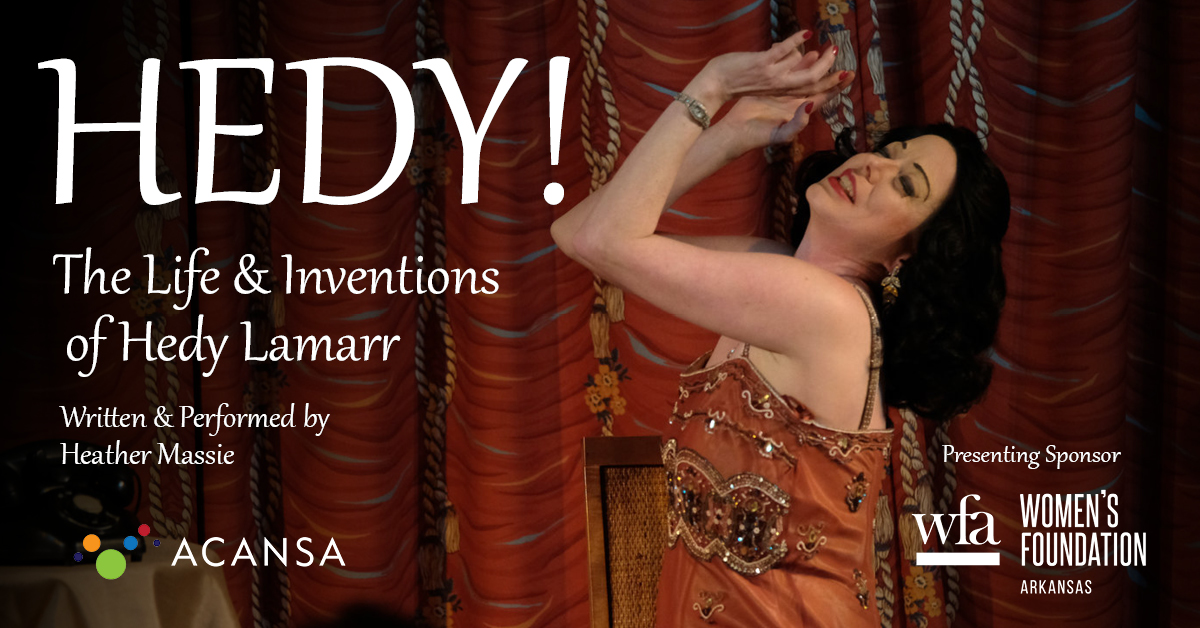
Learn about the life and times of Hedy Lamar in HEDY! tonight presented by ACANSA

Hedy Lamar.  If she is remembered today, it is probably as a screen siren in the golden days of Hollywood.  Written and performed by Heather Massie, this award-winning one-woman show highlights that she was much more than that.  It explores the life, inventions, and person of Lamarr,a  Viennese-born Hollywood film star of the 1930s-50s.

“Hedy Lamarr, glamorous siren of the silver screen, was more than the most beautiful woman in the world. She invented frequency hopping and spread spectrum technology that make the world of wireless communication tick. From Austria to Hollywood, WWII, torpedoes, ecstasy, and intrigue to the very cell phone in your pocket, she was there!”

The performance begins at 7pm tonight at the Argenta Community Theatre.  It is presented by ACANSA Arts Festival.

Business in Early Arkansas is topic of Old State House Museum’s Brown Bag Lecture Today

The Old State House Museum offers a Brown Bag lunch lecture series throughout the year.  Up next is “The Business of Business in Early Arkansas.”
On Thursday, April 25, from Noon – 1pm, Will Nipper explores the interaction of different national and Native American cultures in trade and commerce before the Louisiana Purchase, including the fur trade, mercantile goods, and the introduction and exchange of coins and currency.
Will Nipper is a business consultant, historian, and author of “In Yankee Doodle’s Pocket: The Myth, Magic & Politics of Money in Early America.”

Start of Little Rock’s park system with land swap to create Arsenal Park

April 23, 1892, marked the beginning of the City of Little Rock’s public park sLR City Parkystem.  On that date, the City officially took possession of land which would become what is now known as MacArthur Park.
The park land had originally served as a horse racetrack in the early days of Little Rock.  By 1836, the federal government purchased the land for construction of a military arsenal.  The flagship building, the Arsenal Tower building, is the only remaining structure from that time period.

The land served as a military outpost until 1892.  On April 23, 1892, a land swap took place where in the City of Little Rock was given the property with the stipulation that it would be “forever exclusively devoted to the uses and purposes of a public park.” (Never mind that the federal government took part of the land back for the construction of the Wilbur Mills Freeway.)  In return for giving the City this land, the federal government took possession of land on the north side of the Arkansas River (then part of Little Rock) – that 1,000 acres became Fort Logan H. Roots.

After clearing most of the buildings from the land and preparing it for recreation, the park opened on July 4, 1893, with the name Arsenal Park. Since it was the City’s first and only park at the time, residents started referring to it as City Park. In time, the designation Arsenal Park fell from use.  In fact, it is referred to as City Park exclusively and officially in City documents throughout the first 42 years of the 20th Century.

The City Council’s action to name it MacArthur Park in March 1942, was accompanied by petitions encouraging the action which were submitted by the Arkansas Authors and Composers Society, the Arkansas Engineers Club and the Pulaski County Republican Central Committee.

City records do not indicate if anyone registered opposition to the name change. It would be another decade before General MacArthur would return to the site of his birth, a place he had not visited since his infancy.

Little Rock Look Back: Charles Moyer, LR’s 44th and 49th mayor

On April 18, 1880, future Little Rock Mayor Charles E. Moyer was born in Glenwood, Minnesota. A man of contradictions, he was both a candidate backed by (and probably personally involved in) the Ku Klux Klan, yet he also brought the Goodwill Industries organization to Little Rock and Arkansas to help those less fortunate.
He came to Little Rock shortly after the turn of the 20th century as a clerk in the Post Office, and later served as a mail carrier. He then worked for Plunkett-Jarrell Wholesale Grocer Company in Little Rock. On January 1, 1921, he took office as County Judge for Pulaski County. In 1924, he ran against incumbent mayor Ben Brickhouse in the Democratic primary. Since Brickhouse had displeased the Klan, which was an active part of Democratic politics in Little Rock and throughout the nation at the time, Moyer won the primary.

Mayor Moyer led the City of Little Rock from April 1925 through April 1929. In 1927, the last lynching in Little Rock took place. While race-baiting crowds were surrounding City Hall demanding an African American prisoner be released to them for vigilante justice, Mayor Moyer was in hiding at an undisclosed location. Not able to get the prisoner they wanted, they took out their venom on another man who had assaulted a white woman and her daughter.

Mayor Moyer sought a third term, but was defeated in the 1928 Democratic primary.  After leaving office in 1929, Moyer moved for a time to Batesville. He returned to Little Rock and was a chief deputy sheriff. From 1937 to 1941, he served as Pulaski County Assessor. In 1941, he returned to the office of Little Rock Mayor after J. V. Satterfield opted to serve only one term and did not seek re-election. Mayor Moyer led Little Rock through most of World War II. He left office in April 1945 and died on May 29, 1945, barely one month after leaving City Hall.

Little Rock Look Back: Benjamin Harrison is first current POTUS to visit LR

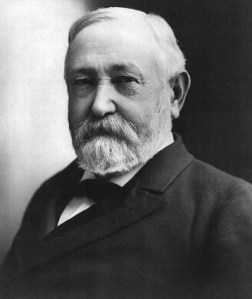
On April 17, 1891, Benjamin Harrison became the first sitting president to visit Arkansas.  He was on a cross-country railroad trip having left DC on April 13.

The morning of the 17th he spoke in Memphis and then took the train to Little Rock.  Accompanying him from Memphis to Little Rock were a delegation which included Governor and Mrs. James P. Eagle, Mayor H. L. Fletcher and Col. Logan H. Roots.  Also in the party was Mrs. W. G. Whipple, a former first lady of Little Rock.

They arrived in Little Rock in the afternoon.  A parade took them from the train station to the State House (now the Old State House Museum) where the Governor formally welcomed the President and his party.

In his brief remarks, President Harrison spoke of the hospitality and the natural resources available in Arkansas.  He also touched on the Civil War, which at the time was less than 30 years in the past. He noted “The commonwealth rests upon the free suffrage of its citizens and their devotion to the Constitution and the flag is the bulwark of its life.  We have agreed, I am sure, that we will do no more fighting among ourselves.” These remarks were met enthusiastically by the crowd assembled.

The President concluded is brief remarks thanking the State officials and the citizenry.  He then took the train to Texarkana where he made his third set of remarks of the day.

Benjamin Harrison was on the Presidential ticket two times. The first time he lost the popular vote but won the Electoral College defeating incumbent Grover Cleveland. The second time he lost both the popular and electoral votes to Cleveland.  He did not carry Arkansas in either election. Though he was the first sitting president to visit Little Rock, there is nothing here named for him.  Since there was already a Harrison Street named after his grandfather, he is skipped between Cleveland and McKinley in the presidential streets.