Kevin Robb’s SERENADING THE CLOUDS to be installed today

Looking UpStaff from the City of Little Rock Department of Parks and Recreation, in partnership with Deltic Timber and Sculpture at the River Market, will install Kevin Robb’s Serenading the Clouds, a 19-foot-tall brushed stainless steel sculpture near the intersection of Rahling Road and St. Vincent Way.

The piece was purchased by Sculpture at the River Market with assistance from Deltic Timber to be enjoyed by the public as they travel through the area.  Iconic public art can serve as a landmark for residents, employees, and visitors.

Kevin Robb’s Serenading the Clouds is a unique design for him because it has an even number of components.  Four components take a special design to ensure the sculpture is strong and not repetitive, bringing the dynamics of space into the design that doesn’t come naturally.

The stainless steel is cut out and the individual components are welded together. When the components are 80% complete he then starts assembling them. The individual elements are hung from a crane system in his studio allowing them to turn, twist, raise, and move.  Once he is pleased with the direction of the components, they are marked, taken down, and cut into one another so they can be conjoined into a continuous piece.  It is never exact to the sketch, the sketch becomes the general idea, the creation happens in the studio.

Serenading the Clouds soars into the air at 19 feet and is 8 feet in width. It commands space and deals with the space around it with the strong, positive presence it displays. The brushed stainless steel finish catches the light in so many different ways.

Robb’s Playing Ball is located at the roundabout on Rebsamen Park Road at Riverfront Drive.

Creative Class 2016: Dave Anderson

cc16-andersonDave Anderson is an award-winning cross media storyteller best known for his work behind the lens. His photography and films have been exhibited, published, screened and lauded across the planet.  Anderson’s work has been profiled on numerous media outlets ranging from Good Morning America to The New York Times to The New Yorker, where Vince Aletti called Anderson’s photography “as clear-eyed and unsentimental as it is soulful and sympathetic.” NPR praised his films, saying they are, “in short…awesome.”

In addition to being a photographer and filmmaker, he currently serves as Winrock International’s Director of Communications and Public Affairs.  Previously Anderson worked as an adviser in the Bill Clinton White House and later oversaw MTV’s road-tripping multimedia election extravaganza, the Choose or Lose Bus, which traveled to 47 states and helped register over 250,000 young people to vote. He has spearheaded content and strategic media efforts for the White House, the U.S. Department of State, Viacom, New York University and Heifer International, among others. Anderson has shot and directed over 50 short films. His photographs can be found in the collections of museums and galleries in the United States and abroad, and have been exhibited across Europe, Asia and the U.S. His editorial photography has been featured in the pages of EsquireSmithsonian and Time among other publications. His long-running video series SoLost (for the Oxford American) won a National Magazine Award, and he has been recognized by the National Association of Black Journalists.

Happy Father’s Day with Rabbit Reach

Cherry - Rabbit ReachToday is Father’s Day.  In honor of that, today’s Sculpture Vulture revisits Tim Cherry’s Rabbit Reach.  The sculpture was given in memory of two fathers.

The sculpture is a gift from Whitlow Wyatt and the Carey Cox Wyatt Charitable Foundation. It was given in memory of George Wyatt and Frank Kumpuris.  Those two gentlemen were the fathers of Whitlow Wyatt and Dean & Drew Kumpuris.

The sculpture is located at the corner of Sherman Street and President Clinton Avenue across from the Museum of Discovery.

Cherry’s sculpture was selected for this spot because of its proximity to children at the Museum and in the River Market district.  The design and size of the sculpture encourages children to climb on it and to play around the rabbit.

While some public art is situated so it cannot be touched, this one is situated to be touched as part of the appreciation experience.

Rabbit Reach received national publicity in 2015 when Melissa Joan Hart featured it on her social media while she was in Little Rock filming a movie.

Arkansas Heritage Month – The architecture of AIA/ALA award winning CALS libraries by Polk Stanley Wilcox

To encourage excellence in the architectural design and planning of libraries, the AIA and the American Library Association/Library Administration and Management Association created this award to distinguish accomplishments in library architecture.  In 2011 and again in 2015, Polk Stanley Wilcox won the award for projects designed for the Central Arkansas Library System.

AIA ALA PSW ASIThe 2011 award went to for work on the Arkansas Studies Institute.  This actually combines three buildings of three different centuries and construction types into one architectural timeline, evoking imagery of pages of an opening book.

The Arkansas Studies Institute is a repository for 10 million historic documents and the papers of seven Arkansas Governors, including President Bill Clinton. Located in a thriving entertainment district comprised of rejuvenated warehouses near the Arkansas River, the design combines significant, but neglected buildings from the 1880’s and 1910’s with a new technologically expressive archive addition. This creates a pedestrian focused, iconic gateway to the public library campus – and the public face of Arkansas history.

The design philosophy is based literally on the book – a physical container of information, with pages flowing into a site-sensitive narrative of the building’s function. Taking cues from the medium for which the Institute was created, the entrance acts as an abstract book cover, pulled away from the building as a double wall, defusing western sunlight and heat in the atrium beyond.

Public Spaces – galleries, a café, museum, and meeting rooms – enliven streetscape storefronts, while the great library research hall encompasses the entire second floor of the 1914 warehouse building. A thin atrium pulls the new structure away to protect the old, stretching the building’s length and flooding all levels with light – a key sustainable strategy. 100 historic images in glass handrails signify that architecture can and should actively engage in storytelling. Suspended bridges span the gap between new and old, open and secure, today and yesterday.

The Arkansas Studies Institute weaves history, research, pedestrians, and a restored streetscape together, healing a gaping wound in the urban fabric, while expanding environmental stewardship into the public realm and serving as a beacon of knowledge.

AIA ALA PSW HRCCLCIn 2015, the award went to PSW for their work on the Hillary Rodham Clinton Children’s Library and Learning Center.

Based on experiential learning where hands-on education teaches life skills needed to become responsible adults, a new Children’s Library and Learning Center boosts hopes for a neglected neighborhood, serves as an exemplary tale of urban renewal, and acts as a beacon of hope for an entire city.

This “community embedded, supportive learning center” offers not only books, but also a performance space, teaching kitchen, greenhouse, vegetable garden, and an arboretum. It is the state’s first library holistically imagined as a children’s education destination. The Library Director’s challenge was to create a “playground without equipment” where nature and imagination create grand adventures on an abandoned six acre site in the heart of the capital city. A charrette with youth uncovered a surprising and heartbreaking result: their top desire wasn’t for the latest video game technologies… it was food security. They wanted to learn how to feed themselves. Children also desired a place that was uplifting, inspirational and full of natural light, while in contrast feeling safe, secure, and sheltered. They wanted a place that “lifted expectations”.

An interstate highway—the railroad tracks of our generation—split Little Rock 40 years ago and destroyed a unified city grid, contributing to racial and socioeconomic divisions that separated citizens physically and emotionally. The site’s border condition became a national symbol for gang violence when featured in a 1990’s HBO documentary. Its opposite side, however, continued to be the city’s version of New York City’s Central Park—the place to live, work, and play. The design team’s overarching idea was centered on three moves: bridge the gap by stretching the park across the highway, create a library that is “the place to be” for all children, and develop civic pride in an underserved neighborhood, helping to mend partitions that have plagued the city for so long.

Landscape ecology and urban connectivity themes provide experiential education. Children see natural vegetation representing the state’s varied ecological regions from the Ozark Highlands to the Mississippi Delta. Two bus lines within a quarter mile assure access from distances, while the hundreds of children living within a half mile can walk or bike. An instructional greenhouse, gardens, and teaching kitchen allow children to cultivate, harvest, prepare meals, and sell produce in a planned farmer’s market. A full time ‘Environmental Educator’ oversees programs, teaching proper use of water, energy, and resources, and how we keep healthy through decisions made within the built environment. The lobby’s smart monitors can display real time water and energy consumption. Mechanical and structural systems are purposefully exposed so operations and construction methods can be discussed.

While this Library exceeded expectations by achieving LEED Gold, the true measure of success beyond points is the neighborhood’s feel, which shifted from dangerous to full of life and pride. The library is a safe zone and home to a sustainable-minded community.

Arkansas Heritage Month – Celebrities and Celebrations open Arkansas Arts Center on May 18, 1963

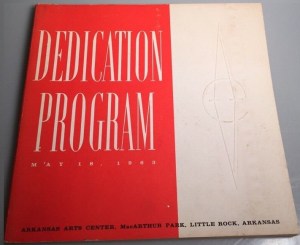
AAC opening programOn Saturday, May 18, 1963, amidst fanfare and fans of the arts, the Arkansas Arts Center officially opened its doors.  (This was thirty-five years and three days after the Fine Arts Club had opened the first permanent art gallery in Arkansas in the Pulaski County Courthouse).

The dedication ceremonies on May 18 featured U.S. Senator J. William Fulbright (who was in the midst of championing what would soon be known as the John F. Kennedy Center for the Performing Arts), Congressman Wilbur Mills, Governor Orval Faubus, Little Rock Mayor Byron Morse, Winthrop Rockefeller and Jeanette Rockefeller.

On Friday, May 17, 1963, film star Gordon MacRae performed two separate concerts in the theatre space.  There were other assorted small events and tours on May 16 and 17.

The culmination of the weekend was the Beaux Arts Bal.  This black tie event, featured Oscar winner Joan Fontaine, cartoonist Charles Addams (creator of The Addams Family), James Rorimer of the Metropolitan Museum, and Dave Brubeck.  Chaired by Jeane Hamilton, the event set a new standard for events in Little Rock.

Among the exhibits at the Arkansas Arts Center for the grand opening was a special exhibit from the Metropolitan Museum of Art in New York entitled Five Centuries of European Painting.  In Little Rock for six months, this exhibit featured works by El Greco, Titian, Claude Monet, Odilon Redon, Pierre Renoir, Paul Signac, Edgar Degas, and Paul Gauguin among many others and spanned from the fifteenth century Early Renaissance era to the nineteenth century.

Prior to the opening, a profile on the Arts Center in The Christian Science Monitor touted the building as one of the first regional arts centers in the country to be completed. Benefiting from national ties of the Rockefeller family, the events in May 1963, set a high standard for the institution, and for other regional art museums.

Arkansas Heritage Month – The Architecture of Little Rock Central High School

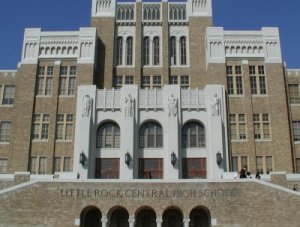
centralentranceArchitecture is often overlooked when considering the arts, but it is definitely an art form.

Built in 1927 as Little Rock Senior High School, Central was named “America’s Most Beautiful High School” by the American Institute of Architects. The New York Times called it the most expensive high school built at the time.

Designed as a mix of Art Deco and Collegiate Gothic architectural styles, the building is two city blocks long and includes 150,000 square feet of floor space. The project involved most of Little Rock’s leading architects who were still practicing at the time: John Parks Almand, George H. Wittenberg and Lawson L. Delony, Eugene John Stern, and George R. Mann.  Over the years, different architects would take credit for various facets of the building.  Given the size of the project, there was plenty of work for each architect to do.

More than 36 million pounds of concrete and 370 tons of steel went into the building’s construction. The building contained 150,000 square feet of floor space, upon its completion. It cost $1.5 million to construct in 1927. The school received extensive publicity upon its opening. An article in the Arkansas Gazette said, “we have hundreds of journalists in our fair city for the dedication” of the new high school.

At its construction, the auditorium seated 2,000 people between a main level and a balcony.  The stage was sixty feet deep and 160 feet long so that it could be used gymnasium. From 1927 until the opening of Robinson Auditorium in 1940, the auditorium would be Little Rock’s main site for hosting performances by musical and theatrical groups.

Subsequent additions would include a separate gymnasium, a library, and a football stadium. In 1953 the school’s name was changed to Little Rock Central High School, in anticipation of construction of a new high school for students, Hall High School.

In 1977, the school was listed on the National Register of Historic Places, and it was designated a National Historic Landmark in 1982. These were in recognition of desegregation events which took place in the school in 1957.

In 1998, President William Jefferson Clinton signed legislation designating the school and visitor center across the street as a National Historic Site to “preserve, protect, and interpret for the benefit, education, and inspiration of present and future generations…its role in the integration of public schools and the development of the Civil Rights movement in the United States.”

Arkansas Heritage Month – Jim Dailey

cna_commissioner_daileyDuring his years of public service, Little Rock Mayor Jim Dailey was a dedicated supporter of the arts. He has been involved in support of the arts prior to and after leaving office, but he was a 2005 Governor’s Arts Awards recipient in recognition of his work while in office.

Mayor Dailey’s understanding of the importance of the arts was essential to the revitalization of downtown Little Rock and the development of the River Market district. Little Rock’s arts district has become home to several art galleries and the 2nd Friday Night Art Walk and provides venues for local and regional musicians.

Other examples of Mayor Dailey’s leadership in the arts include the City of Little Rock’s support of the expansion and renovation of the Arkansas Arts Center and support of the establishment of the Kramer School Artists Cooperative, which provides residential and studio space for artists.  He was also a key player in the location of the Clinton Presidential Center in Little Rock.

The City of Little Rock doubled the number of art institutions it helps fund under Mayor Dailey’s tenure and has developed an Arts & Culture Commission to continue to integrate the arts into the daily fabric of city life. Mayor Jim Dailey has demonstrated outstanding leadership and commitment to the development of the arts community in Little Rock.

While in office, most Tuesday nights he would be a City Hall presiding over a City Board meeting. But many Monday nights he would be found at the Arkansas Arts Center taking a class a the museum school.

Since leaving office, Mayor Dailey has continued to explore art galleries and museums as he travels throughout the United States.  He also served as one of the three co-chairs for the successful campaign to renovate Robinson Center Music Hall. The building is set to reopen in November 2016.