Little Rock Look Back: Louis Armstrong

SatchmoLouis Armstrong was born on August 4, 1901 in New Orleans.  As he rose to fame, he would play Little Rock numerous times in a variety of venues.

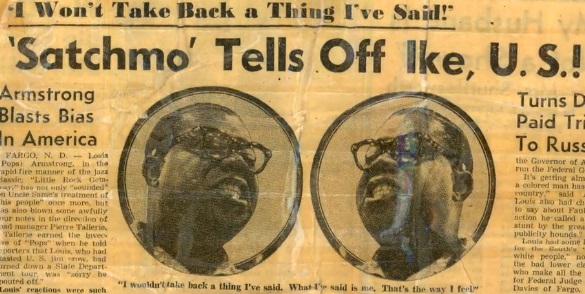
As the Civil Rights movement started taking hold in the mid-1950s, many African American entertainers were vocal in their support.  Armstrong stayed silent.  Until, that is, September 17, 1957.  That night, in Grand Forks, North Dakota, he blasted President Dwight Eisenhower for his lack of action to make Governor Orval Faubus obey the law.  This was in an interview conducted by a 21 year old University of North Dakota journalism student named Larry Lubenow.

Journalist David Margolick wrote about the incident in The New York Times in September 2007 in conjunction with the 50th anniversary of the integration of Little Rock Central High School.  He recounted how the story, written for the Grand Forks Herald, was picked up all over the country.  The entire Margolick piece can be read here.  Margolick tells that when Armstrong was given the chance to back off the comments, he asserted that he meant all of it.

On September 24, 1957, the night that the 101st Airborne was being mobilized to come into Little Rock, Armstrong sent Eisenhower a telegram again criticizing him for lack of action.  He used colorful language which sarcastically spoofed the “Uncle Tom” moniker which some of his critics had bestowed when they felt he was not doing enough for Civil Rights.  The Eisenhower Presidential Library has a copy of that telegram.  The incident between Satchmo and Ike was the basis for two different plays: Terry Teachout’s Satchmo at the Waldorf and Ishmael Reed’s The C Above C Above High C.

Armstrong would again play a part in Little Rock’s Civil Rights history.  In September 1966, he played the first major concert in Robinson Auditorium that was before a fully integrated audience.  Since the early 1960s, there had been a few sporadic concerts which had been before integrated audiences. But the policy of the Auditorium Commission remained that the building was to be segregated.  Following the approval of the 1964 Civil Rights Act, public facilities had to be integrated. Louis Armstrong played before a full house at Robinson Auditorium that night.

Little Rock Look Back: Mayor William Whipple

whippleOn August 4, 1834, future Little Rock Mayor William G. Whipple was born in Connecticut.  He attended school in Massachusetts and graduated from Wesleyan University. After studying law at Albany Law School, he moved to Milwaukee, Wisconsin.

In 1868, Whipple moved to Little Rock following the 1866 death of his first wife in Wisconsin. Long active in Republican politics, he quickly became involved in Little Rock’s political and social life.  Shortly after his arrival he was appointed United States Attorney and served three years.

In 1870, he married Mary S. Dodge, daughter of former mayor Roderick Lathrop Dodge MD.  They had one son Durand, who followed his father into the legal profession. The Whipples were active members of Trinity Episcopal Cathedral.

In 1887, Whipple was elected Mayor of Little Rock and was re-elected two years later.  Whipple’s mayoral administration introduced electric lighting to the city beginning on September 1, 1887, paved many streets with granite and macadam, created sixty miles of new brick and concrete sidewalks, and introduced a steam dummy railway.

In 1892, he ran for Governor of Arkansas as the Republican nominee but was unsuccessful.  In 1895, he sought a third term for Mayor but was defeated by James A. Woodson.

From 1897 to 1900, he served as register of the US Land Office in Arkansas.  Whipple, who had long practiced law, was appointed United States Attorney for the Eastern District of Arkansas in 1900.  He served in that capacity until 1913.

In July 1914, Mayor Whipple died.  He is buried at Oakland Cemetery in Little Rock.

Cleanup day at William E. Woodruff House announced for Saturday, Aug 8

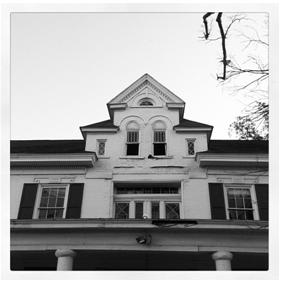
The historic Woodruff house.

The historic Woodruff house.

The QQA acquired the William E. Woodruff Housein December 2014 with the help of the City of Little Rock and the Arkansas Historic Preservation Program.   The QQA has donated interior and façade easements to protect the house in perpetuity, and we continue to work with the City and AHPP to stabilize the house and make repairs before selling it for development.

On Saturday, August 8 from 8am to 12 noon, join other volunteers at the Woodruff House (1017 East 8th Street) for a cleanup day.

The main task is basic landscape cleanup surrounding the house.  Before the house can be treated for termite damage and repaired, weeds and shrubs surrounding the foundation must be removed.  There is also trash on the property that needs to be picked up.

Volunteers must sign a waiver before working, they will be available on site.  Volunteers should wear old clothes, sturdy closed-toe shoes, and bring work gloves. If you would like to be involved but can’t join us on the 8th, you can help by donating cold drinks, snacks, or lunch to our volunteers. Contact the QQA office at qqa@quapaw.com or 501-371-0075 to make arrangements. If you have supplies you would be willing to let us borrow, drop them by QQA office, clearly labeled with your name and phone number, or just bring them with you when you volunteer.

If you’re interested in sponsoring this or future work days at the Woodruff House, please contact the QQA office at qqa@quapaw.com or 501-371-0075. 

The Quapaw Quarter Association’s mission is to promote the preservation of Little Rock’s architectural heritage through advocacy, marketing and education. Incorporated in 1968, the QQA grew out of an effort to identify and protect significant historic structures in Little Rock during the urban renewal projects of the early 1960s. Throughout its existence, the QQA has been a driving force behind historic preservation in Greater Little Rock.

Learn about Little Rock’s earliest auditorium (which also was a roller rink AND rifle range) today at noon at Old State House Museum Brown Bag Lecture

11805726_10154024863604908_1192217255_nToday at noon, the Old State House Museum will have another Brown Bag Lecture.  This one focuses on three decades of unsuccessful efforts to build a municipal auditorium in Little Rock.  That time period was filled with big dreams, lawsuits, personality clashes, disappointments, and a Roller Rink that was also a Rifle Range.

In April 1904, Little Rock Mayor W. E. Lenon spoke of the need for a municipal auditorium in Little Rock. It would take thirty-six years for that dream to be realized. Along the way there were numerous twists, turns, detours and disappointments as the saga was played out in the newspapers, courtrooms, and offices of every major Little Rock architect at the time.

Until a permanent auditorium could be found, the City made do with vaudeville houses, high schools, and even a roller skating rink which doubled as a rifle range. Over the three decades of planning for an auditorium, some names came and went, others such as Mayor Lenon, architect Charles L. Thompson and Arkansas Gazette publisher J. N. Heiskell appeared time and time again. This Brown Bag Lunch Lecture explores the time period from 1904 to 1934 as it looks at the numerous unsuccessful attempts to construct a municipal auditorium in Little Rock.

In 2016, there will be a Brown Bag Lecture to look at construction and opening of Robinson Center Music Hall.

Scott Whiteley Carter is Special Projects Administrator for the City of Little Rock. As the unofficial historian of Little Rock City Hall, he can often be found leafing through sheaves of papers in the City Clerk’s vault or furiously scribbling notes in Little Rock research libraries. He is also the author of the LRCultureVulture.comblog. A native of Little Rock, he is a graduate of Missouri State University.

Vintage Military Vehicles on display today in MacArthur Park

MacMus vintage jeepThe MacArthur Museum of Arkansas Military History will host its third annual vintage military vehicle show on Saturday, July 25, from 9:00 a.m. to 2:00 p.m.

Two dozen military vehicles from World War II through Desert Storm will be on display in front of the museum, located at 503 E. 9th Street in downtown Little Rock’s MacArthur Park.  The vehicle show will feature Jeeps and other vehicles from the Arkansas Military Vehicle Preservation Association and the West Tennessee Military Vehicle Collectors Club. Any vehicle may be displayed, so long as it was used by the military in the past.

The show appeals to those who have an interest in military history, as well as in vintage cars and trucks.    It is free to the public.

Local vendors, with items for sale, will include Bennett’s Military Supplies, Loblolly Creamery, Southern Salt Food Company, and East Ninth Vintage.


2015 Butler Center Genealogy Conference on Saturday

cals_int_sponsor_butlerTomorrow, July 25, the Butler Center for Arkansas Studies’ 2015 Genealogy Conference will take place from 9am to 4pm at the CALS Ron Robinson Theater.  The featured speaker is Lisa Louise Cooke, creator of www.genealogygems.com.

The conference is free and open to the public. Registration is required: http://www.butlercenter.org/conference/.

A lunch break of approximately 1 hour will be provided. Concessions including hot dogs, popcorn, and sodas will be available for purchase in the theater. Conference attendees are also welcome to bring a sack lunch or to purchase lunch at a local eatery, which may be brought back to the Ron Robinson Theater, if desired. Places to purchase lunch within walking distance include Bookends Cafe, the library’s coffee and sandwich shop, located next door to the theater in the Cox Creative Center; the River Market, which offers many dining options; and restaurants along President Clinton Ave.

Workshop topics will include:

Ultimate Google Search Strategies and Tips Google continues to evolve and change every day. In this session, Lisa Louise Cooke will give you an update on the most recent Google changes. Then she will unleash advanced search strategies for genealogy that you probably aren’t using, but are ‘must-haves’ in order to get the best results possible. Here are tips and tricks you can put into practice right away.

Get the Scoop on Your Ancestors with Newspapers Yearning to “read all about it?” Newspapers are a fantastic source of research leads, information, and historical context for your family history. Learn the specialized approach that is required to achieve success in locating the news on your ancestors.  Includes 3 Cool Tech Tools that will get you started.

Google Earth for Genealogy Google Earth is a 360 degree three-dimensional way to view your ancestors’ world!  In this class you will learn how to identify old photos, plot and virtually visit your ancestors’ homestead, and incorporate historic maps. Google Earth has the power to geographically document your ancestors’ lives, and lends itself very well to collaboration with other researchers. It’s one of the best online genealogical tools available, and best of all, it’s free!

How to Reopen and Work a Genealogical Cold Case Become a genealogical detective in this vital session. You’ll learn to track ancestors like a criminal cold case detective, sniffing out holes in your research and getting missing information on the record with cutting edge technology.

Meet & Greet will be held on today, July 24, 4-6 p.m. in the Arkansas Studies Institute building, room 124, 401 President Clinton Ave. This is an opportunity for genealogists to meet each other and share research experiences. If you plan to attend, please register at: http://www.butlercenter.org/conference/

Little Rock Look Back: 1944 Launch of USS Little Rock

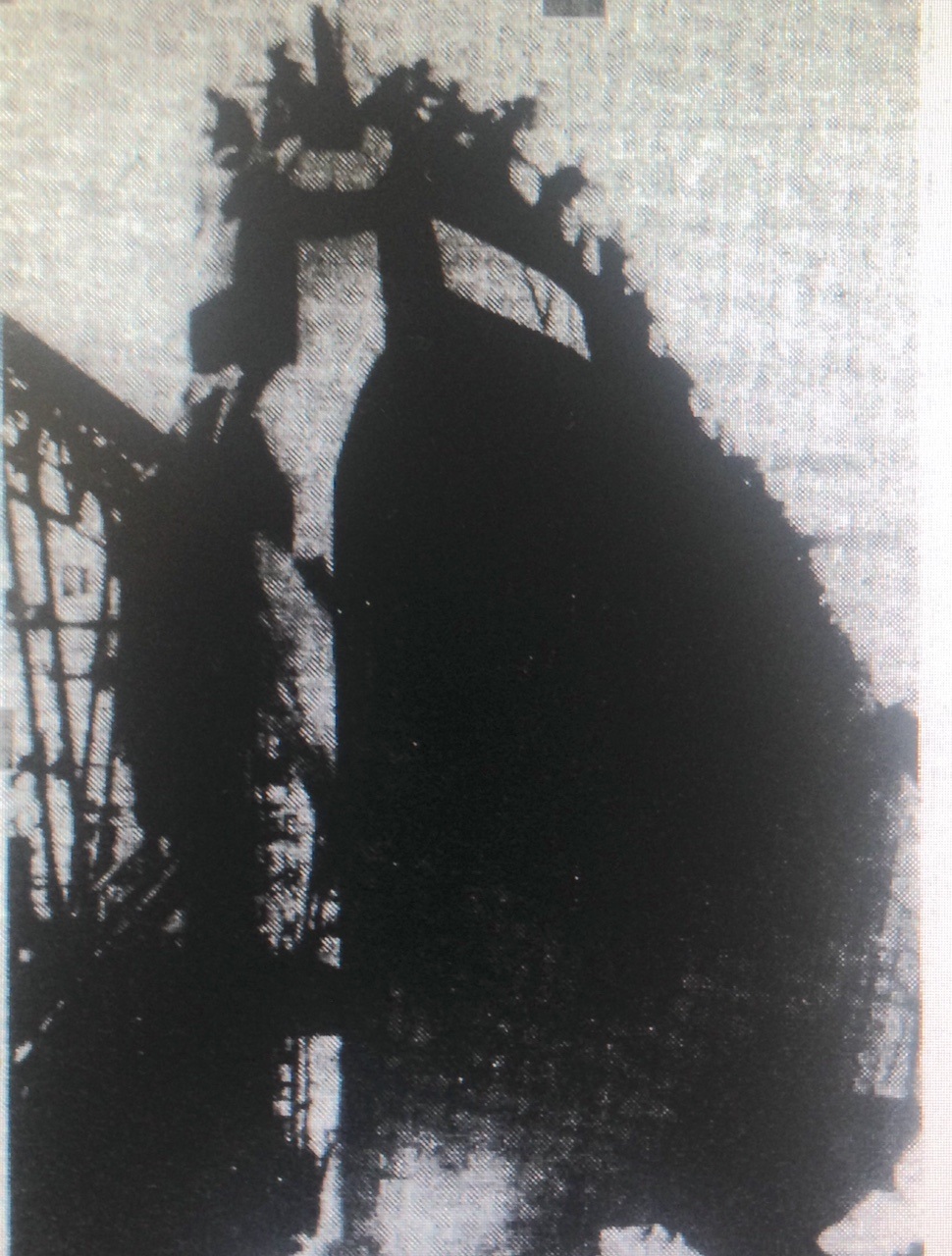
USS LR 1944On August 27, 1944, the first USS Little Rock was launched in Philadelphia at the Cramp Shipbuilding Company shipyards.  A 10,000 ton light cruiser, it first touched water in the Delaware River.

The sponsor of the ship (who broke the champagne bottle on the hull) was Mrs. Ruth May Wassell, the wife of Little Rock alderman Sam Wassell.  The main address was delivered by Congressman Brooks Hays, whose district included Little Rock.  A crowd of 5,000 was gathered to witness the launch.

According to the Associated Press Congressman Hays called light cruisers, “the hottest item of naval combat.”

The congressman further elaborated:

The people of Little Rock are proud to have such a ship as this bear their city’s name.” said Mr. Hays. “Even those of us who know little about the classification of naval vessels know that the cruisers have distinguished themselves in the Pacific war and that this is the outstanding type of combat vessel for that area. The navy men tell us that the cruiser is the ‘work horse of the navy.’ big enough to go into any battle, fast enough to lead any task force.

Carrying, as it has, the heaviest load in the Pacific where the greatest battles have taken place, the cruisers have added luster to naval history. We hope that, in the time remaining before our enemies are put down, the Little Rock will take her place along side the Boise, the San Francisco, the Helena, and the Chicago, preserving the prestige of the cruisers.

We are glad to honor the workmen and the company for which they work.  I am sure we are all impressed with the spirit of teamwork which produced the results we observe today.  In March 1943, the keel was laid and for 18 months materials for the ship have come from everywhere. The taxes to pay for it will be assessed against men and women of great and little resources. Teamwork from beginning to end did the job.

So with the war.  A glorious victory lies ahead, but there is much remaining to be done. Only teamwork can supply the dynamic power yet needed to complete that victory. Every ship launching is a reminder of the power that comes to a people who work together to achieve.”

Other guests at the ceremony included United States Senator John L. McClellan and Congressman and senator-elect J. William Fulbright. Alderman Sam Wassell was also present.  He and his wife hosted a dinner for the Arkansas delegation and other dignitaries the night before the christening while they were in Philadelphia.

At the request of the Secretary of the Navy, Little Rock Mayor Charles Moyer designated Mrs. Wassell for the honor of sponsoring the USS Little Rock. There are not details as to why Mayor Moyer made the designation.  A first cousin of Alderman Wassell, Dr. Corydon Wassell had been an early World War II hero and was a favorite of President Franklin Roosevelt.  That may have been a reason for the designation.

The Little Rock City Council sent a bouquet of roses to the ceremony, fitting since the city’s nickname at the time was “City of Roses.” After the launch, Mrs. Wassell sent a telegram to Mayor Moyer and the Council

Thanks a million for the beautiful bouquet of red roses. They made the christening of the cruiser Little Rock perfect. I wish it could have been possible for you to have been present.  The cruiser is 600 feet long and will have a crew of 1,200 men.  I was so proud of our city.  Little Rock has something to be proud of.