

Potential rendering of new auditorium which appeared in October 30, 1937 ARKANSAS GAZETTE
On October 29, 1937, the Little Rock City Council finally selected the site for the Municipal Auditorium. It had been approved by voters in January of that year, but no site had been identified during the campaign.
During the early autumn, the City had engaged a consultant to evaluate several downtown locations as potential sites for the municipal auditorium. One stipulation was that it had to be an entire city block.
The six sites were:
- Broadway, Markham, Spring and Garland Streets;
- Center, Markham, Spring and Second Streets;
- Center, Eighth, Louisiana and Ninth Streets;
- Scott, Fourth, Cumberland and Capitol Streets;
- Scott, Tenth, Cumberland and Ninth Streets; and
- Third, State, Second and Gaines Streets
The top choice was the site bounded by Center, Markham, Spring and Second Streets. It was felt that location’s proximity to public buildings made it ideal for a civic auditorium. It was across the street from the former state capitol (then known as the Arkansas War Memorial) which was, at the time, housing state and federal offices. The site was also adjacent to the county courthouse structures.
Half of the desired property was owned by the federal government. Because it was being used for federal offices, it was uncertain as to the site’s availability. Therefore a city committee recommended the site bounded by Center, Eighth, Louisiana and Ninth Streets be utilized as the auditorium location.
The City Council met on October 20 to make a decision. But were at a stalemate. They met again a few days later with still no resolution.
At an October 25 City Council meeting, Arkansas Gazette publisher (and chairman of the Planning Commission) J. N. Heiskell, advocated the site on Markham and Broadway Streets. The Council convened on October 29 to meet again. The clock was ticking, a site had to be selected because ground had to be broken prior to January 1, 1938.
At the October 29th meeting, the discussion from previous meetings among the aldermen picked up where it had left off. Again J. N. Heiskell spoke about the importance of employing city planning concepts in selecting the site.
“In the past, selection of a site for a public building has been merely a matter of who could sell the city some property. I had hoped we were starting a new effort in starting selection of an auditorium site with the advice of Mr. Bartholomew. Starting with the auditorium, we should be guided by competent advice and locate future buildings following a city plan. Your vote today will determine the future of Little Rock so far as city building goes.”
After having engaged in discussions with various federal government agencies, Mayor Overman reported that the city could not obtain the recommended site. It would not be possible for the federal government to relocate those agencies currently occupying half of that block within the time allowed. The mayor also stated that he had been warned that if construction did not start by January 1, 1938, (which was just a few weeks away) then the money could be taken back and allocated to other projects.
Ultimately the City Council voted 16 to 1 with 1 absent to locate it at the corner of Markham and Broadway. At last, Little Rock had a location for the new municipal auditorium!
Though it had not been anyone’s first choice (except Mr. Heiskell, who did not have a vote), in retrospect, the auditorium site finally chosen offered many advantages which were not identified during the marathon selection discussions. The grade of the land sloped toward the Arkansas River from Markham Street down to Garland Street which allowed for a street level entrance to both the planned exhibition hall on a lower level and the music hall on an upper level.
Given the topography of the other sites under consideration, this was only possible at the chosen location. By stacking the two major components the project did not take up an entire block, which had been the forecasted footprint. Not using the entire block allowed for subsequent expansion of the complex’s footprint in the coming decades. This would not have been possible at any of the other sites under consideration if the original structure had taken up the entire block. In addition, both Markham and Broadway Streets are wider than normal city streets which allowed for better traffic flow and for easier access to a loading dock.
Interestingly, the Convention & Visitors Bureau, which oversees Robinson Center Music Hall, now has offices in the Cromwell Building. This building is located on the site which had been the first choice for the auditorium in 1937.
 The Arkansas Rep concluded its 25th season with the Cole Porter musical Anything Goes. Directed by Rep founder Cliff Fannin Baker, it featured an onstage orchestra led by then-Arkansas Symphony maestro David Itkin. (Rep Producing Artistic Director Bob Hupp and Itkin had been trying for a while to find a project for collaboration.)
 The Arkansas Repertory Theatre set the American regional theatre world abuzz with its world premiere of a musical version of Bertolt Brecht’s The Good Woman of Setzuan.
 In October 1939, it looked as if Robinson Auditorium would never open. The construction had run out of money. But in an effort to generate a little revenue and give the public the chance to see the building, a few events were booked in the lower level.
 The first four people to enter the building as paying guests were Mr. and Mrs. Alfred Wilheim, Frances Frazier and Bill Christian. Reports estimated 3,200 people attended and danced to the music of Jan Garber and His Orchestra.
 The Little Rock Culture Vulture debuted on Saturday, October 1, 2011, to kick off Arts & Humanities Month.
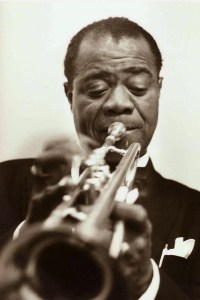 As the Civil Rights movement started taking hold in the mid-1950s, many African American entertainers were vocal in their support. Louis Armstrong generally stayed silent. Until, that is, September 17, 1957.
 As all sectors did, the Little Rock arts and culture community responded to September 11.
 Little Rock Culture Vulture