Little Rock Look Back: Mayoral Election of 1832

Little Rock’s 73rd Mayor will take office on Tuesday, January 1, 2019.  In the next few weeks, past races for mayor will be featured on Tuesdays.

Up first is the the first race for mayor.  It was between Dr. Matthew Cunningham and Rev. W. W. Stevenson.

  • Dr. Cunningham had been a founding father of Little Rock.  He was the first physician, husband of the first woman to be a permanent settler of Little Rock, and father of the first baby born to a Little Rock resident.
  • Rev. Stevenson was a member of the Presbyterian clergy as well as a geologist.  He had first come to Batesville before settling in Little Rock.

In November 1831, the Town of Little Rock was officially chartered by the Territory of Arkansas.  The first election was set for New Year’s Day, 1832.

On the appointed day, the white men who were eligible to vote gathered at the prescribed location and cast their votes. By a vote of 23 to 15, Dr. Cunningham won the race. There are no media accounts of issues that may have arisen during the campaign, or if there was even much of a campaign.

Dr. Cunningham served as Little Rock’s first mayor during the calendar year of 1832 but did not seek a second term.  His successor was Rev. Stevenson. Records suggest that Rev. Stevenson may have been unopposed in his quest. He, too, served only one year.  Later in the 1830s, some friends tried to recruit him to run for mayor again, but he declined.

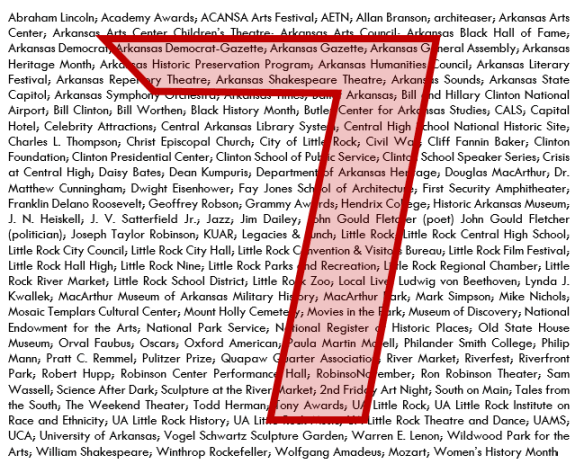
LR Culture Vulture turns 7

The Little Rock Culture Vulture debuted on Saturday, October 1, 2011, to kick off Arts & Humanities Month.

The first feature was on the Arkansas Symphony Orchestra, which was kicking off its 2011-2012 season that evening.  The program consisted of Mendelssohn’s Symphony No. 4 in A, Op. 90, Rossini’s, Overture to The Italian Girl in Algiers, Puccini’s Chrysanthemums and Respighi’s Pines of Rome.  In addition to the orchestra musicians, there was an organ on stage for this concert.

Since then, there have been 10,107 persons/places/things “tagged” in the blog.  This is the 3,773rd entry. (The symmetry to the number is purely coincidental–or is it?)  It has been viewed over 288,600 times, and over 400 readers have made comments.  It is apparently also a reference on Wikipedia.

The most popular pieces have been about Little Rock history and about people in Little Rock.

31 Days of Arkansas Rep: THE THREEPENNY OPERA

October is Arts and Humanities Month.  This year, each day a different past Arkansas Repertory Theatre production will be featured.  This is, in part, a tribute to the late Cliff Baker, and also a countdown to the Rep’s re-emergence.

Up first, is the first Arkansas Repertory Theatre production: 1976’s THE THREEPENNY OPERA.

On November 11, 1976, the curtain went up on the first Arkansas Repertory Theatre production.  It was the Kurt Weill-Bertolt Brecht musical The Threepenny Opera.  Rep founder Cliff Baker directed the show and played the leading role of Macheath aka Mack the Knife.

Others in the cast included local attorney Herb Rule, Jean Lind, Theresa Glasscock, Connie Gordon and Guy Couch.  Byl Harriell was the technical director and production designer while Donia Crofton was the costume designer.

The production took place in the Rep’s home which was the converted former home of Hunter United Methodist Church on the eastern edge of MacArthur Park.  (Harriell’s business Bylites is now in that location.)

Baker had previously worked at the Arkansas Arts Center theatre when it was attached to a degree granting MFA program. He had also directed shows in other parts of Arkansas.  He returned to Little Rock and founded the Arkansas Philharmonic Theatre which performed in Hillcrest.  The Arkansas Repertory Theatre was a step forward with the establishment of a professional repertory company.

The first season of the Rep would include Company, Suddenly Last Summer, Marat/Sade, and Stop the World–I Want to Get Off. Season tickets for a total of seven shows were $30.

Little Rock Look Back: Vogel Schwartz Sculpture Garden Expansion

Photo by Little Rock Convention and Visitors Bureau

On Sunday, October 1, 2017, the expansion of the Vogel Schwartz Sculpture Garden was dedicated.

The expansion more than doubled the area of the garden.  It also allowed for larger sculptures to be installed.

The construction took nearly a year. The design for the garden and the landscaping have all been done by the Little Rock Parks and Recreation Department.

A dozen new sculptures were part of the expansion, which brought the total to 66 pieces by 48 different artists.  (More have been added in the past year.)

The Vogel Schwartz Sculpture Garden was originally dedicated in 2009 at Riverfront Park.

Little Rock Look Back: Dedication of Clinton Presidential Park Bridge and Bill Clark Wetlands

Photo by the Little Rock Convention and Visitors Bureau

On a very warm Friday, September 30, 2011, the Clinton Presidential Park Bridge was dedicated.  This completed the eastern loop of the Arkansas River Trail as well as created another feature in Clinton Presidential Park.

The ceremony featured remarks by both President Bill Clinton and the incumbent Secretary of State Hillary Rodham Clinton.  Chelsea Clinton also took part in the ceremony.  Former US Senators (and Arkansas Governors) Dale Bumpers and David Pryor were in attendance as was Jim Guy Tucker who followed Clinton into the Arkansas Governor’s Office.  Current Governor Mike Beebe was also present and took part in the ceremony, which was emceed by Stephanie Streett, executive director of the Clinton Foundation.  Many other former and current elected officials were present.

In addition to dedicating the bridge, the ceremony officially dedicated the William E. “Bill” Clark Presidential Wetlands which are adjacent to the bridge.  City Director Dean Kumpuris joined Clark’s widow, Margaret, and son, William, in the dedication of the wetlands.

This Clinton Presidential Park Bridge is over 2,600 ft. long.  It was constructed in 1899 as the Rock Island Bridge.  After the Rock Island stopped using the bridge, the lift span was permanently raised.  It had to stay this was for the Clinton redevelopment.  Therefore a new surface was built that slopingly takes persons from park level up to the span level and back down.

The bridge’s “rusty” structure is complemented by a well-lit 12-18-foot walkway flanked on both sides by silver galvanized steel handrails.
The total investment for this area is over $13.5 million.
Later that weekend, the Clinton Foundation hosted an event to commemorate the 20th anniversary of Clinton’s announcement that he was seeking the Presidency.

MacArthur Museum of Arkansas Military History reopens after 5 months and $1.5 million in renovations

After several months of renovations to the building, the MacArthur Museum of Arkansas Military History reopens today.

The museum closed in March 2018 for five months of extensive structural work.  The $1.5 million renovation for the 178-year old structure included both interior and exterior upgrades.  The first phase of the project, which began last December, involved renovation to the north and south porches and was partially funded by a Historic Preservation Restoration Grant from the Department of Arkansas Heritage. The interior renovation includes upgrades to the heating and cooling systems, installation of new lighting, and repainting of interior gallery spaces.

Funding for the renovations came from proceeds of a hotel tax which was approved by Little Rock voters in February 2016.

The MacArthur Museum of Arkansas Military History was created to interpret our state’s military heritage from its territorial period to the present. It is a program of the City of Little Rock’s Department of Parks and Recreation.

Located in the historic Tower Building of the Little Rock Arsenal–the birthplace of General Douglas MacArthur–the museum preserves the contributions of Arkansas men and women who served in the armed forces.  Exhibits feature artifacts, photographs, weapons, documents, uniforms and other military items that vividly portray Arkansas’s military history at home and abroad.

In conjunction with the reopening, there will be a belated 125th birthday party for MacArthur Park. (The park actually opened on July 4, 1893.)  Originally known as Arsenal Park, it became known as City Park shortly thereafter. In 1942, it was renamed in honor of Gen. Douglas MacArthur, who was born there. At the time he was commanding US troops in the Pacific Theatre of Operations during World War II.

Activities include:

9:00 a.m. – 2:00 p.m. – Vintage Military Vehicle Show featuring military vehicles from the Arkansas Military Vehicle Preservation Association.

10:00 – 10:30 a.m.  –  Grand Re-opening of the MacArthur Museum of Arkansas Military History

  • Music provided by Five Star Brass Quintet of the 106th Army (Arkansas) Band
  • Remarks and Ribbon Cutting re-opening the military museum following a $1.55 million renovation

10:00 a.m. – 4:00 p.m.  –  MacArthur Park History Walk

Explore MacArthur Park using a “passport” to learn more about the park’s history during the territorial/Civil War periods, late 19th century/early 20th century periods, and World War II/Modern periods.  There will be eight “passport sites” in total, with other sites to visit as well. Passports and Park materials may be picked up at the MacPark Group Table.  Stamped passports to all eight sites may be turned in for raffle prizes from the Arkansas Arts Center, Little Rock Parks, Arkansas Paranormal Expo, MacArthur Museum of Arkansas Military History, Mac Park Group, Quapaw Quarter Association, and others.

  • AAC Friend Level Membership.
  • AAC Children’s Theatre Tickets (4).
  • Flat Screen Television- MacPark Group.
  • AAC class/workshop.
  • QQA- ticket to Spring Tour of Homes and ticket to Mother’s Day Brunch.
  • MMAMH- Gift basket and passes to the 8th Annual Paranormal Expo.
  • Parks and Rec- Round of Golf at Rebsamen Gold Course.

11:30 a.m. – 1:00 p.m. Woodmen Life will provide grilled hot dogs and chips to first 400 visitors.  Bottled water courtesy of Premium Refreshment Services.   Bluebell ice cream will be provided free.  Families are encouraged to bring picnic lunches.

12:00 – 2:00 p.m. – Concert by Funkle Sam of the 106th Army (Arkansas) Band on the North Plaza. Katie Sunshine will be hoop dancing with Funkle Sam.

4:00 – 8:00 p.m. – Evening German Biergarten.  Local breweries set up to sell beers. *Will have entry fee of $10 which will buy admission, three beer tokens, and a bratwurst plate.

 

Little Rock Look Back: First Meeting of Pulaski Heights City Council

The opening of the first minutes of the Pulaski Heights City Council.

On September 28, 1905, the first meeting of the Pulaski Heights City Council took place.  The newly elected Mayor was J. H. Joslyn, the Recorder was F. D. Leaming, and new Alderman present were E. E. Moss, Maxwell Coffin and C. C. Thompson.  Pulaski Heights had been incorporated on August 1, 1905.  At that time its population was estimated at between 300 and 400.

The first ordinance, which was offered by E. E. Moss, was to set a tax rate and give the City the ability to levy taxes.  Next was a motion to establish a committee to establish rules and procedures for the council. The final business before the Council was to allow the Recorder to order stationary, a seal and a record book (that record book is now in the vault at Little Rock City Hall).

The next meeting would be October 28.  At that meeting, two other Aldermen are mentioned in the minutes (Fauble and Paul) but were absent from that meeting as well.  Mr. C. M. Fauble was present at the third meeting.  Mr. R. O. Paul did not appear until the fifth meeting (December 13, 1905).

Interestingly the Recorder had a vote in the Council meetings (which was not a practice in the City of Little Rock at the time).

The Council did not have a permanent meeting place until the third meeting.  At that point in time, they used space in the offices of Dr. Hockersmith.  They later met in a building which is now part of the Pulaski Heights Baptist Church campus.

Pulaski Heights was a separate City until January 1916.  On January 4, 1916, Little Rock voters approved the annexation of Pulaski Heights by a ten-to-one margin, and the suburb became the city’s ninth ward.

This established a couple of precedents for the City of Little Rock which are in effect to this day.  The first is that Little Rock would not be a central city surrounded by a variety of small incorporated towns (in the manner that St. Louis and other cities are).  It was this thought process which has led the City to continue to annex properties.

In addition, this move to annex Pulaski Heights was the first time that the City grew toward the west.  Previous growth had been to the south.  By emphasizing western expansion, this has allowed Little Rock to continue to grow.