31 Days of Arkansas Rep: PROOF by LR Hall Alum David Auburn

Fourteen years after graduating from Little Rock Hall High School, David Auburn received the 2001 Pulitzer Prize in Drama for his play Proof.  In September 2002, Arkansas Repertory Theatre produced Proof while the original Broadway run was in its final months.

The production at Arkansas Rep was directed by Producing Artistic Director Robert Hupp.  The cast featured Amy Tribbey, Scott Barrow, Jessica Henson and Curt Karibalis.  (Barrow met his future wife, the former Amy Sabin, while in Little Rock during the run of this show.)

The set, a very realistic craftsman house back porch, was designed by Mike Nichols.  On opening night he was lauded because the production marked his 20th anniversary with the Rep. (In 2018, Nichols is still serving as Technical Director and Resident Scenic Designer for the Rep.)

Auburn was unable to come to Little Rock to see the production. His wife was set to give birth to a child during the run of the show.

When Auburn was growing up in Little Rock, he and his brother were active with the Arkansas Arts Center Children’s Theatre which is across MacArthur Park from where the Rep was at the time.

31 Days of Arkansas Rep: 1982’s A CHRISTMAS CAROL

Scott Edmonds as Ebenezer Scrooge in “A Christmas Carol” by Charles Dickens – from Developing Character at the Arkansas Rep 1983-1984 by Andrew Kilgore. Arkansas Arts Center Foundation Collection. Gift of Doyne and Margaret Dodd.There were plenty of Christmas carols during the 1982 Arkansas Rep production of A Christmas Carol. This was the first time, in the Rep’s seven Decembers of existence, that a holiday-themed show had been presented in December.

The production was directed by the Rep’s Artistic Associate Montgomery Kuklenski (who is now an entertainment executive in Los Angeles).  After Cliff Fannin Baker decided to produce a stage version of the Charles Dickens chestnut, Kuklenski read over a dozen versions before selecting one by Tom Markus.

Instead of taking place on the Rep’s stage, the production was mounted in the university theatre on the UALR campus.  (With a cast of nearly 40 actors and many special effects, it would have been difficult to produce this at the Rep’s home adjacent to MacArthur Park.)

Scott Edmonds played the title character with other parts being played by Dallas Miles, Jonathan Michaelson, Rebeccas Wilenski, Charles Hatchock, Larry Edwards, Peter White, Jay Kinney, Tommy Cherepski, Ted Eades, and Ronald J. Aulgur.

One of the reasons that the Markus version was selected was that it incorporated numerous Christmas carols into the script both as part of the action and as transitions between scenes. Sharon Douglas served as pianist and music director for the production.

The production ran from December 9 through 18 of 1982.

Several of the actors were captured in Mark Hughes’s costumes by Andrew Kilgore as part of his multi-season Developing Character black and white photo portrait series.  The Arkansas Arts Center has over twenty of these photos in its permanent collection.

The Rep also has many of these photos. As part of 2nd Friday Art Night, the Rep is displaying some of these photos in the lobby of the current building.

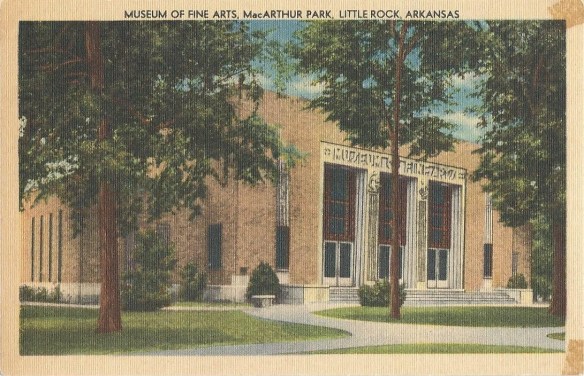
Little Rock Look Back: Open House Gala for Museum of Fine Arts

On Tuesday, October 5, 1937, the Fine Arts Club of Little Rock held its first meeting in the new Museum of Fine Arts.  But it was not a typical meeting. It was an Open House and Dedication for the new building.

Construction on the 10,140 square foot building had commenced with the January 3, 1936, groundbreaking.  By September 1937, the keys were presented to the City, marking the end of the construction process.

During the October 5 events, a letter of congratulations was read by President Franklin D. Roosevelt and WPA Administrator Harry L. Hopkins.  A letter which had been prepared by Sen Joe T. Robinson prior to his death was also read.  Mayor R. E. Overman, architect H. Ray Burks, and Fred W. Allsopp spoke at the event.  The latter was chair of the museum’s board.  Over 1,000 people were in attendance. At the time the city’s population was around 87,000.

The museum officially opened its doors to the public on October 28, 1937.  Nettie L. Robinson, a longtime member of the Fine Arts Club, was its first director and would serve in that capacity for two decades.

The original facade of the Museum can still be seen inside the Arkansas Arts Center.  Once the expansion and renovation of that building is complete in 2022, the original entrance will be highlighted even more with the new design.


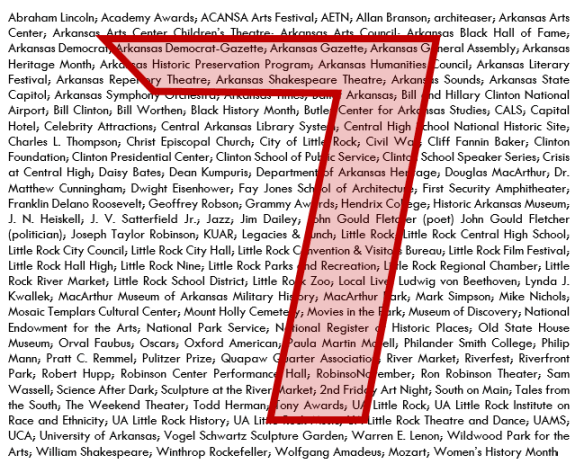
LR Culture Vulture turns 7

The Little Rock Culture Vulture debuted on Saturday, October 1, 2011, to kick off Arts & Humanities Month.

The first feature was on the Arkansas Symphony Orchestra, which was kicking off its 2011-2012 season that evening.  The program consisted of Mendelssohn’s Symphony No. 4 in A, Op. 90, Rossini’s, Overture to The Italian Girl in Algiers, Puccini’s Chrysanthemums and Respighi’s Pines of Rome.  In addition to the orchestra musicians, there was an organ on stage for this concert.

Since then, there have been 10,107 persons/places/things “tagged” in the blog.  This is the 3,773rd entry. (The symmetry to the number is purely coincidental–or is it?)  It has been viewed over 288,600 times, and over 400 readers have made comments.  It is apparently also a reference on Wikipedia.

The most popular pieces have been about Little Rock history and about people in Little Rock.

MacArthur Museum of Arkansas Military History reopens after 5 months and $1.5 million in renovations

After several months of renovations to the building, the MacArthur Museum of Arkansas Military History reopens today.

The museum closed in March 2018 for five months of extensive structural work.  The $1.5 million renovation for the 178-year old structure included both interior and exterior upgrades.  The first phase of the project, which began last December, involved renovation to the north and south porches and was partially funded by a Historic Preservation Restoration Grant from the Department of Arkansas Heritage. The interior renovation includes upgrades to the heating and cooling systems, installation of new lighting, and repainting of interior gallery spaces.

Funding for the renovations came from proceeds of a hotel tax which was approved by Little Rock voters in February 2016.

The MacArthur Museum of Arkansas Military History was created to interpret our state’s military heritage from its territorial period to the present. It is a program of the City of Little Rock’s Department of Parks and Recreation.

Located in the historic Tower Building of the Little Rock Arsenal–the birthplace of General Douglas MacArthur–the museum preserves the contributions of Arkansas men and women who served in the armed forces.  Exhibits feature artifacts, photographs, weapons, documents, uniforms and other military items that vividly portray Arkansas’s military history at home and abroad.

In conjunction with the reopening, there will be a belated 125th birthday party for MacArthur Park. (The park actually opened on July 4, 1893.)  Originally known as Arsenal Park, it became known as City Park shortly thereafter. In 1942, it was renamed in honor of Gen. Douglas MacArthur, who was born there. At the time he was commanding US troops in the Pacific Theatre of Operations during World War II.

Activities include:

9:00 a.m. – 2:00 p.m. – Vintage Military Vehicle Show featuring military vehicles from the Arkansas Military Vehicle Preservation Association.

10:00 – 10:30 a.m.  –  Grand Re-opening of the MacArthur Museum of Arkansas Military History

  • Music provided by Five Star Brass Quintet of the 106th Army (Arkansas) Band
  • Remarks and Ribbon Cutting re-opening the military museum following a $1.55 million renovation

10:00 a.m. – 4:00 p.m.  –  MacArthur Park History Walk

Explore MacArthur Park using a “passport” to learn more about the park’s history during the territorial/Civil War periods, late 19th century/early 20th century periods, and World War II/Modern periods.  There will be eight “passport sites” in total, with other sites to visit as well. Passports and Park materials may be picked up at the MacPark Group Table.  Stamped passports to all eight sites may be turned in for raffle prizes from the Arkansas Arts Center, Little Rock Parks, Arkansas Paranormal Expo, MacArthur Museum of Arkansas Military History, Mac Park Group, Quapaw Quarter Association, and others.

  • AAC Friend Level Membership.
  • AAC Children’s Theatre Tickets (4).
  • Flat Screen Television- MacPark Group.
  • AAC class/workshop.
  • QQA- ticket to Spring Tour of Homes and ticket to Mother’s Day Brunch.
  • MMAMH- Gift basket and passes to the 8th Annual Paranormal Expo.
  • Parks and Rec- Round of Golf at Rebsamen Gold Course.

11:30 a.m. – 1:00 p.m. Woodmen Life will provide grilled hot dogs and chips to first 400 visitors.  Bottled water courtesy of Premium Refreshment Services.   Bluebell ice cream will be provided free.  Families are encouraged to bring picnic lunches.

12:00 – 2:00 p.m. – Concert by Funkle Sam of the 106th Army (Arkansas) Band on the North Plaza. Katie Sunshine will be hoop dancing with Funkle Sam.

4:00 – 8:00 p.m. – Evening German Biergarten.  Local breweries set up to sell beers. *Will have entry fee of $10 which will buy admission, three beer tokens, and a bratwurst plate.


An Appreciation of Cliff Fannin Baker

Two times Cliff Baker declined to hire me.

The first was, upon reflection, a “what the hell he thinking even interviewing me I was nowhere qualified for that job?!” situation.

The second time I had three interviews. Met the entire staff. And at the last minute some board members wanted to restructure staffing and go another direction.

I was disappointed. But because it was Cliff, I was not bitter.

I mean, that elfin grin. Those sparkling eyes. You could tell there were fifty-thousand ideas going through his mind at once. He was an encourager and a dreamer.

Cliff Baker willed Arkansas Rep into existence.  He had a merry band of players to join him.  But in the end, it was his vision, his determination, his blood, his sweat, and his tears that made the dream a reality.

The genesis for the Rep predates even the Arkansas Philharmonic Theatre. It goes back to the theatre program of the Arkansas Arts Center during its degree granting days.  Cliff worked with Dugald MacArthur who led the dramatic arts section during most of the four years the school existed.   Cliff was part of Of Prisons and Men, the environmental staging production of a new play which was critical of the Arkansas prison system.  It was aborted due partially to the involvement of actual inmates in the production (to the dismay of some in prison leadership system). Though not publicly stated, there was also some discomfort with the tone and tenor of the play.

Earlier this year, Cliff and I talked about this play.  Sometime over the years, he had lost his papers on it.  But longtime Arts Center trustee Jeane Hamilton had hers and gave them to Cliff.   As the theatre production was cancelled and later the entire degree granting program dropped for budget reasons, Jeane had encouraged Cliff to keep dreaming of theatre for Little Rock.  When Mimi Dortch was helping Cliff launch the Rep, Jeane was excited to join in.  (And it was Jeane who recruited Ruth Shepherd to become involved with the Rep.)

I was fascinated to hear Cliff talk about the visits to the prison, the rehearsal process, and the disappointment for the way it ended.  But fifty years later, it was just one stop on his career providing anecdotes from his youthful baptism into the Little Rock theatrical scene.

As a child, I was taken to a production at Cliff’s Arkansas Philharmonic Theatre in Hillcrest.  I could not tell you what it was, nor do my parents remember.  One of my babysitters was in the play.  I may not remember the play or the plot (I was five or six), but I vividly remember the cramped space. There was an electricity to it.  And it showed that theatre did not have to take place in a large auditorium.

The next year, the Arkansas Rep was born in an abandoned church space adjacent to MacArthur Park.  Operating for the first few years as a true repertory company, the same core cadre acted, sold tickets, built sets, and cleaned the building. What Cliff was creating in Little Rock was rare at the time.  Professional theatre did not exist in cities of its size.

My first personal interaction with Cliff was at Arkansas Governor’s School.  They were touring the musical Quilters to campus.  Since I was in Drama at AGS, Cliff and some cast members visited with us.  I don’t remember anything profound he said, but I remember him treating this group of 21 seventeen-year olds with respect.  Later that evening, the light board was not cooperating. So the show actually started with only house lights until the light board started functioning.  Before the show, Cliff gave brief remarks about the show.  He apologized for the technical glitch, but “the show must go on.”  About 15 minutes into it, the theatrical lighting appeared.

Over the years, I saw many shows he directed. Cliff was at home in so many different styles of theatre.

Perhaps one of my favorite Cliff memories was a decade or so back when the Rep produced A Chorus Line. I and some friends were at an event which involved a behind-the-scenes talk about the production.  By this point, Cliff had been retired from the Rep (the first time) for several years but was directing the production.  He and I were sitting at the same table.  A friend of mine who was relatively new to town quite innocently asked, “So what is your connection to the Rep?”  I just about did a Danny Thomas spit take to the drink I was sipping.  Cliff very humbly said, “Well, I have been involved since the first days of it and am now back directing this show.”  He was not upset that someone did not know who he was. He was actually very glad to see many new people continuing to be involved with the Rep.

The Cliff stories keep coming back as I write this. We all have them. He had the ability to make people feel connected, to make you feel you were the most important person in the room.  It was that gift that made him a good director, actor, producer, and fundraiser.

My last conversation with Cliff was on the opening night of Gridiron.  We had chatted earlier in the evening.  Then after the show, I saw he and Guy, right after I had passed Herb Rule.  The three of them played the key male roles in the Rep’s first production: The Threepenny Opera. I teased Cliff that it was time for a revival of that production. He smiled and said, “It was such a fun show to do.” We shook hands and parted ways. I knew he needed to work the room. This was a space filled with people who wanted to support the Rep as it refreshed itself.

When the announcement of the Rep suspending operations was made in April, one of my first thoughts was, quite selfishly, “Damn, I won’t be able to see a Cliff Baker God of Carnage.”  It was the show I had most been anticipating from this season.  As the Rep was working to plan for a new season, I was hopeful that Cliff would be able to mount that production in the new season.  A very dark comedy, it is reminiscent of some of his best work.  Alas, just as the Rep is on the cusp of a new phase, Cliff won’t be there to direct.

But Cliff WILL be there.  He will always be a part of the Rep. It is more than him, but it is very much him.

For the rest of us – those who are left to mourn, to support Guy, to face life after Cliff, I keep thinking of a line from Lincoln’s Gettysburg Address.  In it, he said, “It is for us the living, rather, to be dedicated here to the unfinished work.” And there is much unfinished work.  The Rep needs to return to regular programming to be sure.  But it is more than that.  We need to all redouble our efforts to exhibit the compassion, the passion, the wit, and the sincerity he showed. To inspire others to be their best whether in the arts or whatever field they choose.

Cliff Fannin Baker was a Pied Piper, and we were all glad to follow along.

Little Rock Look Back: Establishment of Arkansas Arts Center

Architectural model of the original Arkansas Arts Center which would open in 1963.

On Tuesday, September 6, 1960, the City of Little Rock Board of Directors adopted ordinance 11,111 which formally established the Arkansas Arts Center.

In July 1957, the City Council of Little Rock granted the Museum of Fine Arts the authority to solicit and receive funds for expanding that museum’s physical plant.  During that process, it had been decided that the museum needed an expanded mission and a new name.  By the summer of 1960, the museum supporters had raised sufficient funds to proceed with constructing the new facility.  Therefor the new ordinance was prepared and submitted to the City Board.  (In November 1957, the City Council had been replaced by a City Board.)

Ordinance 11,111 set forth that the Museum of Fine Arts would be known as the Arkansas Arts Center and that the previous museum’s board would serve as the board for the new museum.  The Board of the Arkansas Arts Center was given the authority to have the new building constructed in MacArthur Park and the existing building modified.  As a part of the planning for the new museum, the City committed $75,000 for the capital campaign.

The groundbreaking for the new museum would take place in August 1961.  Mayor Werner Knoop, who signed Ordinance 11,111, took part in the groundbreaking.

Media attending the September 6, 1960, City Board meeting were more interested in discussion about a potential leash law for dogs within the City limits.