
18 Cultural Events from 2018 – Dedication of Elizabeth Eckford Bench

Sixty-one years after Elizabeth Eckford took the long walk down Park Street as she was trying to enter Little Rock Central High for her first day of classes there, she again went down the street. But on September 4, 2018, her journey was to celebrate the dedication of a new bench.

Met by a mob and kept out of the school by the soldiers she thought were there to protect her, Eckford finally made her way to a bus bench at Sixteenth and Park Streets.  This year, a replica of that bench is being dedicated at that location.

Little Rock Central High School National Historic Site collaborated with the Central High Memory Project students and additional partners for the ceremony.

September 4, 1957, was supposed to be the first day of school for the African American students who were selected to integrate Little Rock Central High School.  Due to the mobs gathered outside of the school and interference from Governor Orval Faubus, the students would not get in the school that day.

The most famous images from that day are the photos of Elizabeth Eckford walking in front of the school, only to be rebuffed by soldiers and tormented by the crowds. Elizabeth’s decision to walk through the mob of protesting segregationists to enter school, only to be turned away became world news. The story of the desegregation of Central High School was thrust into a defining role within the Civil Rights Movement. Elizabeth’s efforts to overcome the fear and uncertainty that she faced that morning resulted in her seeking refuge at a lonely bus stop bench.

In order to highlight this aspect of the story and create more personal connections with this turning point in history for students and visitors, the National Park Service and the Central High Memory Project Student Team will work with community partners in a new public history project.  The Bench Project includes building a replica of the bus stop bench, creating a mobile app for the students’ audio walking tour of eyewitness accounts of that first day of desegregation, and developing a storycorps recording booth for interviews and student podcasts.

The partnership includes: Bullock Temple C.M.E., Central High School and their EAST LAB, the Little Rock School District, the City of Little Rock, the Clinton School of Public Service, Central Arkansas Library System’s Butler Center for Arkansas Studies, Good Earth Garden Center, Friends of Central High Museum Inc., Home Depot, Little Rock Club 99 and other Rotary International Clubs,  Unity in the Community, and others.

Count Pulaski subject of December Legacies and Lunch

As they do from time to time, the Clinton School of Public Service is co-presenting this month’s Butler Center for Arkansas Studies Legacies and Lunch program.  The program, focusing on the life of Count Casimir Pulaski, will begin at noon today at the Ron Robinson Theater.

Authors Mel and Joan Gordon will discuss the life of General Casimir Pulaski, a Polish immigrant who saved George Washington’s life at the Battle of Brandywine and died at age thirty-four after being wounded at the Siege of Savannah in Georgia.

The Gordons published a historical novel about Pulaski, who was known as the “Father of American Cavalry.” The authors were recently inducted into the Lafayette Order in France in recognition of their work on Pulaski and the Marquis de Lafayette. December 15 will mark the 200th anniversary of the establishment of Pulaski County in Arkansas, one of seven counties in America named for Pulaski.

All Clinton School Speaker Series events are free and open to the public. Reserve your seats by emailing publicprograms@clintonschool.uasys.edu or by calling (501) 683-5239.

Little Rock Look Back: The 2004 opening of the Clinton Presidential Center

wjc library openingIt has been fourteen years since the Clinton Presidential Center opened on a wet, cold Thursday.

The days leading up to it had been glorious.  And while the weather may have literally dampened spirits a bit, it was still an important day for Little Rock and Arkansas.

The events leading up to the opening included a concert by Aretha Franklin with the Arkansas Symphony Orchestra and an appearance by Senator John Glenn at the Museum of Discovery.  Events were hosted by the Arkansas Arts Center, Arkansas Repertory Theatre, Historic Arkansas Museum, and Old State House Museum.  There were scores of receptions and parties as Hollywood, New York, and DC descended on Little Rock.

November 18 dawned rainy and cool.  As the day continued on the precipitation continued while the temperature did not warm up.  Years of planning for a grand opening ceremony came down to this.  But at the appointed time, festivities began.

On the site of an abandoned warehouse district and unofficial dump which had previously been a train station, many leaders of the free world were gathered.  They rubbed shoulders with thousands of Arkansans from probably every county in the state.

It had been seven years and eleven days since Bill Clinton had announced the site of his presidential library.  It had been five years since artifacts and articles started arriving from Washington DC in Little Rock.  There had been lawsuits, threats of lawsuits, the threat of a Counter-Clinton Library, and countless meetings.

After speeches from Presidents Carter, Bush 41 and Bush 43, remarks from President Clinton and then-Senator Clinton (who was made even wetter by water pouring off an ill-placed umbrella), and even a musical performance by Bono and The Edge, Chelsea Clinton turned over the ceremonial key from the Clinton Foundation to the National Archives to officially open the Clinton Presidential Center.

In his capacity leading the Clinton Foundation, Skip Rutherford oversaw the planning for the Clinton Library and the grand opening festivities.  He, along with the foundation’s Executive Director Stephanie S. Streett, oversaw a phalanx of volunteers and staff to anticipate every detail.  The 1,000 days countdown sign that had been on the construction site (the brainchild of Tyler Denton) finally reached 0.

Isabelle Rodriguez, Shannon Butler, Mariah Hatta, Jordan Johnson, Lucas Hargraves, Ben Beaumont, Denver Peacock — among others — had been putting in twelve plus hour days for months on end to get ready for the opening.  City Manager Bruce T. Moore led a team of City officials who had assisted on the planning and execution of the site preparation and making sure Little Rock was ready to welcome the world.  Moore and City Director Dean Kumpuris had been appointed by Little Rock Mayor Jim Dailey to lead Little Rock’s efforts to land the library.  After Clinton’s announcement of the site, Dailey, Kumpuris and Moore continued to work together to ensure the library would be successful.

Among those present were Oscar winning actors Barbara Streisand, Robin Williams, and (of course) Arkansan Mary Steenburgen.  Future Oscar winner Morgan Freeman was also in attendance. Among the Oscar nominees who were present were Bono and The Edge (who performed at the ceremony) and Alfre Woodard.  It was the first public appearance by Senator John Kerry after his loss earlier in the month to President George W. Bush. Scores of Senators and members of Congress as well as countless Clinton Administration staffers were also in attendance.

While the weather on November 18, 2004, may have been a disappointment, the people who were gathered knew they were witnesses to history.  And fourteen years later, is a day people still talk about.


This weekend’s ASO guest conductor Sarah Ionnides speaks today at the Clinton School

This weekend, Sarah Ioannides is guest conductor with the Arkansas Symphony Orchestra.  Today at noon, she is featured at the Clinton School Speaker Series.
Sarah Ioannides has received international acclaim for her work as a conductor. She has been listed as one of the top twenty female conductors worldwide by Lebrecht’s “Woman Conductors: The Power List,” and described by the LA Times as “one of the six female conductors breaking the glass podium.” Ioannides is a recipient of the Joann Falletta award for the most promising female conductor.

She is now in her 5th season as Music Director of the Symphony Tacoma. Previously she was Music Director with the Spartanburg Philharmonic Orchestra from 2005-17 and the El Paso Symphony between 2005-11. Under her leadership both Spartanburg Philharmonic Orchestra and Symphony Tacoma have received ArtWorks grants from the National Endowment for the Arts for creativity in collaboration, community, and commissioning projects and is now well recognized for her skills as a musical curator and adventurous programming.

In her career, Ioannides has had guest engagement spanning 6 continents. She has conducted the Tonkünstler Orchestra, Royal Philharmonic Orchestra, Orchestre Nationale de Lyon, Gothenburg Symphony Orchestra, Flemish Radio Orchestra, National Symphony of Colombia, Daejeon Philharmonic, Translyvannia Philharmonic Orchestra, Wuttenbergisches Kammerorchester, and the Simon Bolivar Youth Orchestra.

Ioannides has also led orchestras extensively in the United States including the Buffalo Philharmonic, Charleston Symphony, Hawai’i Symphony, Louisville Orchestra, New Haven Symphony, New West Symphony, North Carolina Symphony, Rochester Philharmonic, Toledo Symphony, and Tulsa Symphony with numerous return engagements. Ioannides has also appeared in special engagements with the Los Angeles Philharmonic, New World Symphony and the London Symphony Orchestra.

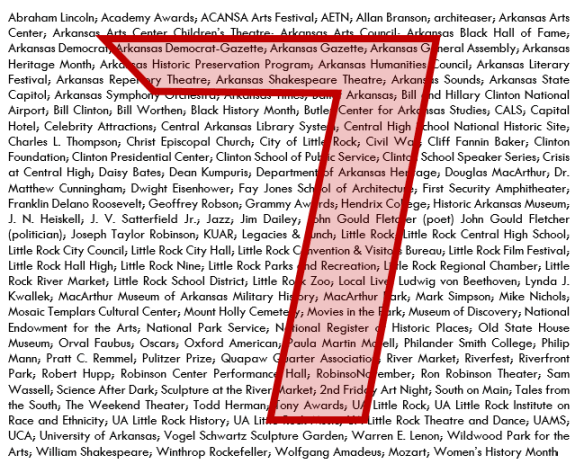
LR Culture Vulture turns 7

The Little Rock Culture Vulture debuted on Saturday, October 1, 2011, to kick off Arts & Humanities Month.

The first feature was on the Arkansas Symphony Orchestra, which was kicking off its 2011-2012 season that evening.  The program consisted of Mendelssohn’s Symphony No. 4 in A, Op. 90, Rossini’s, Overture to The Italian Girl in Algiers, Puccini’s Chrysanthemums and Respighi’s Pines of Rome.  In addition to the orchestra musicians, there was an organ on stage for this concert.

Since then, there have been 10,107 persons/places/things “tagged” in the blog.  This is the 3,773rd entry. (The symmetry to the number is purely coincidental–or is it?)  It has been viewed over 288,600 times, and over 400 readers have made comments.  It is apparently also a reference on Wikipedia.

The most popular pieces have been about Little Rock history and about people in Little Rock.

Little Rock Look Back: First Meeting of the WEC

Vivion Brewer, Adolphine Terry, and Pat House with an award presented to the WEC around the time the group disbanded.

On Tuesday, September 16, 1958, the first meeting of the Women’s Emergency Committee to Open Our Schools took place at the Pike-Fletcher-Terry House in downtown Little Rock.  Fifty-eight women were in attendance at the initial meeting.

The group had been envisioned four days earlier, on September 12. At the time, Adolphine Fletcher Terry had invited Vivion Lenon Brewer and Velma Powell to her house to discuss the current school situation. Terry and Brewer were both daughters of former Little Rock mayors.  They were frustrated with the stalemate that was taking place with the Little Rock School District, the State, and the Federal Government.

In a conversation about the group with her friend Arkansas Gazette editor Harry Ashmore, Mrs. Terry stated, “The men have failed, it’s time to call out the women.”

The same day the trio met, an immediate concern superseded their general discontent.

On September 12, Governor Faubus had signed several segregationist bills into law. One of them gave him the authority to temporarily close schools in order to keep the from being integrated. After signing the bills, he issued an order closing Little Rock’s four high schools. He set October 2 as the election day for Little Rock voters to ratify or reject the closing.

The closure of the schools and impending election, gave an urgency and an immediate focus for the WEC. The women sprung into action.

The way the election law was written, keeping the schools open would require a majority of all registered voters — not just those voting in the election.  There were several other requirements written into the law that made it all but impossible to reject the closure.  Nonetheless the WEC went to work.  They wrote letters, made phone calls, made personal pleas, raised money, and placed newspaper ads.

Their need for a quick and efficient organization became even more paramount with the Governor moved the election forward to September 27.  His public reason was to remove the uncertainty; but privately he was likely concerned that there was organized opposition.

Though the voters approved keeping the high schools closed, the WEC was undaunted. They continued to work throughout the 1958-59 school year in a variety of ways. They backed candidates in the December 1958 school board elections, and succeeded in getting three moderates elected.  In May 1959, they were a crucial bloc in the campaign to recall of three segregationist school board members.

Following the reopening of the schools in 1959, the WEC continued to focus on social issues until disbanding in 1963.

The membership of the WEC was kept a secret. No official roll was kept.  With a membership which swelled to over 1,300, obviously not all attended meetings at once. There were well organized phone trees which quickly got the word out to the membership.  During elections, they would create files on all registered voters with codes for Saints, Sinners and Savable.

In an effort of intimidation (as if anyone could intimidate Adolphine Fletcher Terry), there were efforts to force the WEC to disclose membership lists. The officers and their legal counsel replied that there were no lists in existence, so there was nothing to disclose.

On March 13, 1998, the names of the WEC were made public for the first time when they were published in the Arkansas Democrat-Gazette.  This was done in conjunction with the 40th anniversary of the year of the founding.  Later in the year, the names were etched in glass in the solarium of the Pike-Fletcher-Terry House.  (In the 1970s, the house was given by the family to the City of Little Rock for use by the Arkansas Arts Center.)

A ceremony at the house in October 1998 celebrated the 40th anniversary and the names permanently etched there.  First Lady Hillary Rodham Clinton came back to Little Rock to deliver remarks at the ceremony.

Sara Murphy, a member of the WEC wrote a book about the organization which was published in 1997, shortly after her death.  Around the same time, Sandra Hubbard produced a documentary called The Giants Wore White Gloves.  A sold out screening of the film is scheduled today at the CALS Ron Robinson Theatre as a presentation of the Clinton School Speaker Series in conjunction with the Butler Center for Arkansas Studies.

Elizabeth Eckford Bench Dedicated Today

Sixty-one years ago today, Elizabeth Eckford took the long walk down Park Street as she was trying to enter Little Rock Central High for her first day of classes there.

Met by a mob and kept out of the school by the soldiers she thought were there to protect her, Eckford finally made her way to a bus bench at Sixteenth and Park Streets.

Today at 4:30 pm, a replica of that bench is being dedicated at that location.

Little Rock Central High School National Historic Site is collaborating with the Central High Memory Project students and additional partners for the ceremony.

September 4, 1957, was supposed to be the first day of school for the African American students who were selected to integrate Little Rock Central High School.  Due to the mobs gathered outside of the school and interference from Governor Orval Faubus, the students would not get in the school that day.

The most famous images from that day are the photos of Elizabeth Eckford walking in front of the school, only to be rebuffed by soldiers and tormented by the crowds. Elizabeth’s decision to walk through the mob of protesting segregationists to enter school, only to be turned away became world news. The story of the desegregation of Central High School was thrust into a defining role within the Civil Rights Movement. Elizabeth’s efforts to overcome the fear and uncertainty that she faced that morning resulted in her seeking refuge at a lonely bus stop bench.

In order to highlight this aspect of the story and create more personal connections with this turning point in history for students and visitors, the National Park Service and the Central High Memory Project Student Team will work with community partners in a new public history project.  The Bench Project includes building a replica of the bus stop bench, creating a mobile app for the students’ audio walking tour of eyewitness accounts of that first day of desegregation, and developing a storycorps recording booth for interviews and student podcasts.

The partnership includes: Bullock Temple C.M.E., Central High School and their EAST LAB, the Little Rock School District, the City of Little Rock, the Clinton School of Public Service, Central Arkansas Library System’s Butler Center for Arkansas Studies, Good Earth Garden Center, Friends of Central High Museum Inc., Home Depot, Little Rock Club 99 and other Rotary International Clubs,  Unity in the Community, and others.

The groundbreaking ceremony will be held at the corner of Park and 16th Street starting at 4:30 p.m. The program will include remarks by the NPS Superintendent and the directors of some of the partnering organizations regarding the projects that will be completed in connection with this effort. The Central High Memory Project Student Team will be on hand to meet the public and share details about their work.