Rock the Oscars 2019: Nine from Little Rock

On April 5, 1965, the Academy Award for Best Documentary, Short Subject went to the film “Nine from Little Rock.”

Narrated by Jefferson Thomas, Charles Guggenheim’s documentary looks at the nine African-American students who enrolled in Little Rock Central High School in 1957. Thomas, one of the students reflects on the state of race relations in the seven years that had elapsed (up to 1964).  The film also focuses on Ernest Green, Elizabeth Eckford and Thelma Mothershed.

Guggenheim both directed and co-wrote the film. The latter credit was shared with Shelby Storck, who also produced the film.   The film had been commissioned by George Stevens, Jr., for the United State Information Agency.

The Oscar that night was Guggenheim’s first of four.  His others would be for: 1968’s “Robert Kennedy Remembered” (Live Action Short), 1989’s “The Johnstown Flood” (Documentary Short) and 1994’s “A Time for Justice” (Documentary Short).  His son Davis Guggenheim won the Oscar for Documentary, Feature for An Inconvenient Truth.

The film was digitally restored by the Motion Picture Preservation Lab for the 50th anniversary of its win for Best Short Documentary at the 1965 Academy Awards.  It is available for purchase on DVD and can also be viewed in its entirety on YouTube

Little Rock Look Back: A 1956 attempt at integrating LR schools

Arkansas Democrat photo by staff photographer Mr. Bisgood

Arkansas Democrat photo by staff photographer Mr. Bisgood

On Monday, January 23, 1956, twenty-seven African American students attempted to integrate four Little Rock schools.  By the end of the day, all four school principals had refused entry and some of the students had met with LRSD Superintendent Virgil Blossom.

Eight girls who were students at Horace Mann High School arrived at Central High at 9:30 am accompanied by Daisy Bates and Frank W. Smith both of the NAACP.  One male student attempted to integrate Little Rock Technical High School.  Four students arrived at Forest Heights Junior High (accompanied by three adults) and fourteen students attempted to integrate Forest Park Elementary (accompanied by four adults).  Neither the Arkansas Gazette nor the Arkansas Democrat broke down the age or gender of the junior high and elementary students.

Though all were referred to meet with Mr. Blossom, only the young women from Horace Mann visited with him.  After the conversation both he and Mrs. Bates declared the conversation had been friendly.   Mr. Blossom, in denying the request, noted that the Little Rock School District had a plan for integration. To allow them to integrate immediately would have been going against the plan.  The integration plan was connected to the completion of the new high school.  If it were ready to open in the fall of 1957, then integration at the high schools would start then.  The newspapers noted that there was no timeline for when it would extend down to the junior high and elementary levels.

That evening, Rev. J. C. Crenchaw, the president of the Little Rock NAACP, issued a statement.  In it he expressed frustration that the LRSD was vague on its timeline for integration.  He noted that the students lived near the schools which they tried to integrate and were therefore forced to travel several extra miles each day to attend school.  He also commented that the young man who attempted to enroll at Tech was not afforded the training available there at his current school.

The Arkansas Democrat ran a photo of the meeting with Mr. Blossom.  It identified the seven students who were pictured.  No mention was made as to whether the eighth student was present but not photographed, or if she did not attend the meeting.  As was the practice at the time, the addresses of the students were listed by their names.  Based on those addresses, the students lived between 0.4 and 0.9 miles from Central High School and were between 2.1 and 3.2 miles away from Horace Mann High School.  Of the seven students in the photo, two were seniors, three were juniors, and three were sophomores.  None of the students named became part of the Little Rock Nine who did integrate Central High twenty-one months later.

On January 24, the Gazette editorial writer opined they were glad for the amicable nature of the conversations. They hoped it did not affect the good race relations in Little Rock.  The writer concluded by saying they did not want it to incite extremists (but did not specify if they viewed the extremists as being for or against integration.)

LR Culture Vulture turns 7

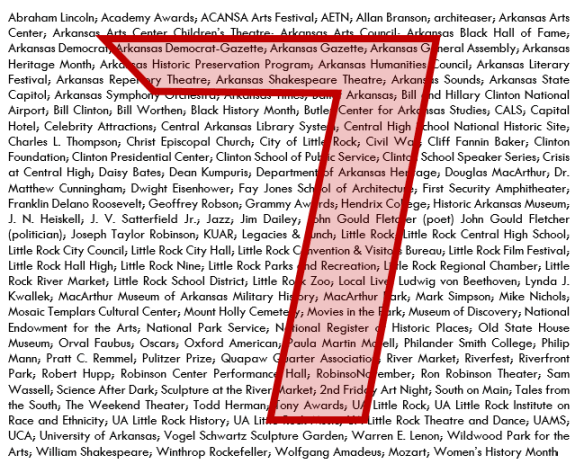
The Little Rock Culture Vulture debuted on Saturday, October 1, 2011, to kick off Arts & Humanities Month.
The first feature was on the Arkansas Symphony Orchestra, which was kicking off its 2011-2012 season that evening.  The program consisted of Mendelssohn’s Symphony No. 4 in A, Op. 90, Rossini’s, Overture to The Italian Girl in Algiers, Puccini’s Chrysanthemums and Respighi’s Pines of Rome.  In addition to the orchestra musicians, there was an organ on stage for this concert.

Since then, there have been 10,107 persons/places/things “tagged” in the blog.  This is the 3,773rd entry. (The symmetry to the number is purely coincidental–or is it?)  It has been viewed over 288,600 times, and over 400 readers have made comments.  It is apparently also a reference on Wikipedia.

The most popular pieces have been about Little Rock history and about people in Little Rock.

Little Rock Look Back: Little Rock Nine enter Central High for First Full Day

After legal challenges, stymied attempts, and literally countless threats, it was on Wednesday, September 25, 1957, that the group of African American students known as the Little Rock Nine actually entered Little Rock Central High School for a full day.  They would return each day through the end of the school year.

Unlike September 23, when they went in a side door before being hustled a few hours later for their own protection, on September 25 they walked in the front door.  They did so escorted by members of the 101st Airborne who had been ordered to Little Rock by President Eisenhower.

Much has been written about the events of September 25, 1957.  Several of the participants that day have penned memoirs.

Whatever I would write today would pale in comparison to the accounts of those who lived it.

So I just end this with words of gratitude to:

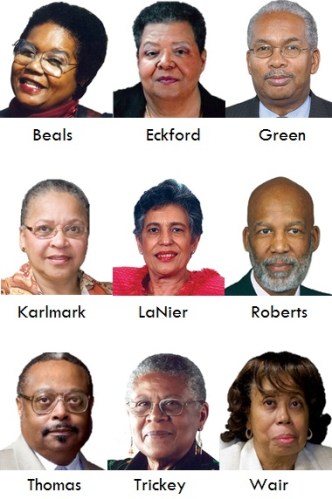
  • Melba Pattillo Beals
  • Elizabeth Eckford
  • Ernest Green
  • Gloria Ray Karlmark
  • Carlotta Walls LaNier
  • Terrence Roberts
  • Jefferson Thomas
  • Minnijean Brown Trickey
  • Thelma Mothershed Wair

Thank you to these nine pioneers, who were simply teenagers trying to have equal education opportunities.  Thank you to their parents, their families, their pastors, their legal team, their support system.  Thank you to Daisy and L. C. Bates, Wiley Branton Sr. Chris Mercer, and Thurgood Marshall for the roles they played.

While Jefferson Thomas passed away in 2010, the other eight continue to tell their stories and speak truth to audiences ranging from one to thousands and ages from pre-school to seniors.

Sculpture Vulture: Clay Enoch’s UNITED installed on Sept 22, 2017

Clay Enoch’s sculpture UNITED was dedicated to kick off the public events for the commemoration of the 60th Anniversary of the Central High School integration by the Little Rock Nine.
The piece, which depicts two figures working together to close two circles, is located in front of Little Rock Central High School.

Enoch was joined at the dedication by several members of the Little Rock Nine, City of Little Rock officials, and current Central High School personnel.

City Director Dean Kumpuris and Little Rock Nine member Ernest Green (who was celebrating a birthday that day) made remarks about the importance of the message of United.  Enoch discussed his process in creating the sculpture.

Principal Nancy Rousseau accepted the sculpture on behalf of the school.  Then Mr. Enoch, Mr. Green, and current Central High students unveiled the sculpture.

The sculpture was installed by Little Rock Parks and Recreation staff.  The Central High School PTSA has landscaped the area around the sculpture and maintains it.

Enoch was chosen through a national public monument commission process sponsored by Sculpture at the River Market.

Little Rock Look Back: Satchmo Criticizes Ike over Little Rock

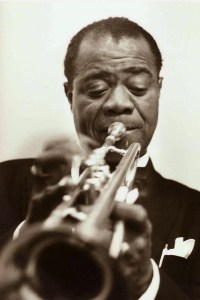
As the Civil Rights movement started taking hold in the mid-1950s, many African American entertainers were vocal in their support.  Louis Armstrong generally stayed silent.  Until, that is, September 17, 1957.
That night, in Grand Forks, North Dakota, Armstrong blasted President Dwight Eisenhower for his lack of action to make Governor Orval Faubus obey the law.  This was in an interview conducted by a 21 year old University of North Dakota journalism student named Larry Lubenow.

Journalist David Margolick wrote about the incident in The New York Times in September 2007 in conjunction with the 50th anniversary of the integration of Little Rock Central High School.  He recounted how the story, written for the Grand Forks Herald, was picked up all over the country.  The entire Margolick piece can be read here.  Margolick tells that when Armstrong was given the chance to back off the comments, he asserted that he meant all of it.

On September 24, 1957, the night that the 101st Airborne was being mobilized to come into Little Rock, Armstrong sent Eisenhower a telegram again criticizing him for lack of action. (It appears this was sent by Armstrong without knowledge of the President’s plans for intervention.) Armstrong used colorful language which sarcastically spoofed the “Uncle Tom” moniker which some of his critics had bestowed when they felt he was not doing enough for Civil Rights.  The Eisenhower Presidential Library has a copy of that telegram.

The incident between Satchmo and Ike was the basis for two different plays: Terry Teachout’s Satchmo at the Waldorf and Ishmael Reed’s The C Above C Above High C.

Little Rock Look Back: Ike meets with Orval

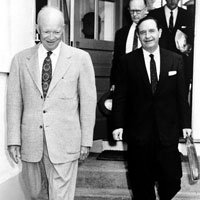
On September 14, 1957, in an attempt to end the stalemate in Arkansas, President Dwight D. Eisenhower met with Arkansas Governor Orval Faubus.  The meeting was brokered by Rep. Brooks Hays, whose district included Little Rock.

The meeting took place in Newport, Rhode Island, where the President was vacationing.  After exchanging pleasantries, the President and Governor adjourned to the Presidents office where they met privately for about twenty minutes.  During that conversation, Faubus proclaimed to the President that he was a law abiding citizen and discussed his own World War II service.  President Eisenhower suggested to Faubus that as a law abiding citizen, he should change the National Guard’s orders so that they protected the Little Rock Nine, not kept them from the building.  He reminded Faubus that the Justice Department was prepared to issue a injunction against him and that the governor would undoubtedly lose in court.

Following their conversation, Congressman Hays and U.S. Attorney General Herbert Brownell Jr.  joined the two in a larger office and continued conversations for approximately another 100 minutes.

When the meeting was over, the President felt like Faubus had agreed to refocus the mission of the National Guard and allow the Little Rock Nine to enter.  The President’s statement to the press thanked Faubus for his cooperation.  Upon returning to Little Rock, Faubus issued his own statement which did not address the President’s statement directly.  He did not even mention the National Guard or the students.

Apparently, President Eisenhower felt betrayed by the Governor’s actions.

The stage was set for these two to continue their face off.