Making History: African-American Mayors in Arkansas is topic of noon conversation today at the Clinton Presidential Center

Clockwise from left: Smith-Creer, Washington, McGill, Scott

Today at noon, the Clinton Presidential Center will host a program featuring four African-American mayors from across Arkansas.

The panel will be moderated by former Little Rock Mayor Lottie Shackelford, who was Little Rock’s first female mayor and second African-American mayor.

The program will feature the newly elected Mayor Veronica Smith-Creer of El Dorado, Mayor George McGill of Fort Smith, Mayor Frank Scott, Jr. of Little Rock, and Mayor Shirley Washington of Pine Bluff, who was first elected in 2016.

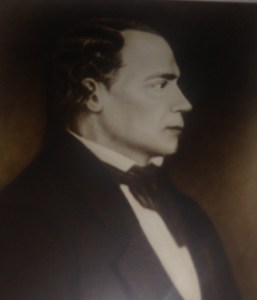
Little Rock Look Back: W W Stevenson

On January 29, 1797, future Little Rock Mayor William Wilson “W. W.” Stevenson was born in South Carolina.

In 1811, he came to Arkansas when his family settled in Batesville.  An ordained Presbyterian minister, he married Ruana Trimble in 1821 and had two children. After she died, he married Maria Tongray Watkins in 1831 and had two more children.

In 1831, he ran for Little Rock Mayor in the first election for the office but was defeated by Dr. Matthew Cunningham.  The next year he ran to succeed Cunningham and was elected.  After leaving the Mayor’s office on December 31, 1833, he continued public service.  He was asked to run for Mayor later in the 1830s, but declined.  He did serve as State Commissioner for Public Buildings in 1839.

In 1849, he delivered the funeral oration at the ceremony for Hon. Ambrose H. Sevier.  Later that year, he was hired as a geologist for the Little Rock and California Association which was created to take advantage of the gold rush.  He and his two oldest sons moved to California and never returned to Arkansas. He died in 1888.

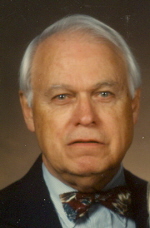
Little Rock Look Back: 57th Mayor Martin Borchert

On January 16, 1916, future Little Rock Mayor Martin Borchert was born in Stuttgart.  After graduating high school he moved to Little Rock.  During World War II, he served as a bomber.  He started work at ACME Brick and spent 21 years there before engaging in other business interests.  Among these businesses were Martin Borchert Co., ASCO Hardware, Detection Systems Inc. and Component Systems Inc.  In 2005 he was inducted into the Arkansas Construction Hall of Fame.

Mayor Borchert was elected to the Little Rock City Board of Directors in 1964 and served from January 1965 through December 1968. He chose not to seek a second term.  In 1967 and 1968 he served as Mayor of Little Rock. During this time, he laid out the vision for what has become Riverfront Park along the Arkansas River.

Other civic achievements included being a member of the Board of the Little Rock Chamber of Commerce, being on the Governor’s Citizens Advisory Committee, a member of the Pulaski County Quorum Court, vice chairman of the Arkansas Planning Commission, and being on the Little Rock Air Force Base Community Council. In 1967 he served on the President’s National Advisory Council to the Small Business Administration.

Mayor Borchert served on the Little Rock Water Commission, including a tenure as chairman. In 1985, he was chairman of the Metropolitan Transit Policy Board and as chairman oversaw the transfer of the Central Arkansas Transit system to the Central Arkansas Transit Authority. One of the achievements of which he was very proud of was that he was one of the very first in Arkansas to receive an Adopt the Highway road.

Mayor Borchert was married for 57 years to Rosemary “Biddy” Branch Borchert.  They had two children, a son, John “Topper” Borchert and a daughter, Leslie Borchert Wilson.  He died on May 11, 2007.

Little Rock Look Back: First Little Rock edition of ARKANSAS GAZETTE

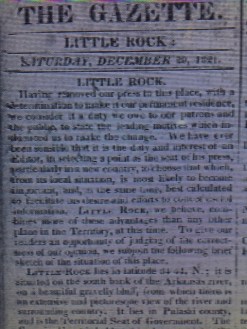
First LR ArkGaz insideAfter months of planning, on Saturday, December 29, 1821, the first edition of ARKANSAS GAZETTE to be published in Little Rock came off the press.  Due to a shortage of paper supplies, it was only a two page edition, instead of the four pages which publisher William Woodruff had been customarily printing.

Because the capitol of the Arkansas Territory had moved from Arkansas Post to Little Rock earlier in 1821, Woodruff wanted to relocate as well.  Not only did it make sense for a newspaperman to be close to the seat of government for purposes of stories, there was a financial reason for the move, too.  Woodruff wanted to continue to be the contracted official publisher of government records.  If he stayed in Arkansas Post, someone else would certainly have opened up an operation in Little Rock to do the printing.

The first Little Rock edition featured the usual mix of national news (often culled from other newspapers once they arrived at Woodruff’s establishment), local stories, and advertisements.  One of the stories was a letter from General Andrew Jackson to the citizens of the Florida Territory.  There was also a dispatch from Pernambuco, Brazil.

Because it was the first issue from Little Rock, Woodruff took time to write about Little Rock.  He noted it was located on the south side of the Arkansas River on a “beautiful gravelly bluff” with picturesque views of the river and surrounding areas.  He noted the territorial and federal government offices which were located in Little Rock.

Though the Gazette ceased publication in 1991, the 1821 publication of that paper in Little Rock set the stage for more than just that one newspaper.  It marks a continual presence of newspaper and journal publication in Little Rock for 197 years.

Little Rock Look Back: Little Rock named Capital of Arkansas

On October 18, 1820, Territorial Governor James Miller signed legislation designating Little Rock as the new capital for Arkansas.  This was a mere 10 months after the first permanent settlement was established in Little Rock.
While Little Rock became the Capital, technically it was not the Capital City, since it would not be incorporated as a City until 1835. It wasn’t even incorporated as a town until 1831.

The Act provided that after June 1, 1821, the sessions of the Legislature and the Superior Court would be held at Little Rock.  This caused Arkansas Post, the first territorial capital, to fade from prominence.

The move was made based on the lobbying of Amos Wheeler, Chester Ashley and William Russell.  These men all owned land in the Little Rock area and would benefit from the move of the Capital to Little Rock. The official reason given was Little Rock’s geographical center to the Arkansas Territory and that it was elevated land less prone to flooding.

But just as important, Messrs. Wheeler, Ashley and Russell promised to donate land for a capitol building and a guarantee of $20,000 for construction of a suitable building. (That would be the equivalent of $432,000 today.)

Around the time the legislation was approved, several members of the Territorial legislature purchased land around Little Rock.  When a subsequent effort to relocate the Capital upstream was launched, it failed due to the financial ties of these legislators to land in Little Rock.

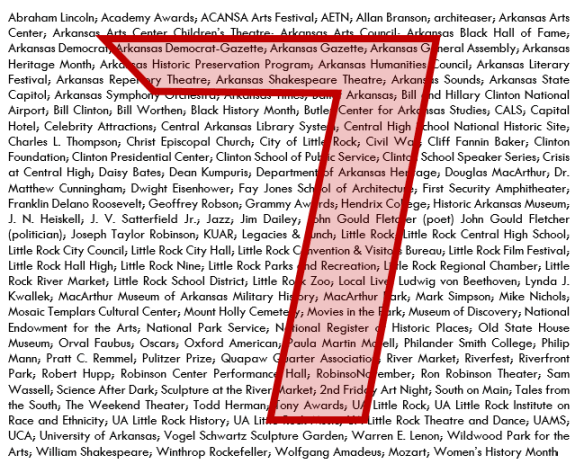
LR Culture Vulture turns 7

The Little Rock Culture Vulture debuted on Saturday, October 1, 2011, to kick off Arts & Humanities Month.

The first feature was on the Arkansas Symphony Orchestra, which was kicking off its 2011-2012 season that evening.  The program consisted of Mendelssohn’s Symphony No. 4 in A, Op. 90, Rossini’s, Overture to The Italian Girl in Algiers, Puccini’s Chrysanthemums and Respighi’s Pines of Rome.  In addition to the orchestra musicians, there was an organ on stage for this concert.

Since then, there have been 10,107 persons/places/things “tagged” in the blog.  This is the 3,773rd entry. (The symmetry to the number is purely coincidental–or is it?)  It has been viewed over 288,600 times, and over 400 readers have made comments.  It is apparently also a reference on Wikipedia.

The most popular pieces have been about Little Rock history and about people in Little Rock.

Little Rock Look Back: Sharon Priest

Little Rock’s 70th mayor, Sharon Priest, celebrates her birthday on September 12.

She began her public service at the grassroots level when she led the effort to bring flood relief to Southwest Little Rock and Pulaski County following the devastating flood of 1978 that killed 13 people in central Arkansas.

Sharon was appointed to the Little Rock City Beautiful Commission.  Following that, she challenged an incumbent City Director and won her first elective office in 1986. In January 1989, she was named Vice Mayor of Little Rock by her colleagues on the City Board.  Two years later, she was selected Mayor becoming only the second female to serve as Mayor of Little Rock.  During her service to the City of Little Rock, she spearheaded the effort to create a Little Rock flag.  At the conclusion of her second four year term on the City Board, she decided to run for Secretary of State.

In November 1994, she elected Secretary of State, becoming the first woman to be elected to that position in Arkansas.  She was reelected in 1998.   In the summer of 2000, she became President of the National Association of Secretaries of State. After the 2000 presidential election, she was thrust into the forefront of the movement toward election reform. Ms. Priest testified before U.S. House and Senate Committees on election reform. As Secretary of State, restoring the Governor’s Reception Room and the Old Supreme Court Chamber of the State Capitol to their original splendor and restoring the rotunda marble are a few of her proudest achievements.

In January 2003, Priest was selected to serve as Executive Director of the Downtown Little Rock Partnership. She served in that capacity until early 2015.  She has also been a leading champion for the redevelopment of MacArthur Park, the City’s oldest park.