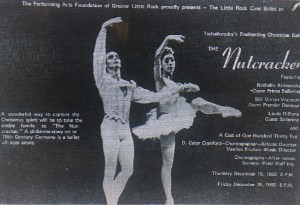
Little Rock Look Back: 1968 THE NUTCRACKER is largest production to date at Robinson

In December 1968, the final stretch of Interstate 40 between Little Rock and Memphis was completed. (Little did anyone know that milestone merely meant work would change from construction to non-stop reconstruction.)  Talks were underway about merging private Little Rock University with the University of Arkansas system.  On the TV on December 19, “The Little Drummer Boy” TV special was being shown for the first time.  Also, Arkansan Glen Campbell was one of the guest stars on Bob Hope’s Christmas TV special.

For those who did not sit at home watching TV, at Robinson Auditorium on December 19 and 20, 1968, the nascent Little Rock Civic Ballet (a forerunner to today’s Ballet Arkansas) presented its first production of THE NUTCRACKER. (There appears to be some debate as to whether this was the first complete production of this ballet in Little Rock.)

Under the direction and choreography of D. Cater Cranford, this production featured 135 performers, a fifty piece orchestra under the direction of Vasilios Priakos, and the largest number of stagehands in Robinson Auditorium’s history.  The production cost $25,000 to mount.  That would be the equivalent of just over $181,000 in 2018.

A large portion of the money went to renting sets from Dallas for the production.  The costumes were designed and sewn by Cranford.  He also appeared as Drosselmeyer in the production.  His wife Lorraine, assisted with the choreography and also appeared on stage.

Though most of the dancers were local, the leading roles were danced by Bill Martin-Viscont, Nathalie Krassovak, Linda DiBona, Margo Dean and Carl Tressler.  Some of the dancers who had rehearsed for the production were unable to participate due to several cast members coming down with flu in the days immediately prior to the production.

The production sold out both public performances as well as the daytime matinee for school children.  The dress rehearsal on December 18 was opened up for children with disabilities to attend.

Though The Nutcracker has not been presented in Little Rock every year since 1968, the overwhelming response to this production set the stage for it to become a much-loved holiday tradition in the city.


UA Little Rock Wind Ensemble concert this evening

The UA Little Rock Music Department has announced the plans for the UA Little Rock Wind Ensemble Concert which is entitled Under the Cover of Night.

The concert will be held Friday, November 30th at 7:30 – 8:30 pm in the Stella Boyle Smith Concert Hall located in the Fine Arts Building on the UA Little Rock Campus.

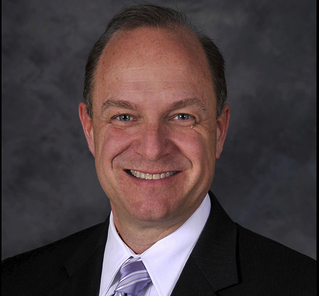
The Wind Ensemble, under the direction of Dr. Kenneth Goff, will perform music by Jack Stamp, Pavel Tschesnokoff, John Philip Sousa, and Stephen Melillo and will feature guest conductor and UA Little Rock music education major David Burkhalter.

The concert is free and open to the public.

Little Rock Look Back: Mr. J. N. Heiskell

At the age of 87, J. N. Heiskell in 1960.

John Netherland (J. N.) Heiskell served as editor of the Arkansas Gazette for more than seventy years.  He was usually called “Mr. Heiskell” by all, but a very few confidantes felt confident to call him “Ned.”

Mr. Heiskell is the person most responsible for Robinson Center Music Hall being located at the corner of Markham and Broadway.  As Chair of the Planning Commission and editor of the Arkansas Gazette he had twin bully pulpits to promote this location when those on the City Council (who actually had the final say) were looking at other locations.  He felt the location would help create a cluster of public buildings with its proximity to the county courthouse and to City Hall.  Mr. Heiskell finally succeeded in winning over the mayor and aldermen to his viewpoint.

He was born on November 2, 1872, in Rogersville, Tennessee, to Carrick White Heiskell and Eliza Ayre Netherland Heiskell. He entered the University of Tennessee at Knoxville before his eighteenth birthday and graduated in three years at the head of his class on June 7, 1893.

His early journalism career included jobs with newspapers in Knoxville and Memphis and with the Associated Press in Chicago and Louisville. On June 17, 1902, Heiskell’s family bought controlling interest in the Arkansas Gazette. Heiskell became the editor, and his brother, Fred, became managing editor.

Governor George Donaghey appointed Heiskell to succeed Jeff Davis in the United States Senate after Davis’s death in office. Heiskell served from January 6, 1913, until January 29, 1913, when a successor was chosen by the Arkansas General Assembly.  His tenure is the shortest in the U. S. Senate history.  His first speech on the Senate floor was his farewell.  He was also only the second US Senator to live to be 100.

On June 28, 1910, Heiskell married Wilhelmina Mann, daughter of the nationally prominent architect, George R. Mann. The couple had four children: Elizabeth, Louise, John N. Jr., and Carrick.

In 1907, he joined a successful effort to build the city’s first public library. He served on the library board from that year until his death and was issued the first library card.  He also served on the City’s Planning Commission for decades.  In 1912, he was instrumental in bringing John Nolen to Little Rock to devise a park plan.

In the paper and in his own personal opinions, he crusaded on a variety of progressive causes.  Perhaps the most famous was the Gazette’s stance in the 1957 Central High desegregation crisis.  It was for this effort that the paper received two Pulitzer Prizes.

Although Heiskell stopped going to the office at age ninety-nine, he continued to take an active interest in the newspaper. He began by having a copy of the newspaper delivered to his home by messenger as soon as it came off the press each night. Eventually, he switched to having his secretary call him daily at his home and read the entire newspaper to him. He operated on the premise that “anyone who runs a newspaper needs to know what’s in it, even to the classified ads.”

A few weeks after turning 100, Heiskell died of congestive heart failure brought on by arteriosclerosis on December 28, 1972. He is buried in Little Rock’s Mount Holly Cemetery.  Interestingly, he is buried in the same cemetery as two of his most notable adversaries: Governor Jeff Davis, and segregationist Congressman Dale Alford.

Mr. Heiskell donated his vast papers to UALR. They are part of the Arkansas Studies Institute collection. These papers give insight into not only his career as a journalist, but also his political and civic affairs.  Thankfully he saved much of his paperwork. Without it, much insight into Little Rock in the 20th Century would be lost.

31 Days of Arkansas Rep: 1982’s A CHRISTMAS CAROL

Scott Edmonds as Ebenezer Scrooge in “A Christmas Carol” by Charles Dickens – from Developing Character at the Arkansas Rep 1983-1984 by Andrew Kilgore. Arkansas Arts Center Foundation Collection. Gift of Doyne and Margaret Dodd.There were plenty of Christmas carols during the 1982 Arkansas Rep production of A Christmas Carol. This was the first time, in the Rep’s seven Decembers of existence, that a holiday-themed show had been presented in December.
The production was directed by the Rep’s Artistic Associate Montgomery Kuklenski (who is now an entertainment executive in Los Angeles).  After Cliff Fannin Baker decided to produce a stage version of the Charles Dickens chestnut, Kuklenski read over a dozen versions before selecting one by Tom Markus.

Instead of taking place on the Rep’s stage, the production was mounted in the university theatre on the UALR campus.  (With a cast of nearly 40 actors and many special effects, it would have been difficult to produce this at the Rep’s home adjacent to MacArthur Park.)

Scott Edmonds played the title character with other parts being played by Dallas Miles, Jonathan Michaelson, Rebeccas Wilenski, Charles Hatchock, Larry Edwards, Peter White, Jay Kinney, Tommy Cherepski, Ted Eades, and Ronald J. Aulgur.

One of the reasons that the Markus version was selected was that it incorporated numerous Christmas carols into the script both as part of the action and as transitions between scenes. Sharon Douglas served as pianist and music director for the production.

The production ran from December 9 through 18 of 1982.

Several of the actors were captured in Mark Hughes’s costumes by Andrew Kilgore as part of his multi-season Developing Character black and white photo portrait series.  The Arkansas Arts Center has over twenty of these photos in its permanent collection.

The Rep also has many of these photos. As part of 2nd Friday Art Night, the Rep is displaying some of these photos in the lobby of the current building.

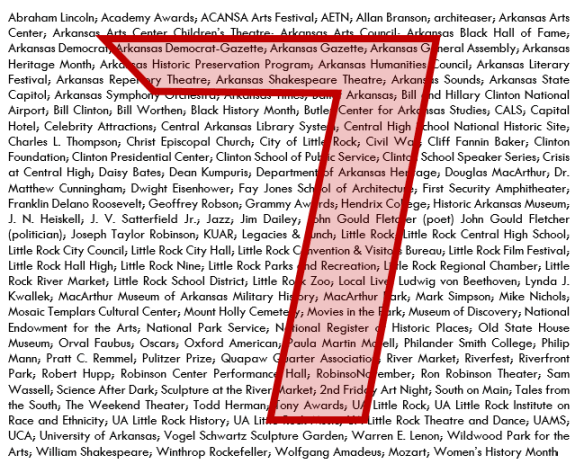
LR Culture Vulture turns 7

The Little Rock Culture Vulture debuted on Saturday, October 1, 2011, to kick off Arts & Humanities Month.
The first feature was on the Arkansas Symphony Orchestra, which was kicking off its 2011-2012 season that evening.  The program consisted of Mendelssohn’s Symphony No. 4 in A, Op. 90, Rossini’s, Overture to The Italian Girl in Algiers, Puccini’s Chrysanthemums and Respighi’s Pines of Rome.  In addition to the orchestra musicians, there was an organ on stage for this concert.

Since then, there have been 10,107 persons/places/things “tagged” in the blog.  This is the 3,773rd entry. (The symmetry to the number is purely coincidental–or is it?)  It has been viewed over 288,600 times, and over 400 readers have made comments.  It is apparently also a reference on Wikipedia.

The most popular pieces have been about Little Rock history and about people in Little Rock.

Services announced for Dr David O. Belcher

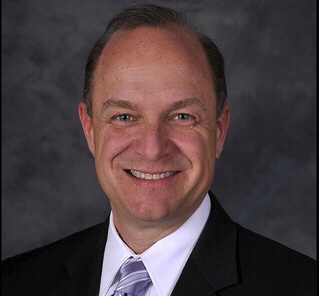
Western Carolina University has announced the services for Dr David O. Belcher.

The memorial will be Saturday, June 23, 2018, at 1:00pm EDT. It will be at the Bardo Fine and Performing Arts Center on the WCU campus, where Dr. Belcher often performed.

A dessert reception will follow the service in the Bardo Arts Center Star Lobby.

It will be livestreamed on the WCU website here. (12 noon for those from the Missouri State University and University of Arkansas at Little Rock communities who might want to watch it.)

Remembering Dr. David O. Belcher

As a undergraduate and later graduate student at then-Southwest Missouri State University, I first became aware of Dr. David O. Belcher.  I had several friends who were music majors, and they would speak glowingly of him.  Another friend, an accounting major, took piano lessons from him.

As the College of Arts and Letters had leadership vacancies, Dr. Belcher was tapped to fill them.  He was chosen because he was a visionary, a perfectionist, and a consensus builder.

My favorite memory of him during the time we were both in Springfield, however, is of him playing the piano portion of “Rhapsody in Blue” at the Grand Opening Gala of Juanita K. Hammons Hall for the Performing Arts.  Backed by the Springfield Symphony, he deftly handled this classic piece.  As a graduate assistant on the staff, I was able to listen to several rehearsals.  He always gave his all during every run-through.

A few years after I returned to Little Rock, I received a phone call from Jo Jones in the Chancellor’s office at UALR.  Dr. Joel Anderson was considering David to be his Provost.  Jo (a family friend) knew I had attended SMSU and wanted to know my thoughts about him.  I told her that due to the fact I was not involved directly in the music department, I had probably said fewer than 10 words to him, outside of “Hello” but then proceeded to tell her of his reputation, of what I had observed, and what I had heard from others.   A week or so later, she called to tell me that Dr. Anderson had just announced to the UALR faculty the hiring of Dr. Belcher.

I sent him an email to welcome him to Little Rock. Since he was a musician, and cultural affairs were part of my duties at the City of Little Rock, I was especially excited to have him come.  Some mutual friends asked me to also reach out to Susan. (I think they were not yet married but were engaged.) I was thrilled to do so.

Once they arrived, the Little Rock arts community embraced them, and they embraced it.  It was a definite mutual admiration society.  They became involved with the Symphony, the Rep, Wildwood, the Arts Center,  Accademia dell’Arte, and numerous music organizations.  They promoted the UALR arts to the community and supported on-campus efforts with their attendance and participation.  I was eventually able to convince David to serve on the City’s Arts+Culture Commission.  After service of  few months, he was asked to be the chair. Though busy with numerous major tasks at UALR, he agreed.

From time to time we would meet for lunch. Our conversations would veer between Springfield, Little Rock, and the arts in general.  They were always delightful.

In 2005, he was a finalist to become the next president at what would be Missouri State University.  At the time, I joked to Dr. Anderson that either way the selection went, I would benefit. He responded with a smile that he appreciated my response, but that he did not benefit if David left. He followed up by saying, “He is so good, I know I won’t be able to keep him here forever, but I want a few more years.”

While it was not meant for David and Susan to return to Springfield, he maintained many close ties. (He also poached several excellent faculty and administrators from Springfield to come to Little Rock.)

Alas for Little Rock, in 2011 he was hired by Western Carolina University to lead that campus.  Not only did it give him the chance to be a Chancellor, but it also took him closer to his family and his roots.

By all accounts, he was as dynamic and respected at WCU as he had been in Springfield and Little Rock.  Unfortunately, in 2016, he was diagnosed with a brain tumor.  Through two years of treatments, surgery, improvements, and setbacks, he kept up as well as possible with his duties.

A page on the WCU website posted updates. He felt it was important for the faculty, students, and donors to know about his status.  A photo on that page shows hundreds of people standing in the rain at a rally to show support for him as he battled this.  On August 1, 2017, he announced the tumor had returned.  Later in the semester, he announced he would be going on medical leave effective December 31, 2017.

On June 14, 2018, the first update of the year was made. It noted he was in a care facility and receiving only family and close friends. It encouraged people to write notes and stressed that the Belchers wanted any tributes to be made for scholarships at WCU.

Following his death on June 17, 2018, his obituary also encouraged memorials be made to Furman (his alma mater), Missouri State University, and the University of Arkansas at Little Rock.  Unselfish to the end, his last wishes paid tribute to the institutions which had prepared him to lead WCU.

Godspeed Dr. David O. Belcher.  The music will continue to play. But it will be a slightly different tune without your contributions.