31 Days of Arkansas Rep: KENNEDY’S CHILDREN in 1977

Since October 3, 2018, marks the 55th anniversary of JFK speaking in Little Rock, it seems an appropriate day to feature the 1977 Arkansas Rep production of Robert Patrick’s KENNEDY’S CHILDREN.

The play takes place in a NYC bar on Valentine’s Day 1974 as its denizens speak in intertwining monologues about the 1960s and coping with the disillusions they feel from that earlier decade.  The title comes from the sense that the 1960s after November 1963 were a reaction to the loss of JFK and his idealism.

One of the characters, who was played by Jean Lind at Arkansas Rep, is obsessed with the Kennedy Administration. Others in the cast were Jean Hendrickson, Phyllis Blumenfeld, Scott Edmonds and Barry Carter.  Guy Couch played the important, but non-speaking, role of the bartender who plies the quintet with drinks throughout the play.

In the original production, there is a jukebox which plays musical interludes as transitions. In a nod to director Cliff Fannin Baker’s ingenuity, that role was played by Frank Gordon on jazz clarinet. It actually added a sense of humanity and added soulfulness to the production.

The bar in which the action took place was designed and lit by Byl Harriell.  The physical presence was described by Bill Lewis in the Arkansas Gazette review as a “masterful sleezy bar.”

The production ran from December 1 through 17 in 1977. Tickets were $5.00 a person. (This is the equivalent of $20.80 today.)

JFK in ARK (and specifically LR)

On October 3, 1963, President John F. Kennedy delivered remarks at the Arkansas State Fairgrounds.  Only a few weeks later, he would be felled by an assassins bullet in Texas.

In the speech, the President praised Arkansas’ congressional delegation including Senators John McClellan and J. William Fulbright and Congressmen Took Gathings, Bill Trimble, Wilbur Mills and Oren Harris.  Each of these men held senior leadership positions in key committees.  The main focus of the speech was to discuss President Kennedy’s vision for a new economy in the South.

The President was actually in the state to speak at the dedication of the Greers Ferry Dam. He agreed to make that appearance as a part of a negotiation with Congressman Mills as they were deadlocked over changes to the tax code.  He had previously visited Little Rock in 1957 when he came to the state to address the Arkansas Bar Association meeting in Hot Springs.

President Kennedy continued the string of 20th Century Presidents to visit Little Rock.  Presidents Theodore Roosevelt, William Howard Taft, Franklin Roosevelt and Harry Truman had all visited while in office.  Woodrow Wilson, Herbert Hoover and Dwight Eisenhower all visited prior to attaining the presidency.

31 Day of Arkansas Rep: THE RUNNER STUMBLES in 1979

Pat Brown, director of THE RUNNER STUMBLES

While he directed most shows at the Rep during the early years, Cliff Fannin Baker would bring in guest directors from time to time. One of these was Pat Brown who helmed the February 1979 production of The Runner Stumbles.

A co-founder of Houston’s Alley Theatre, Brown also had connections to Little Rock; she was a niece of Little Rock businesswoman Mae Horn (who dressed ALL the best-dressed men.)

Though Brown had worked all over the US, this was the first time she had directed The Runner Stumbles. This Milan Stitt play had run for 396 performances on Broadway from 1976 to 1978. The Arkansas Rep was one of the first regional theatres to produce the play.  (Side note: the original Broadway production was directed by Austin Pendleton who would later direct A Loss of Roses at Arkansas Rep.)

In his Arkansas Gazette review, Bill Lewis called the production “one of the strongest yet” for the Rep.  He described it as a “compelling, somber drama” that was “impeccably directed and acted with highest octane virtuosity.”  Lewis was not one to mince words, so when he gave praise it was deserved.

The cast for A Runner Stumbles included Craig Fuller, Jean Hendrickson, Scott Edmonds, Jean Lind, Ron Aulgur, Ken Klingenmeier, Jeannine Le May, Robert Boles, and Phyllis Blumenfeld. The show was designed by Byl Harriell.  Guy Couch assisted with set decoration and props.

The production ran from February 1 to 18 of 1979.

Little Rock Look Back: Mayoral Election of 1832

Little Rock’s 73rd Mayor will take office on Tuesday, January 1, 2019.  In the next few weeks, past races for mayor will be featured on Tuesdays.

Up first is the the first race for mayor.  It was between Dr. Matthew Cunningham and Rev. W. W. Stevenson.

  • Dr. Cunningham had been a founding father of Little Rock.  He was the first physician, husband of the first woman to be a permanent settler of Little Rock, and father of the first baby born to a Little Rock resident.
  • Rev. Stevenson was a member of the Presbyterian clergy as well as a geologist.  He had first come to Batesville before settling in Little Rock.

In November 1831, the Town of Little Rock was officially chartered by the Territory of Arkansas.  The first election was set for New Year’s Day, 1832.

On the appointed day, the white men who were eligible to vote gathered at the prescribed location and cast their votes. By a vote of 23 to 15, Dr. Cunningham won the race. There are no media accounts of issues that may have arisen during the campaign, or if there was even much of a campaign.

Dr. Cunningham served as Little Rock’s first mayor during the calendar year of 1832 but did not seek a second term.  His successor was Rev. Stevenson. Records suggest that Rev. Stevenson may have been unopposed in his quest. He, too, served only one year.  Later in the 1830s, some friends tried to recruit him to run for mayor again, but he declined.

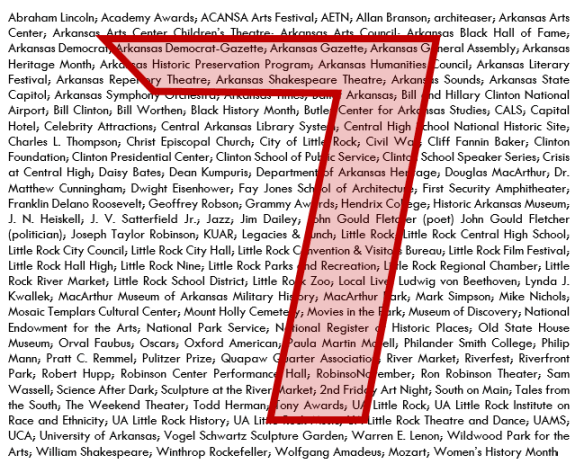
LR Culture Vulture turns 7

The Little Rock Culture Vulture debuted on Saturday, October 1, 2011, to kick off Arts & Humanities Month.

The first feature was on the Arkansas Symphony Orchestra, which was kicking off its 2011-2012 season that evening.  The program consisted of Mendelssohn’s Symphony No. 4 in A, Op. 90, Rossini’s, Overture to The Italian Girl in Algiers, Puccini’s Chrysanthemums and Respighi’s Pines of Rome.  In addition to the orchestra musicians, there was an organ on stage for this concert.

Since then, there have been 10,107 persons/places/things “tagged” in the blog.  This is the 3,773rd entry. (The symmetry to the number is purely coincidental–or is it?)  It has been viewed over 288,600 times, and over 400 readers have made comments.  It is apparently also a reference on Wikipedia.

The most popular pieces have been about Little Rock history and about people in Little Rock.

31 Days of Arkansas Rep: THE THREEPENNY OPERA

October is Arts and Humanities Month.  This year, each day a different past Arkansas Repertory Theatre production will be featured.  This is, in part, a tribute to the late Cliff Baker, and also a countdown to the Rep’s re-emergence.

Up first, is the first Arkansas Repertory Theatre production: 1976’s THE THREEPENNY OPERA.

On November 11, 1976, the curtain went up on the first Arkansas Repertory Theatre production.  It was the Kurt Weill-Bertolt Brecht musical The Threepenny Opera.  Rep founder Cliff Baker directed the show and played the leading role of Macheath aka Mack the Knife.

Others in the cast included local attorney Herb Rule, Jean Lind, Theresa Glasscock, Connie Gordon and Guy Couch.  Byl Harriell was the technical director and production designer while Donia Crofton was the costume designer.

The production took place in the Rep’s home which was the converted former home of Hunter United Methodist Church on the eastern edge of MacArthur Park.  (Harriell’s business Bylites is now in that location.)

Baker had previously worked at the Arkansas Arts Center theatre when it was attached to a degree granting MFA program. He had also directed shows in other parts of Arkansas.  He returned to Little Rock and founded the Arkansas Philharmonic Theatre which performed in Hillcrest.  The Arkansas Repertory Theatre was a step forward with the establishment of a professional repertory company.

The first season of the Rep would include Company, Suddenly Last Summer, Marat/Sade, and Stop the World–I Want to Get Off. Season tickets for a total of seven shows were $30.

Little Rock Look Back: Vogel Schwartz Sculpture Garden Expansion

Photo by Little Rock Convention and Visitors Bureau

On Sunday, October 1, 2017, the expansion of the Vogel Schwartz Sculpture Garden was dedicated.

The expansion more than doubled the area of the garden.  It also allowed for larger sculptures to be installed.

The construction took nearly a year. The design for the garden and the landscaping have all been done by the Little Rock Parks and Recreation Department.

A dozen new sculptures were part of the expansion, which brought the total to 66 pieces by 48 different artists.  (More have been added in the past year.)

The Vogel Schwartz Sculpture Garden was originally dedicated in 2009 at Riverfront Park.