

31 Days of Arkansas Rep: PROOF by LR Hall Alum David Auburn

Fourteen years after graduating from Little Rock Hall High School, David Auburn received the 2001 Pulitzer Prize in Drama for his play Proof.  In September 2002, Arkansas Repertory Theatre produced Proof while the original Broadway run was in its final months.

The production at Arkansas Rep was directed by Producing Artistic Director Robert Hupp.  The cast featured Amy Tribbey, Scott Barrow, Jessica Henson and Curt Karibalis.  (Barrow met his future wife, the former Amy Sabin, while in Little Rock during the run of this show.)

The set, a very realistic craftsman house back porch, was designed by Mike Nichols.  On opening night he was lauded because the production marked his 20th anniversary with the Rep. (In 2018, Nichols is still serving as Technical Director and Resident Scenic Designer for the Rep.)

Auburn was unable to come to Little Rock to see the production. His wife was set to give birth to a child during the run of the show.

When Auburn was growing up in Little Rock, he and his brother were active with the Arkansas Arts Center Children’s Theatre which is across MacArthur Park from where the Rep was at the time.
31 Days of Arkansas Rep: 1994’s LOST IN YONKERS

Over the years, the Arkansas Rep has produced several Neil Simon plays and musicals.
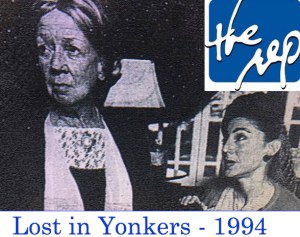
In October 1994, Arkansas Rep produced Simon’s only play to win a Pulitzer, Lost in Yonkers.  Though darker in tone than many of his plays, it still provided a host of laughs.

The two boys at the center of the story were played by future filmmaker Graham Gordy and future Broadway producer Will Trice.  The matriarch who presides over the action was played by Anne Sheldon, a Little Rock native who’d left the city after marrying during World War II.

Others in the cast were Lori Wilner, Clif Morts, Elizabeth Aiello and Ed Romanoff.  The production was directed by William Gregg, a guest director at the Rep.  Mike Nichols provided the scenic design, while Don Bolinger was the costume designer.


31 Days of Arkansas Rep: 1985’s CRIMES OF THE HEART

Since at least Chekov, playwrights have been fascinated with a trio of women at the center of a play.  Southerner Beth Henley put her own twist on this concept with her 1981 Pulitzer Prize winner Crimes of the Heart.
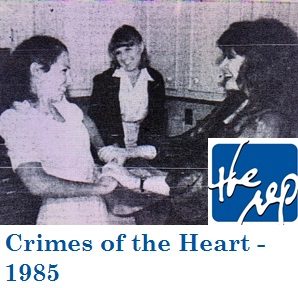
Focusing on the three Magrath sisters and their assorted friends in Hazelhurst, Mississippi, the story looks at how they come together because one of the sisters is accused of shooting her estranged husband.  A comedy with some dark undertones, it was a hit Off Broadway and then transferred to Broadway after winning the Pulitzer.

Arkansas Rep presented it in April 1985.  The cast featured Evelyn Carol Case, Cathey Crowell Sawyer and Laurel Anne White as the three sisters.  Maggie Murphy, Jeff Bailey and Mark Johnson rounded out the cast.  The show was directed by Cliff Baker, who had  directed the same show (with a different cast and design team) at the Alley Theatre earlier in 1985.

LR Culture Vulture turns 7

The Little Rock Culture Vulture debuted on Saturday, October 1, 2011, to kick off Arts & Humanities Month.

The first feature was on the Arkansas Symphony Orchestra, which was kicking off its 2011-2012 season that evening.  The program consisted of Mendelssohn’s Symphony No. 4 in A, Op. 90, Rossini’s, Overture to The Italian Girl in Algiers, Puccini’s Chrysanthemums and Respighi’s Pines of Rome.  In addition to the orchestra musicians, there was an organ on stage for this concert.

Since then, there have been 10,107 persons/places/things “tagged” in the blog.  This is the 3,773rd entry. (The symmetry to the number is purely coincidental–or is it?)  It has been viewed over 288,600 times, and over 400 readers have made comments.  It is apparently also a reference on Wikipedia.

The most popular pieces have been about Little Rock history and about people in Little Rock.

Remember the Fallen on Memorial Day at Mount Holly Cemetery

Today is Memorial Day – a time to pay tribute to the men and women in uniform who died in service to their country.
As a way to give this recognition, today would be a good day to visit a cemetery. One of Little Rock’s most storied cemeteries is Mount Holly Cemetery. There are numerous persons buried there who died while in service to their country.

One of them is 2Lt Carrick W. Heiskell, son of Arkansas Gazette editor J. N. Heiskell.  2Lt Heiskell died while flying for the Air Transport Command in the Himalayas during World War II.  He was posthumously the recipient of the Distinguished Unit Emblem, Purple Heart, and the Air Medal.

Founded in 1843, Mount Holly has been called “The Westminster Abbey of Arkansas.” Thousands of visitors come each year. Those interested in history come to see the resting places of the territorial citizens of the state, including governors, senators, generals, black artisans, and even a Cherokee princess. For others the cemetery is an open air museum of artistic eras: Classical, Victorian, Art Deco, Modern––expressed in gravestone styles from simple to elaborate. Some come to read the epitaphs that range from heartbreaking to humorous to mysterious.

Though a City of Little Rock facility, the cemetery is maintained by the Mount Holly Cemetery Association, a non-profit organization with a volunteer Board of Directors. The cemetery is located at 1200 South Broadway in Little Rock. Gates are open from 8 a.m. until 5 p.m. in the summer and from 8 a.m. until 4 p.m. in the winter.

Little Rock Look Back: Pulitzer Prize to SOUTH PACIFIC

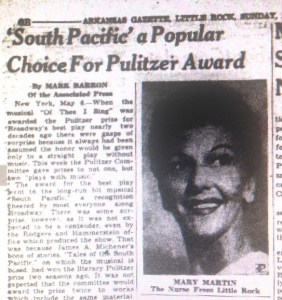
On May 5, 1950, the Rodgers and Hammerstein musical South Pacific captured the Pulitzer Prize in Drama. This would receive special attention in the Arkansas Gazette. The reason this carried such weight in Arkansas was that the musical had a connection to Little Rock.
The 1950 Pulitzer for Drama went to a musical, for only the second time in the history of the awards. The recipient was South Pacific by Richard Rodgers, Oscar Hammerstein II and Joshua Logan. The character was the leading lady of Nellie Forbush. She was an Navy ensign and a nurse stationed on an exotic island during World War II. The musical was based on a Pulitzer Prize winning novel, James Michener’s Tales of the South Pacific.

In the Michener novel, Miss Forbush is not from Little Rock. She is actually from a small town in Alabama. But the book does mention Nellie and her mother visiting Little Rock.  The part was written for Mary Martin from Weatherford, Texas. Rodgers, Hammerstein & Logan did not discuss why they relocated Nellie’s birthplace.

Originally the musical contained a song entitled “My Girl Back Home” in which Nellie sang of being from “Little Rock, A-R-K” while another character sang of being from “Philadelphia, P-A” and “Princeton, N-J.” It is possible the change to Little Rock was made because it offered more lyrical possibilities, but that is only a supposition on the part of the Culture Vulture. That song did appear in the movie version in which Mitzi Gaynor played Nellie Forbush. It was also featured in the 2008 Broadway revival, this time with Kelli O’Hara playing Nellie.

In the musical, Nellie struggles with her own prejudices. This issue of prejudice became an instance of fact meeting fiction. In 1957, a few weeks after Eisenhower sent troops into Little Rock to ensure that Central High would be desegregated, a production of South Pacific on Long Island was temporarily halted when the audience booed and yelled after Nellie mentioned she was from Little Rock. Interestingly, the movie was released in 1958, but retained references to Little Rock. That was either a testament to the expense of re-editing it, or the fact that audience reaction had lessened.

Little Rock Look Back: 2 Pulitzers for the ARKANSAS GAZETTE

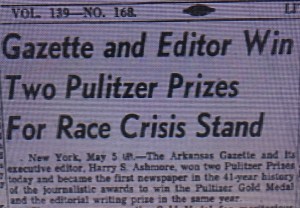
On May 5, 1958, it was announced that the Arkansas Gazette had received two Pulitzer Prizes.  These were for the coverage of the 1957 integration (or lack thereof) at Little Rock Central High School.

The first Pulitzer was for Public Service.  It was awarded to the newspaper.  The citation stated:

For demonstrating the highest qualities of civic leadership, journalistic responsibility and moral courage in the face of great public tension during the school integration crisis of 1957. The newspaper’s fearless and completely objective news coverage, plus its reasoned and moderate policy, did much to restore calmness and order to an overwrought community, reflecting great credit on its editors and its management.

The second Pulitzer was for Editorial Writing.  It was awarded to Harry Ashmore.  The citation read:

For the forcefulness, dispassionate analysis and clarity of his editorials on the school integration conflict in Little Rock.

This was the first time that the Pulitzer for Public Service and Editorial Writing went to the same publication in the same year.

The newspaper coverage in the afternoon Arkansas Democrat and morning Arkansas Gazette was provided by the Associated Press.  The Democrat‘s story ran on the afternoon of the announcement. The front page story had the headline “Pulitzer Honors Go to Gazette.”  The next morning the Gazette ran a longer story under the headline “Gazette and Editor Win Two Pulitzer Prizes for Race Crisis Stand.”  It included a quote from publisher Hugh Patterson, Jr.  He stated, “This recognition belongs to every member of the staff of the Gazette.  I am proud to be associated with these men and women.”

The Pulitzer for National Reporting went to Relman Morin of the Associated Press for his coverage of the events.  His citation noted:
for his dramatic and incisive eyewitness report of mob violence on September 23, 1957, during the integration crisis at the Central High School in Little Rock, Arkansas.

Photographer Will Counts of the Arkansas Democrat was the unanimous choice of the jury to receive the Pulitzer in photography for his photo of the crowd jeering at Elizabeth Eckford.  The board overruled that selection, as was their purview. Speculation was that the board may not have wanted to award four Pulitzers for the same news story.