
Little Rock Look Back: Christmas Eve 1937 Groundbreaking for Robinson Auditorium

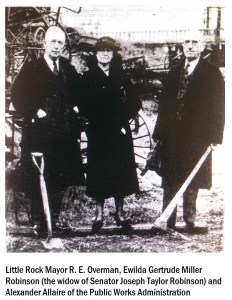
On December 24, 1937, at 11:30 a.m., Little Rock Mayor R. E. Overman, Ewilda Gertrude Miller Robinson (the widow of Senator Joseph Taylor Robinson) and  Alexander Allaire of the PWA turned dirt to participate in the brief groundbreaking ceremony for Little Rock’s municipal auditorium.

That morning, the Arkansas Gazette ran a brief story on the upcoming groundbreaking.  The story mentioned that the building would be named in memory of the late beloved Arkansas politician.  This appears to be the first public pronouncement of the Robinson name for this civic structure.

Among others in attendance at the groundbreaking were Mrs. Charles Miller (sister-in-law of Mrs. Robinson), Mr. and Mrs. Grady Miller (brother and sister-in-law of Mrs. Robinson), the mayor’s wife, the three architects (George Wittenberg, Lawson Delony and Eugene John Stern), and D. H. Daugherty and Will Terry of the City’s Board of Public Affairs.

Construction had to start by January 1, 1938, in order to receive PWA funds.  By breaking ground on December 24, there was over a week to spare.  The site had been selected in late October 1937, and the purchase had not been finalized.  But the PWA did give permission for the City to let a contract for excavation, demolition and filling on the site.

The groundbreaking took place at the corner of Garland and Spring Streets which was on the northeast corner of the block set aside for the auditorium.  Today, Spring Street does not extend north of Markham; the street was closed to make way for the parking structure and what is now the Doubletree Hotel.  Garland Street is basically an alley that runs parallel to Markham north of City Hall, Robinson Auditorium and the Doubletree Hotel.

Little Rock Look Back: Thanksgiving Day Football in 1918

100 years ago, the Little Rock High School Tigers football game on Thanksgiving was against a group of soldiers from Camp Pike.
The game took place on Thursday, November 28, 1918. The Great War had ended a little over a fortnight earlier, but the game had been scheduled while hostilities were still going.

The Tigers, who had never lost on Thanksgiving Day after starting a tradition of playing on the day in 1914, were for the first time the underdogs. The soldiers of the 13th Training Battalion were slightly older and much bigger – an average of 20 pounds bigger per player.

Going into the game, the Little Rock High School team was down a key player. Julian Adams was out with wrenched knee.  Another player John Ward was also absent (though the newspaper accounts do not indicate why).

Coach George H. Wittenberg was missing along the sidelines due to illness. He was not the first coach to be absent that season.  The regular coach, Earl Quigley, had been drafted and was stationed in South Carolina during the season.  Wittenberg, was a faculty member at the time. He had lettered for the football team when he had been a student a decade or so earlier. Later, as an architect, he would be one of the designers of the new Little Rock High School, now Central High School.

The game took place at Kavanaugh Field (a baseball field also used for football).  Though it is now the site of current Central’s storied Quigley Stadium, this was nearly a decade before the high school moved from Scott Street to Park Street.

The Camp Pike gridiron team dominated the game before a crowd of 1,000. The soldiers made three touchdowns in the first quarter, two in the second, one in the third, and one more to cap off the game in the fourth.

The closest the Tiger eleven got to scoring was in the second quarter when Hershell Riffel caught the ball at the 12 yard line and team captain and quarterback Alvin Bell advanced another six yards.  Camp Pike held them there.  Just before the game ended, Bell injured his knee and was taken out of the game.

Also that day, the University of Arkansas beat Kendall College (now the University of Tulsa) in Tulsa by a score of 23 to 6, West Tennessee Normal (now University of Memphis) defeated the Jonesboro Aggies (now Arkansas State Red Wolves) by a score of 37 to 0, and Hendrix College bested Henderson-Brown (now Henderson State University) by a score of 9 to 7.

Thanks to Brian Cox’s book Tiger Pride: 100 Years of Little Rock Central High Football for filling in some of the players names which were omitted in the newspaper coverage.

LR Culture Vulture turns 7

The Little Rock Culture Vulture debuted on Saturday, October 1, 2011, to kick off Arts & Humanities Month.
The first feature was on the Arkansas Symphony Orchestra, which was kicking off its 2011-2012 season that evening.  The program consisted of Mendelssohn’s Symphony No. 4 in A, Op. 90, Rossini’s, Overture to The Italian Girl in Algiers, Puccini’s Chrysanthemums and Respighi’s Pines of Rome.  In addition to the orchestra musicians, there was an organ on stage for this concert.

Since then, there have been 10,107 persons/places/things “tagged” in the blog.  This is the 3,773rd entry. (The symmetry to the number is purely coincidental–or is it?)  It has been viewed over 288,600 times, and over 400 readers have made comments.  It is apparently also a reference on Wikipedia.

The most popular pieces have been about Little Rock history and about people in Little Rock.

Little Rock Look Back: Approval of a temporary municipal auditorium

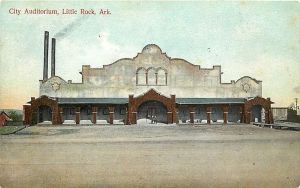
Following the court decision which forbade the City of Little Rock from using public dollars to construct a municipal auditorium, a temporary solution was sought.  On August 20, 1906, the City Council approved plans for such a structure.

Now for some context….

After the September 10, 1906, City Council meeting, the mayor told the Gazette that the Board of Public Affairs had leased part of the City’s land at Markham and Arch Streets to A. C. Read to construct the rink and auditorium.  The lease also allowed the building to extend out into Arch Street (the 1913 Sanborn Map shows it covering approximately two-thirds of the width of the street).  The mayor noted that, “It is stipulated in our lease to Mr. Read that the city shall have the use of the auditorium which he shall erect at any time.”

According to the Democrat, by September the building was already under construction.  That paper also noted that “after three years it passes into the hands of the city, when it can be repaired or remodeled to suit convention purposes.”  In the story about the new plans, the Democrat also gave the facility a very optimistic seating capacity of 9,000 people.

This announcement by Mayor Lenon should not have been a surprise to close observers of the City Council.  On August 13, 1906, A. C. Read, a businessman and real estate developer, petitioned the City for the right to construct a skating rink.  The matter was referred to the Street & Fire Committee, the Superintendent of Public Works and Aldermen Louis Volmer and Benjamin S. Thalheimer, who represented the Sixth Ward, in which the structure would be located.

Neither the Gazette nor the Democrat carried a mention of this petition in their coverage of that meeting.  By the next Council meeting a week later, the committee had reported back with a recommendation for approval.  Resolution 288 was adopted giving Mr. Read the right to build the skating rink.  Interestingly, the resolution did not contain the words “skating rink” though the original petition had.  Instead it permitted Mr. Read to construct a building “suitable for purposes as defined by the Board of Public Affairs.”

The resolution also stated that within three years the building would become property of the City.  The unnamed Gazette reporter at the August 21, 1906, City Council meeting did note in a story the day after the meeting that Mr. Read’s structure would probably be used as an auditorium in three years when the lease was up and the land use reverted back to the City.

Matters often languished in committees of the City Council for weeks; the one week turnaround of Mr. Read’s petition was highly uncommon.  It was also rare for the City Council to meet two weeks in a row.  The fact that it was reported back so quickly would be an indication that this was no standard petition from a citizen.

Civic observers might also have noted that the resolution contained language that a private citizen had been given permission to construct a building on City-owned property to the specifications of the City’s Board of Public Affairs.  Records do not indicate who concocted this scheme, but it is likely that Mayor Lenon was involved.  However his papers shed no light on that time in his administration.

1906 verdict scuttles plans for new LR City Hall with Auditorium

The 1906 plans for City Hall with the Municipal Auditorium on the left portion.

Little Rock Mayor Warren E. Lenon had been advocating for a new City Hall a municipal auditorium since shortly after taking office in April 1903. After plans were approved in July 1906, a group of citizens, led by Arkansas Gazette publisher J. N. Heiskell, filed suit to stop the City.

The closing arguments in the trial against plans for a new City Hall and auditorium complex had been heard on Monday, July 30.  The case was heard by Chancery Judge J. C. Hart.  Serving as an advisor to Chancellor Hart throughout the trial (though with no official legal standing) was Pulaski County Circuit Court Judge Robert J. Lea.  To accommodate the expected large attendance, the trial had been moved into his courtroom which was larger than Chancellor Hart’s.

On Friday, August 3, Pulaski County Chancery Judge J. C. Hart issued an injunction to keep the City from signing a contract for the construction of a city hall, jail and auditorium.  Chancellor Hart concurred with the plaintiffs that Arkansas’ constitution and laws dictated all taxation must be for public purposes.  He found there was nothing in Arkansas case law which defined an auditorium to be used for conventions as a public purpose.

As had been the case throughout the trial, the tone of the coverage of the decision differed greatly in the city’s two daily papers.  The subheading in the Democrat noted that the plaintiffs would be liable for any losses to the municipal government’s coffers due to a delay in commencing the construction if Little Rock eventually prevailed.  That fact is not mentioned by the Gazette.  Both papers did make note that Judge Lea agreed with the Chancellor’s decision.

For now, it looked as if the City of Little Rock would be stuck in the 1867 City Hall on Markham between Main and Louisiana.  Mr. Heiskell and his compatriots waited to see if the City would appeal the decision.

While August would be a quiet month publicly, work would go on behind the scenes.  More on that, in the future.

Rocking the Tonys: Baryshnikov at Robinson (part 2)

One of the presenters at Sunday’s 72nd Tony Awards is Mikhail Baryshnikov.  Twenty-nine years ago, he himself was a 1989 Tony nominee for Actor in a Play (for playing a man-turned-cockroach in an adaptation of Kafka’s Metamorphosis.

In 1985, Baryshnikov returned to Little Rock to perform again at Robinson Center under the auspices of Ballet Arkansas.   He had performed here two years earlier, as well.

Among the dancers who joined him in the program was future Tony nominee Robert LaFosse.  He would be nominated for a 1989 Tony as well. But he was up for Best Actor in a Musical for his performance in Jerome Robbins’ Broadway.  Other dancers in the company were Cynthia Harvey, Susan Jaffe, Leslie Browne, Elaine Kudo, Cheryl Yeager, Amanda McKerrow, Deirdre Carberry, Bonnie Moore, Valerie Madonia, Ross Stretton, Peter Fonseca, Gil Boggs, John Gardner, and John Turjoman.

The company danced to pieces choreographed by George Balanchine, Jerome Robbins, Marius Petipa, future Tony Award winner Twyla Tharp, Lisa de Ribere, and La Fosse.  The music composers included George Gershwin, Jacques Offenbach, Frederic Chopin, Peter Ilyich Tchaikovsky, Hector Berlioz, as well as composers who wrote songs for Frank Sinatra.

While Ballet Arkansas did not have any dancers perform during the evening, the organization presented it and was able to receive the proceeds which exceeded the expenses.  For several years in the 1980s, the Ballet would either commence or conclude their season with such an performance. In fact, the 1985 Baryshnikov program contained a promotion of a 1986 visit by Alvin Ailey’s dance company.

Whereas the 1983 Baryshnikov appearance had been sponsored by the Arkansas Democrat, this time, the rival Arkansas Gazette was the sponsor.


Little Rock Look Back: Final Graduation of Dunbar High School

On May 27, 1955, on the stage of Robinson Auditorium, the Dunbar High School senior class graduated. This academic year marked not only the 25th anniversary of Dunbar’s opening, but it was the last year that the school building would offer junior high through junior college classes.

In the fall of 1955, the new Horace Mann High School would open. Dunbar would continue to be open, but only as a junior high.  (Though no reason was given, the junior college component ended in May 1955.)

The new Mann High School was constructed, in part, as a way to delay any integration plans for the Little Rock School District.  With a new second all-white high school in the works for Little Rock, it was thought that a new African American school would placate the African-American community by not only giving them a new building, but relieving the overcrowding at Dunbar.

But on May 27, 1955, and the days leading up to it, the focus was on celebrating the final graduation class and the 25th anniversary of Dunbar High School.  On May 25, teachers who had taught for 25 years at the school, and original teachers who retired from the school were honored.

The school’s original principal, Dr. John H. Lewis, was the commencement speaker.  The current principal, Dr. L. W. Christophe presided over the awarding of the diplomas and announcements of scholarships.  Among the higher education institutions to which they received scholarships were the University of Michigan, Wiley College, Tennessee State, Arkansas AM&N, Talladega College, and Philander Smith College.

While the Arkansas Gazette and Arkansas Democrat  both DID run stories on the graduation, it was hardly equal to the coverage they gave Central High School.  In fact, on the day after Dunbar’s graduation, the Democrat ran a photo of two Central graduates huddled under an umbrella in the rain – three days after the ceremony took place.

In 1971, Mann ceased its status as a high school as well.  Today, both Mann and Dunbar serve as middle schools within the Little Rock School District.