#5WomenArtists – Robyn Horn

Through their social media campaign #5WomenArtists, the National Museum of Women in the Arts (NMWA) asks, “Can you name five women artists?

In response to that, this month five artists with Little Rock connections will be highlighted throughout March.  Up next is Robyn Horn. She is a talented artist who also is an avid collector and promoter of other artists.

Born in Fort Smith, Horn graduated from Hendrix College with a degree in art.  In the late 1970s, she was the photographer for Arkansas Parks and Tourism.

Her work as an wood artist started in 1983.  Since then, she has worked in a variety of styles that have evolved over the years. Horn is drawn to abstract, geometric sculpture, the volume of it, the form, the textures, the negative spaces. She is influenced by the nature of the material and its resistance to being changed and thinks in terms of wood and stone,.  Her works explore line and mass, the interplay of angles and planes to create effects of light and shadow, with a strong emphasis on visual grace, and a sense of structural strength and unity.  She has also resumed painting.

Currently her works can be seen at the Clinton Presidential Center (in the White House Craft exhibit which runs through the end of the month) and at Galleries at Library Square on the CALS campus. Her work is also part of the Arkansas Arts Center permanent collection as well as on display at Crystal Bridges and other locations throughout Arkansas and beyond.  In 2018, she published a book The Sculpture of Robyn Horn.

#5WomenArtists – Betty Dortch Russell McMath

Through their social media campaign #5WomenArtists, the National Museum of Women in the Arts (NMWA) asks, “Can you name five women artists?

In response to that, this month five artists with Little Rock connections will be highlighted throughout March.  Up next is Betty Dortch Russell McMathThe Arkansas Governor’s Arts Awards were presented today.  In 2004, she was a recipient of one of the awards.

Born in 1920, she grew up just outside of Little Rock near Scott. After graduating from Little Rock Central High School, she attended Hendrix College. Beginning in the late 1930s, she studied art with such well-known artsits as Adrian Brewer, Louis Freund and Elsie Freud.

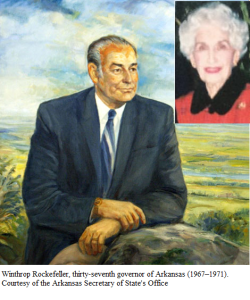
Her first commission was a portrait. While she also has painted numerous landscapes and scenes from Arkansas life, it is probably for her portraits she is best known. Among those she has painted are five Arkansas governors: Daniel Webster Jones, Sid McMath, Orval Faubus, Winthrop Rockefeller, and acting governor Bob Riley. Her painting of Rockefeller is the only official portrait of an Arkansas governor (to date) to have an outdoor setting. She has also painted many notable Arkansas women (including a 1986 exhibit for the Arkansas sesquicentennial).

In the 1960s, she and Marge Holman were commissioned to paint a mural on the flood wall in North Little Rock. Around the same time, she repeatedly took top honors at the Arkansas Festival of the Arts (which had been founded by Adolphine Fletcher Terry).

A longtime teacher at the Arkansas Arts Center, she was also active in numerous artistic and civic organizations.

For over 40 years, she was married to Henry Wellington “Rusty” Russell, who she met when he was stationed in Little Rock during World War II.  Several years after his death, she and Sid McMath married and were married until his death.

Rock the Oscars 2019: BlacKkKlansman

The Oscars are tonight.  One of the films nominated for Best Picture is BlacKkKlansman by Spike Lee.  Though previously nominated for Best Screenplay (Do the Right Thing) and Docmentary (4 Little Girls), this is the first time Lee has been nominated for producing a Best Picture nominee and for Best Director.

There are at least three Little Rock connections to the film.  First, it opens with vintage news footage of members of the Little Rock Nine being escorted into Central High in September 1957 (even though the film erroneously says August 25, 1957).

Second, Adam Driver stars in the film, and has earned a Best Supporting Actor nomination.  His father now lives in Little Rock. Driver also participated in the 2017 Arkansas Cinema Society’s “Premiere” event. Following a screening of Star Wars: The Force Awakens, Driver and ACS founder Jeff Nichols took part in a discussion.

Third, Little Rock native and Hendrix College alum Ashlie Atkinson appears in the movie. She is also a former intern at Arkansas Times.

Little Rock Look Back: Thanksgiving Day Football in 1918

100 years ago, the Little Rock High School Tigers football game on Thanksgiving was against a group of soldiers from Camp Pike.

The game took place on Thursday, November 28, 1918. The Great War had ended a little over a fortnight earlier, but the game had been scheduled while hostilities were still going.

The Tigers, who had never lost on Thanksgiving Day after starting a tradition of playing on the day in 1914, were for the first time the underdogs. The soldiers of the 13th Training Battalion were slightly older and much bigger – an average of 20 pounds bigger per player.

Going into the game, the Little Rock High School team was down a key player. Julian Adams was out with wrenched knee.  Another player John Ward was also absent (though the newspaper accounts do not indicate why).

Coach George H. Wittenberg was missing along the sidelines due to illness. He was not the first coach to be absent that season.  The regular coach, Earl Quigley, had been drafted and was stationed in South Carolina during the season.  Wittenberg, was a faculty member at the time. He had lettered for the football team when he had been a student a decade or so earlier. Later, as an architect, he would be one of the designers of the new Little Rock High School, now Central High School.

The game took place at Kavanaugh Field (a baseball field also used for football).  Though it is now the site of current Central’s storied Quigley Stadium, this was nearly a decade before the high school moved from Scott Street to Park Street.

The Camp Pike gridiron team dominated the game before a crowd of 1,000. The soldiers made three touchdowns in the first quarter, two in the second, one in the third, and one more to cap off the game in the fourth.

The closest the Tiger eleven got to scoring was in the second quarter when Hershell Riffel caught the ball at the 12 yard line and team captain and quarterback Alvin Bell advanced another six yards.  Camp Pike held them there.  Just before the game ended, Bell injured his knee and was taken out of the game.

Also that day, the University of Arkansas beat Kendall College (now the University of Tulsa) in Tulsa by a score of 23 to 6, West Tennessee Normal (now University of Memphis) defeated the Jonesboro Aggies (now Arkansas State Red Wolves) by a score of 37 to 0, and Hendrix College bested Henderson-Brown (now Henderson State University) by a score of 9 to 7.

Thanks to Brian Cox’s book Tiger Pride: 100 Years of Little Rock Central High Football for filling in some of the players names which were omitted in the newspaper coverage.

LR Culture Vulture turns 7

The Little Rock Culture Vulture debuted on Saturday, October 1, 2011, to kick off Arts & Humanities Month.

The first feature was on the Arkansas Symphony Orchestra, which was kicking off its 2011-2012 season that evening.  The program consisted of Mendelssohn’s Symphony No. 4 in A, Op. 90, Rossini’s, Overture to The Italian Girl in Algiers, Puccini’s Chrysanthemums and Respighi’s Pines of Rome.  In addition to the orchestra musicians, there was an organ on stage for this concert.

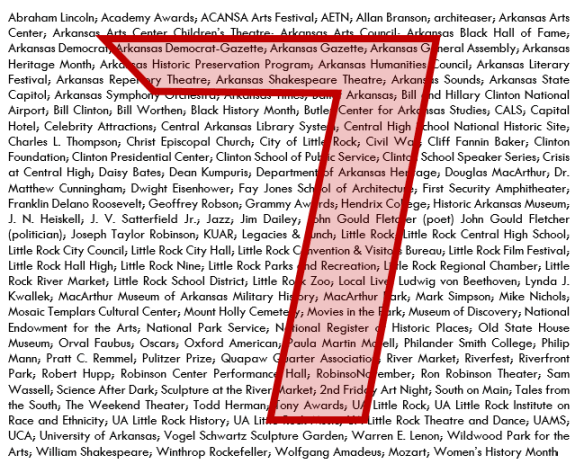
Since then, there have been 10,107 persons/places/things “tagged” in the blog.  This is the 3,773rd entry. (The symmetry to the number is purely coincidental–or is it?)  It has been viewed over 288,600 times, and over 400 readers have made comments.  It is apparently also a reference on Wikipedia.

The most popular pieces have been about Little Rock history and about people in Little Rock.

Birthday of Haco Boyd, Little Rock Mayor and Hijack Victim

On July 6, 1902, future Little Rock Mayor Haco O. Boyd was born in Leslie, Arkansas.  At the age of four, his family moved to Little Rock; he graduated from the Little Rock public schools.  He attended and graduated from Hendrix College.

In World War II, he was in the Army Air Corps.  He was a very decorated soldier earning two Purple Hearts, a Legion of Merit, and a Bronze star among other designations from the United States.  He also received high military honors from numerous European governments.  Boyd would remain in the Air National Guard and retired with the rank of Colonel in 1964.

As a businessman, he was a founder of Rebsamen Ford and then state manager of Benjamin Moore for Arkansas.  In 1952, he joined Union Life Insurance.  Throughout his career, he received most any recognition and honor and designation that the field of life insurance offered.

In November 1968, he won a three-candidate race for the Little Rock City Board of Directors. One of the candidates he defeated was former (and future) Director and Mayor Byron Morse.  In January 1969, he was selected to serve as Mayor of Little Rock.

One week later, Mayor Boyd and 70 others were on an Eastern Airlines plane headed for a life insurance convention in  Nassau, departing from Miami.  A passenger hijacked it and the plane was diverted to Cuba.   The next morning the passengers were returned to Miami and then sent to Nassau without incident. Once the media found out that one of the passengers was the Mayor of Little Rock, he was interviewed by numerous newspapers.  Mayor Boyd expressed that they had been treated well by the Cuban government, but that all in all he had rather not made that leg of the trip.

In other civic involvement, Boyd served on the Little Rock Airport Commission, including a term as chair.  He was also honored for his involvement with the Boy Scouts of America and Easter Seals.

In September 1923, Boyd married Mary Josephine “Polly” Goodrum.  They were married until her death in February 1977.  Haco Boyd died on March 27, 1988.  The couple are buried at Roselawn Cemetery.  They had two children and four grandchildren.

RIP David McCollum

I was not blessed with athletic ability.  Or coordination.  But I am very competitive.

My lack of skill did not stop me from dragging my parents to four years of soccer and a concurrent six years of basketball.

McCollum_David_400x400Because of my lack of talents on the field, and my interest in competition, I have found myself drawn to sports journalism and sports history.  Which, being in Central Arkansas, lead me to the writing of David McCollum.

Disclosure, for several years I attended church with him and his family.  My parents and sister still do.  But he was such an unassuming gentleman, my interest in his writing sprung not from familiarity with him. It came from what and how he wrote.

With a career of over 50 years, David entered the newspaper business as it was starting the transition from hot lead and pecking out a story on typewriters into the world of computers and electronic filing.  Likewise the field of sports journalism was transitioning from the era of colorful, hyperbolic language (which might not always be 100% accurate) into a time of bare facts crammed into increasingly shrinking column inches.

David did not try to be a colorful sportswriter. He was not trying to have the spotlight shown on him through his writing.  In his stories, David sought to serve the sports. But he brought to his writing a sense of history and style that hearkened back to bygone days without sacrificing the facts that he knew his readers wanted.  In serving his sports, he also served his readers.

While often the smartest guy in the room, especially when it came to Conway sports, David never acted like it.  In his prose, he shows his expertise without lording it over the reader.  He used his knowledge to let his readers be more informed. He was like that favorite teacher we all had at least once in high school or college. He wanted to bring us along on the journey.

For a sportswriter, working in Conway must have been a dream job.  Both UCA and Hendrix have active athletic programs.  And the Wampus Cats of Conway have long been dominant. In addition, during his career, David was able to see towns like Vilonia, Mayflower, and Greenbrier grow and develop into powerhouses in their own high school sports classifications.

Over the years, as I’ve been seeking to learn more about a sports topic, I’ve often gone back to his writing on a player, an event, a game.  Whether it was a story or an interview, his trademark understated and engaging prose was on display.  Earlier this year, I was needing background on a Little Rock Touchdown Club scholarship because we were honoring a recipient at Little Rock City Hall.

There it was.

In a column David wrote a few years ago, there were not just the facts, but the emotions. In writing about how some Texas Longhorns had created a scholarship in Little Rock to pay tribute to the memory of one of their own, David touched on the sentiment without being maudlin.  He did not pile on the irony of Longhorns who beat the Hogs in the 1969 shootout creating a scholarship here. He let the story speak for itself.  The kinship the two teams feel for each other now came through in David’s prose.

As David’s son Gavin said in making the announcement his father had died, “there were more stories for him to write.”  Yes, there were.  I feel sorry for future athletes in Faulkner County that they won’t get to be interviewed by him.  I feel sorry for the readers who won’t get his take on a future game.

David had seen enough games to know that the outcome does not always go your way.  As much as he would probably be uncomfortable with the outpouring of emotions that are now going on, I think he would understand we need to do this.  We need to express our sadness.  It helps us to move on to the next challenge.  And part of that challenge is a world without him.  I know he would be very pleased to see, just as a team rallies together, people are rallying together to support his wife and son.

So thank you, David McCollum. For your life and your commitment to excellence.  Though it has fallen out of usage these days, I’m old school enough to pay tribute to your life and career with an old journalism and PR tool to indicate the end.

David McCollum -30-